Article · · 7 min read
Rules of the Road, 2026: What Binds, What's Voluntary, and Where the Gaps Are
A map of today's space-debris rules: IADC guidelines, the FCC five-year rule and new Part 100, the FAA's retreat, the EU Space Act and the Zero Debris Charter.
Space has no traffic police. What it has instead is a layered patchwork: international guidelines that nearly everyone endorses and no one is forced to follow, national licensing rules that bind only the operators within a regulator's reach, and a growing set of voluntary pledges. In 2026 that patchwork shifted in several directions at once. This guide sorts what actually binds from what is aspirational, and highlights the gaps.
The international baseline: guidelines, not law
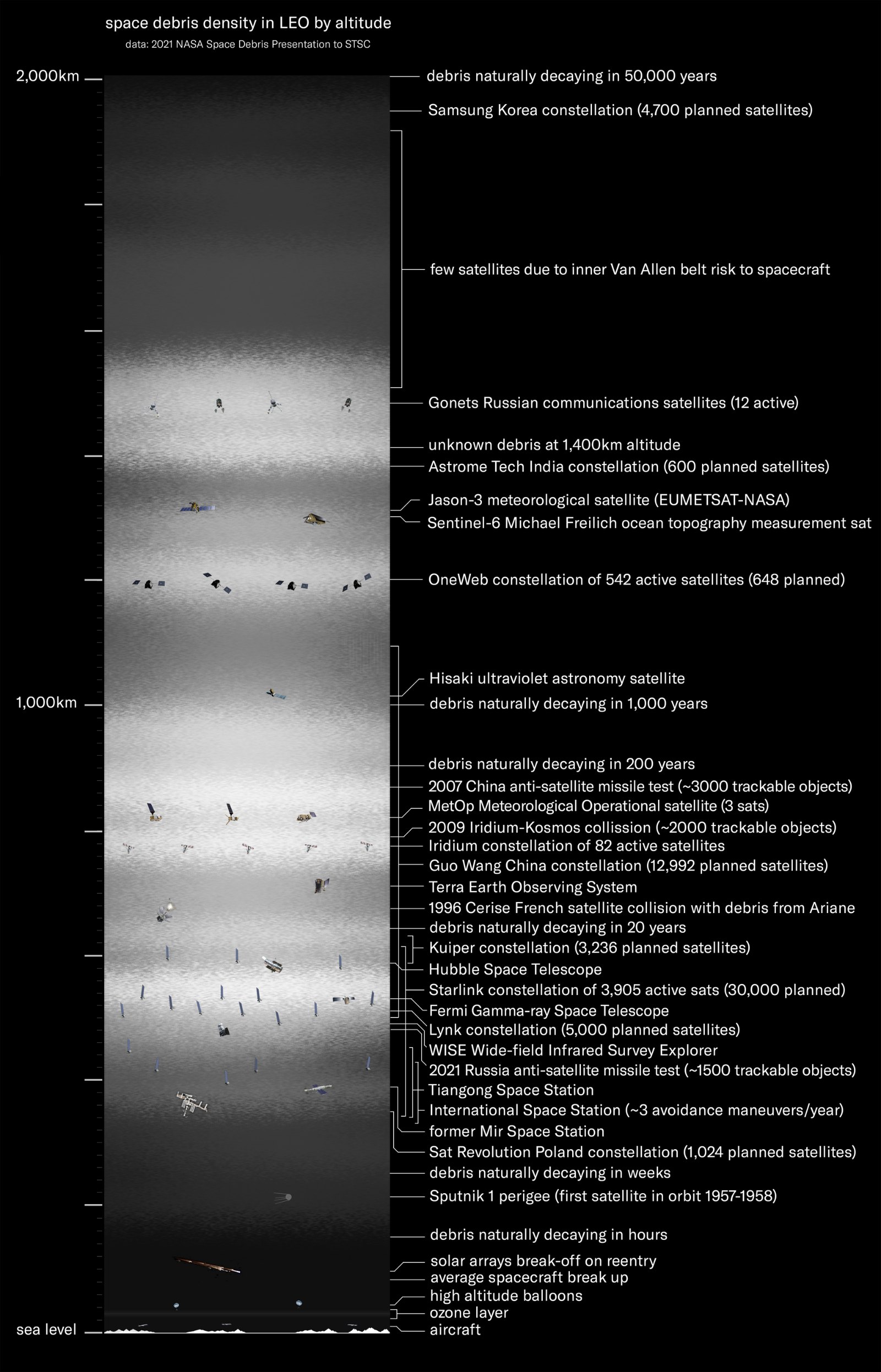
IADC guidelines. The Inter-Agency Space Debris Coordination Committee, a forum of national space agencies, published Revision 4 of its Space Debris Mitigation Guidelines on 16 January 2025 IADC Rev 4. The guidelines define two protected regions: LEO from the surface to 2,000 km, and the geostationary ring within 200 km in altitude and 15 degrees in latitude. They call for post-mission orbital lifetime in LEO to be "as short as practicable and no more than a maximum of 25 years," a disposal success probability of at least 90% with a goal of 99%, and passivation of stored energy at end of life. Revision 4 also adds a new section acknowledging that large constellations may need much shorter lifetimes IADC Rev 4.
ISO 24113. The international standard for debris mitigation requirements is in its fourth edition, published in May 2023, and is already marked for revision ISO. Standards become binding only when contracts or regulators adopt them.
UN long-term sustainability guidelines. In June 2019, the UN Committee on the Peaceful Uses of Outer Space adopted 21 guidelines for the long-term sustainability of outer space activities after more than eight years of work UNIS. They cover regulation, safety of operations, cooperation and research, and they are voluntary UNOOSA LTS.
All three are influential. None imposes penalties.
United States: one tightening, one loosening, one overhaul
The FCC five-year rule (binding). In September 2022 the Federal Communications Commission adopted a rule requiring satellites it licenses, or grants US market access, that end their missions in or pass through LEO to dispose of themselves "within 5 years of completing their missions" FCC 22-74. The FCC described this as replacing "a long-standing guideline" of 25 years FCC news release. After a two-year transition it applies to satellites launched from late 2024. It is the most important binding debris rule in the world, largely because so many commercial satellites seek access to the US market.
FCC Part 100 (binding, new). On 22 July 2026 the FCC adopted a "Space Modernization" order that replaces its long-standing Part 25 satellite rules with a new Part 100 of performance-based "bright-line" rules Akin Gump. Operators must share ephemeris data with approved space-safety services and file periodic space safety reports; surety bonds for geostationary satellites are eliminated and default licence terms rise from 15 to 20 years FCC fact sheet. Commentators have questioned whether the FCC has legal authority over debris at all Akin Gump. Whether the five-year disposal requirement carries over unchanged into Part 100 could not yet be confirmed from primary text, and this piece will be updated when that is clear.
The FAA withdrawal (a gap). Rockets leave debris too. In September 2023 the Federal Aviation Administration proposed requiring commercial upper stages to leave orbit within 25 years. On 15 January 2026 it withdrew that proposal, citing questions about its legal authority and the cost to industry Federal Register. That leaves US commercial upper stages without a binding federal disposal rule of their own.
Europe: a law in negotiation and a standard that leads
The EU Space Act (proposed). On 25 June 2025 the European Commission proposed an EU Space Act that would require mitigation plans, trackability, use of collision-avoidance services, manoeuvrability and re-entry coordination, with additional duties for megaconstellations European Commission. It would apply to non-EU operators serving the EU market, an approach similar in reach to the FCC's European Parliament briefing. As of late 2026 it is in trilogue negotiations, with the Council and Parliament divided over burdens on non-EU operators, cybersecurity and overlap with existing national law The European Post. Until it passes, it binds no one.
ESA's Zero Debris approach (binding on ESA missions). ESA's 2023 Space Debris Mitigation Requirements apply to its own missions and contractors: at least 90% probability of successful disposal, residual LEO lifetime under five years, no intentional release of mission-related objects, and break-up prevention. ESA also set a goal of demonstrated removal services by 2030 ESA Zero Debris approach.
The Zero Debris Charter (voluntary). Announced in June 2023 and co-developed with the community, the Charter aims to "significantly limit" debris creation by 2030 ESA. As of May 2026 it had "228 signatories from 34 countries, including 21 state signatories," and new working groups on upfront funding of decommissioning, disposal timelines and state engagement ESA Zero Debris webinar. It is a statement of intent, not an enforcement mechanism, but it is where much of the practical policy thinking is now happening.
What binds, in one list
- Binding: FCC five-year disposal rule and Part 100 obligations for FCC-licensed and US market-access satellites; ESA requirements on ESA missions; national licensing rules where they exist.
- Voluntary: IADC guidelines, ISO 24113 unless contractually adopted, UN LTS guidelines, Zero Debris Charter.
- Proposed: EU Space Act.
- Withdrawn: FAA upper-stage disposal rule.
Where the gaps are
Compliance is weak even where rules exist. ESA's 2026 report finds that over the last decade only 5 to 35% of payloads and 30 to 80% of rocket bodies met a five-year disposal standard ESA Report I10R1.
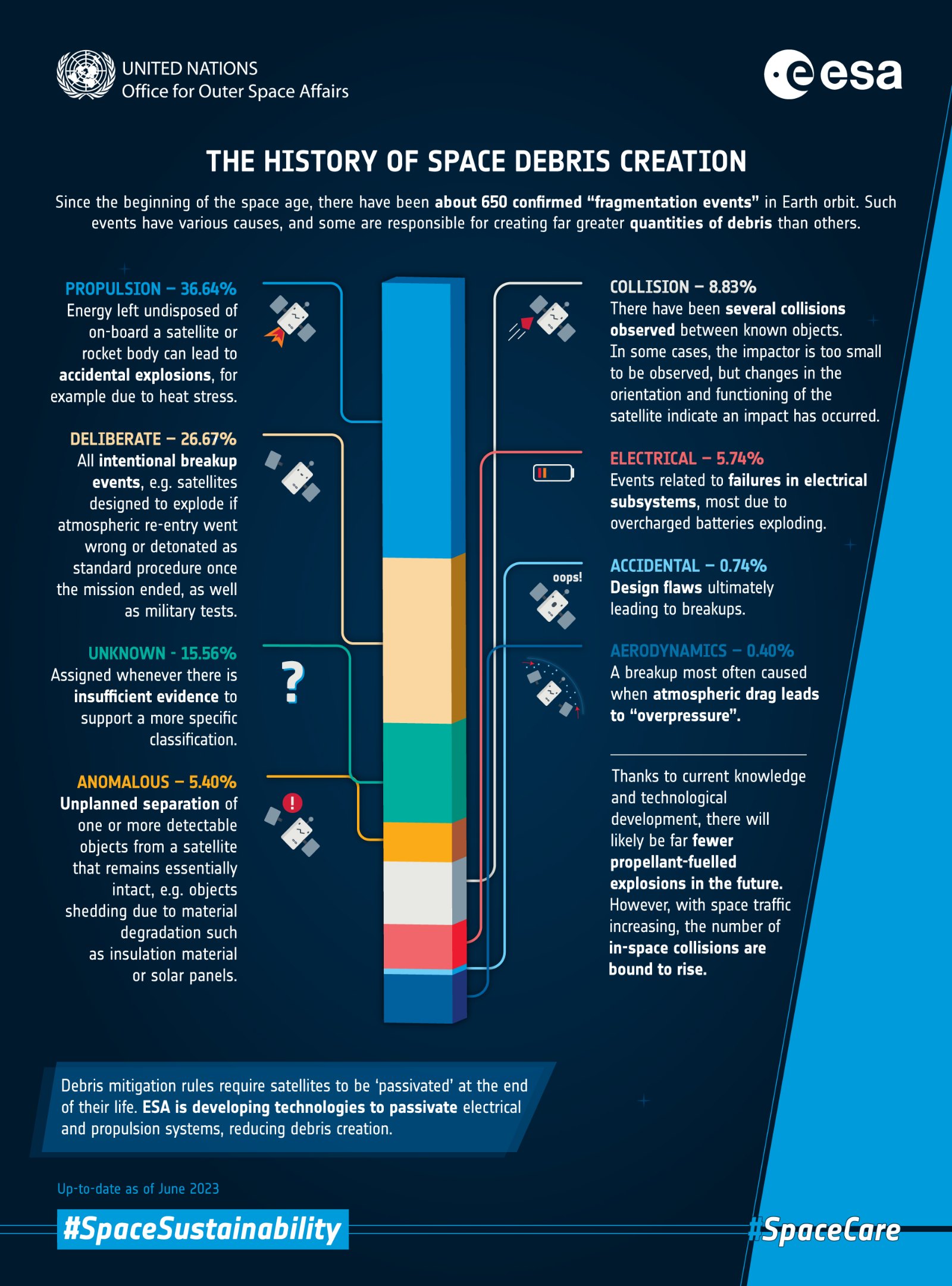
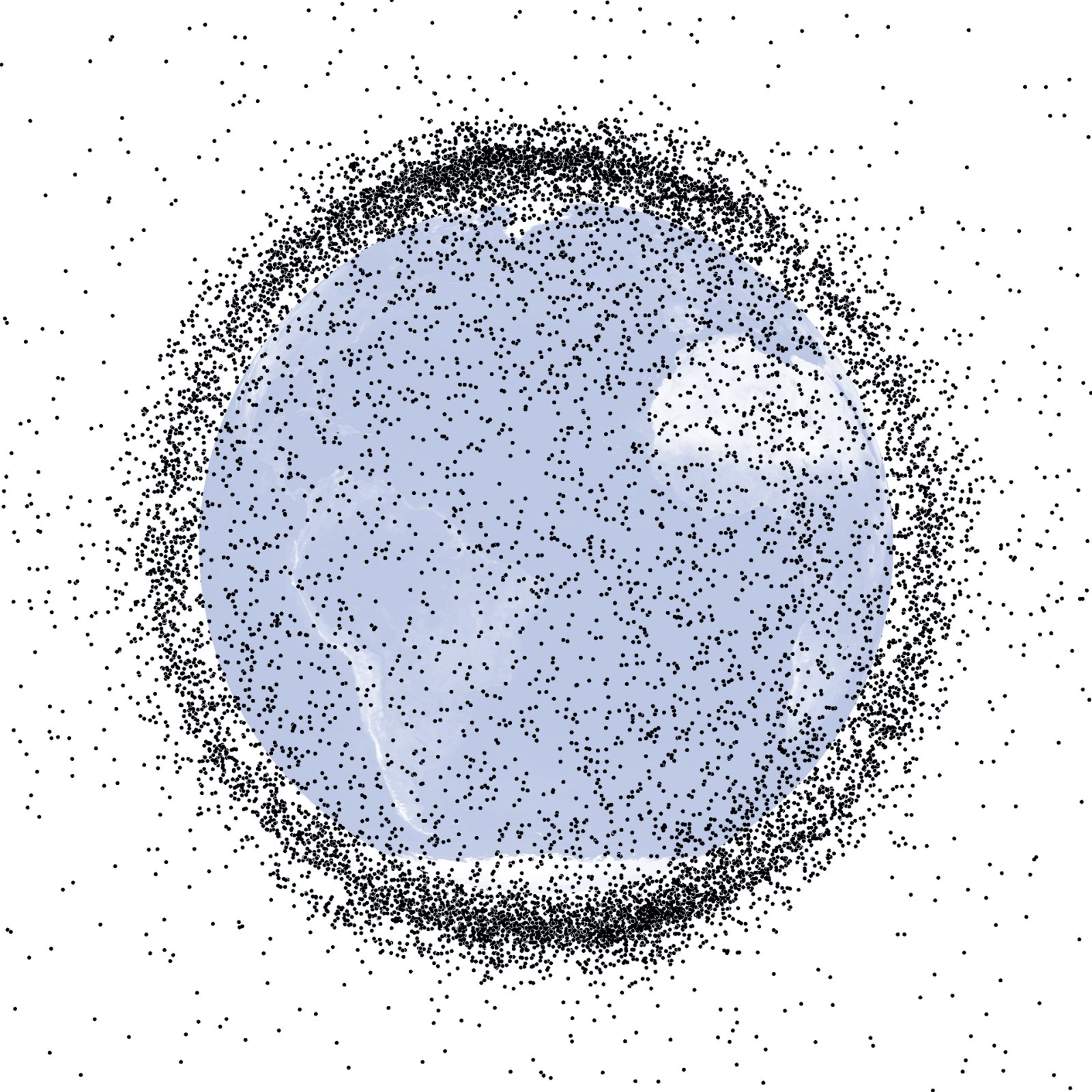
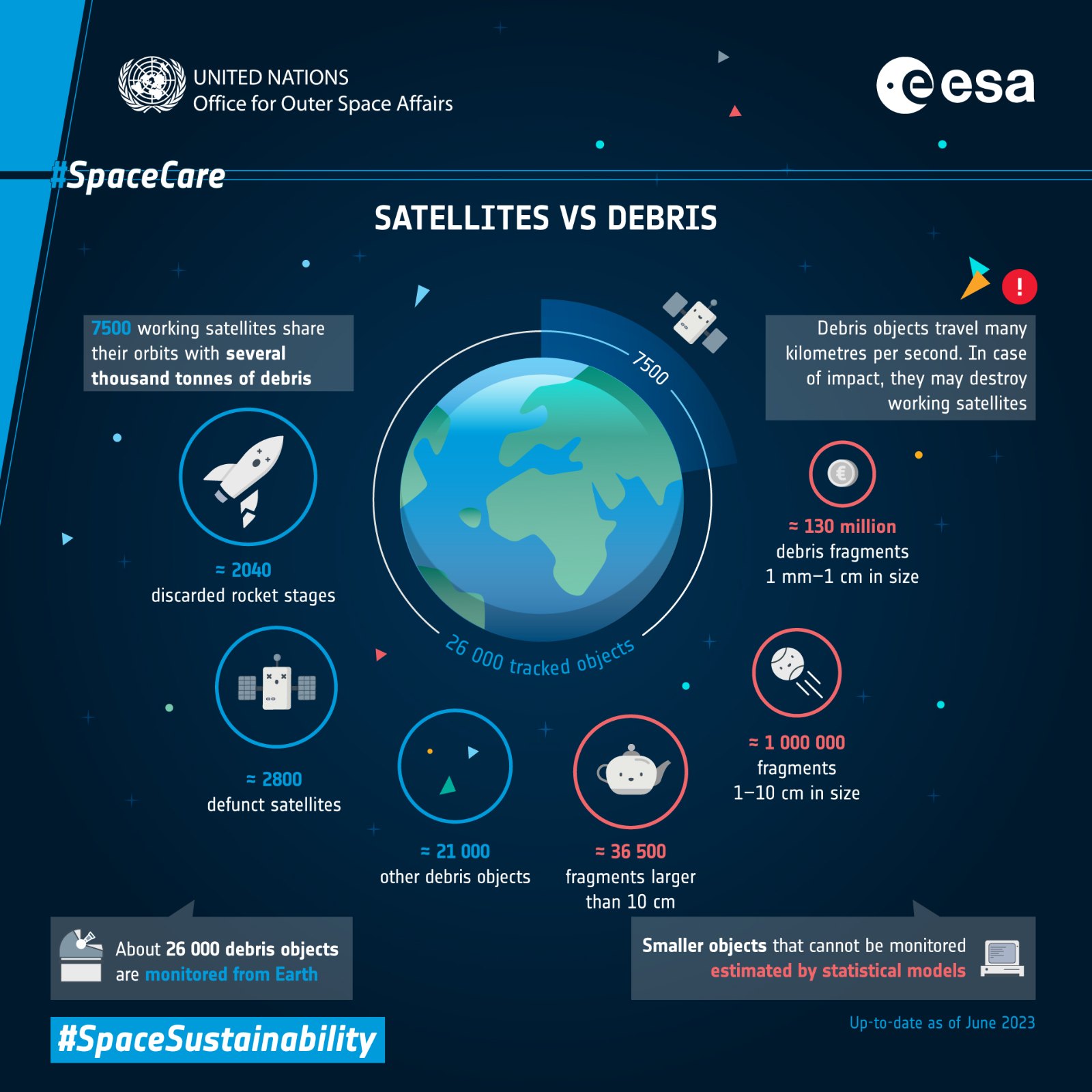
No rule addresses legacy debris. Every instrument above governs future behaviour. None assigns responsibility for, or funds removal of, the derelict hardware already in orbit, part of more than 17,000 tonnes of human-made mass circling Earth ESA DISCOS statistics. Removal is funded case by case, such as the UK's £75.6M national mission commitment European Spaceflight.
Rocket bodies are under-regulated. The FAA withdrawal leaves a gap in the US for commercial upper stages, one of the categories most likely to become large, long-lived derelicts.
Liability has no teeth. In-orbit third-party liability insurance is "rare" Gallagher, so there is little financial signal for operators whose hardware creates risk for others.
Jurisdiction is fragmented. Each national rule binds only its own operators, and the most dangerous derelicts often belong to states that are not bound by any of the stricter regimes.
ClearOrbit's view
We think 2026 shows both the promise and the limit of the current approach. The FCC and ESA have proved that shorter disposal timelines are workable, and the Zero Debris Charter has built a genuine coalition. But rules that only govern the future cannot fix the environment ESA now describes as 50 times over its sustainability threshold.
The next step we want to see is a rule set that covers the whole lifecycle: binding disposal for both satellites and upper stages, pre-funded decommissioning so the money exists when a satellite fails, and a clear legal path for removing another party's derelict with consent. The EU Space Act is the best near-term opportunity to write some of that into law, and we hope the trilogue keeps its ambition.
We also believe regulators should treat removal capacity as infrastructure. A licence regime that requires disposal is far stronger when a commercial service exists to carry it out if a satellite fails. Building that service, and the coalition to support it, is the core of the ClearOrbit plan.
Reader mail
Have a better idea?Spotted something we got wrong?
We publish in public so the numbers can be checked. If a figure looks wrong, a source is missing, or you know something this piece should have said, send it over. One box, no sign-up.
Send an idea or correctionQuick question
Who should pay for cleaning up orbit?
Anonymous. You will see how others answered after you vote.
Sources
- IADC Space Debris Mitigation Guidelines, Revision 4 (2025)
- ISO 24113:2023
- UN COPUOS Long-term Sustainability Guidelines (UNIS, 2019)
- UNOOSA LTS Guidelines overview
- FCC 22-74, Second Report and Order
- FCC news release on the 5-year rule
- Akin Gump, FCC adopts Part 100
- FCC Space Modernization fact sheet
- Federal Register, FAA upper-stage rule withdrawal
- European Commission, EU Space Act
- European Parliament briefing on the EU Space Act
- The European Post, Space debris rules split the EU
- ESA, Zero Debris approach
- ESA, The Zero Debris Charter
- ESA Zero Debris webinar 4, policy and governance (May 2026)
- ESA Space Environment Report, Issue 10 Rev 1 (PDF)
- European Spaceflight, UK commits £75.6M
- Gallagher, Space insurance update Q2 2025
- ESA DISCOS statistics