Article · · 7 min read
The Orbital Clock: What Actually Decides How Long Something Stays Up
Two objects from the same 1985 launch are now 470 km apart in altitude. Altitude alone never set the clock; area-to-mass ratio and the Sun do most of the work.
On 12 December 1985 a single Tsiklon-3 launch placed two objects into almost the same orbit. One was Kosmos-1707, a 1,750 kg Soviet electronic intelligence satellite; the other was the 1,600 kg third stage that had carried it there. The catalog's reference orbits put the satellite at 633 by 665 km and the stage at 623 by 656 km: ten kilometres and ninety kilograms apart, on the same morning (GCAT).
Forty-one years later the satellite is at 125 by 142 km and has days left. The stage is at 597 by 623 km and has centuries (GCAT). Today's daily briefing treats that pair as the object of the day, and it deserves a longer look, because the divergence was never written into the altitude. It was written into the shape.
Almost every argument about orbital debris is, underneath, an argument about how long a given object will stay up. Disposal rules are written in years, and licensing, insurance and constellation design all hinge on that number. It is worth being precise about what sets it.
The altitude ladder is real, but coarse
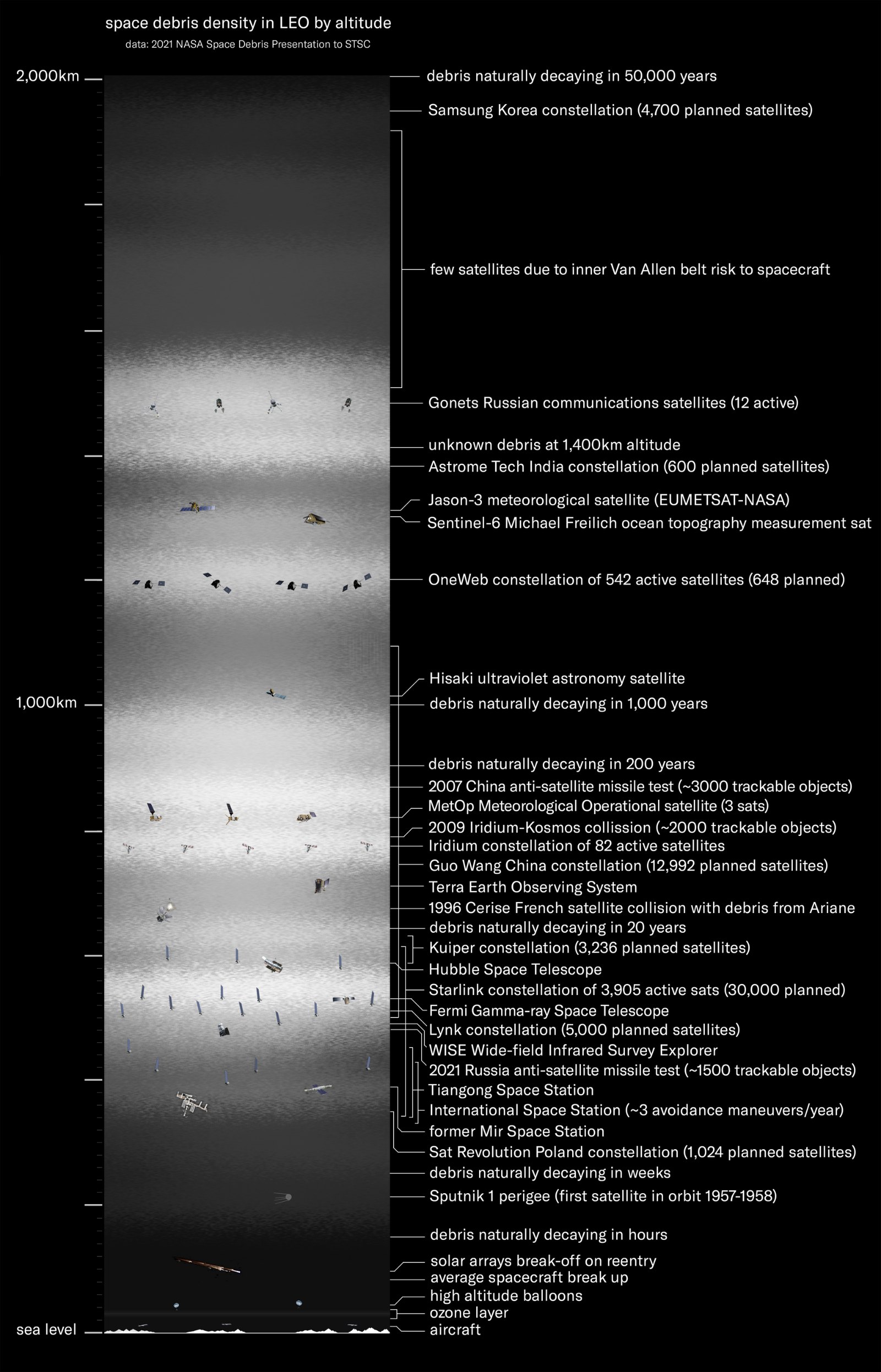
The familiar version is a ladder, and NASA's Orbital Debris Program Office states it plainly: debris left below 600 km "normally fall back to Earth within several years"; at 800 km "the time for orbital decay is often measured in centuries"; above 1,000 km objects "will normally continue circling the Earth for a thousand years or more" (NASA ODPO).

That ladder explains the shape of today's catalog. The most crowded 100 km band is 400 to 500 km, with 10,150 objects of which 9,966 are working payloads and only 184 debris — a shell that largely cleans itself, where Starlink's 11,127 satellites sit at a mean altitude of 459 km. The bands that accumulate are higher: 800 to 900 km holds 2,763 objects, 2,486 of them debris or rocket bodies, and 700 to 800 km holds 2,649 with 2,248 debris (GCAT). Nothing there is leaving on a human timescale, which is why those bands dominate the fifty most dangerous objects.
But the ladder describes typical objects. The 1985 pair started on the same rung and ended 470 km apart. Something else is doing the work.
Area over mass
Atmospheric drag is a force proportional to cross-sectional area and to the density of the gas the object moves through. Deceleration, though, is force divided by mass. Divide through and the quantity that decides an object's fate is its area-to-mass ratio, quoted in square metres per kilogram. Two objects of identical mass at the same altitude decay at very different rates if one presents ten times the area.
Kosmos-1707 is a cylinder 3.2 m long and 1.3 m across that spans 13.1 m with its antennas deployed. The Tsiklon-3 stage is a bare cylinder 2.8 m long and 2.2 m across (GCAT). Their masses differ by nine percent; their frontal areas do not. Over four decades of patient integration, that gap became five hundred kilometres of altitude.
This is not an inference from one anecdote. NASA's then chief scientist for orbital debris, Nicholas Johnson, used three calibration spheres at 1,000 to 1,200 km with area-to-mass ratios of 0.10, 0.05 and 0.01 m²/kg as a controlled experiment, and found decay rates that tracked both the ratio and the solar flux, confirming that "atmospheric density changes extend to much higher altitudes" than the ladder suggests (NASA, IAC-12.A6.2.9).
Once you see the ratio, several removal techniques stop looking exotic. A drag sail does not push anything; it multiplies the area term until the clock runs at a useful speed. That approach has been Flown on small satellites and is the subject of our explainer on drag sails and inflatables. It also explains the limit: a sail needs gas to grip, which means the lower half of the ladder.
The Sun moves the deadline
The other variable is not in the object at all. The thermosphere expands when solar activity is high and contracts when it is low, so density at a given altitude varies by a large factor over an eleven-year cycle. An orbital lifetime "of 25 years" is therefore not a property of an orbit but a forecast, only as good as the solar forecast underneath it.
Johnson's paper documents exactly this failure mode. Models built in 2008 assumed a solar cycle 24 peaking near 190 solar flux units; NOAA's revised 2009 forecast cut that to 140, and the consequence was that debris stayed in orbit substantially longer than the earlier calculations had promised (NASA, IAC-12.A6.2.9). The same paper notes that roughly ten percent of catalogued Fengyun-1C fragments had re-entered by mid-2012, with perhaps a third expected down by 2020 depending on the strength of the maximum. The catalog still tracks 2,127 of them at a mean altitude of 832 km (GCAT). The weaker cycle won.
The practical consequence is that any compliance claim resting on a modelled decay date carries a hidden error bar measured in years, and the error is asymmetric: a quiet Sun always makes things worse.
What the rules ask, and what operators actually deliver
For two decades the international standard was the 25-year post-mission disposal guideline. In September 2022 the US Federal Communications Commission voted unanimously to replace it for satellites under its jurisdiction, requiring operators below 2,000 km to dispose of spacecraft "as soon as practicable and no more than five years after the end of their mission", with the requirement applying to satellites launched two years after the order's adoption (FCC, SpaceNews). ESA tightened its own standard to five years in 2023.
Delivery is the weak point. ESA's 2026 environment report finds that, among payloads reaching end of life in a non-compliant low-Earth orbit and attempting to comply, between 5 and 50 percent succeed against the 25-year threshold and between 5 and 35 percent against the five-year threshold over the last decade, "far from targets" in the report's own words (ESA, Annual Space Environment Report 2026).
The cheerful headline figure needs the same scrutiny. Between 88 and 99 percent of payloads under 1,000 kg do sit in orbits that naturally satisfy the 25-year rule — but that number is dominated by constellations deliberately placed low, where the atmosphere does the work for free. Above 1,000 kg, where the atmosphere does not, only 54 percent are set to remove themselves within 25 years (ESA). Compliance, in other words, is largely being achieved by choosing altitudes that comply by themselves, not by disposing of the objects that do not.
That is the gap the same report points at when it concludes that "active debris removal is required to stop the growth of the number of objects over time" and that "prevention alone is no longer enough", alongside a Space Environment Health Index that rose from about 4 to 50 in a single year (ESA). Meanwhile the modelled population stands at 68,450 objects larger than 10 cm and about 1.5 million between 1 and 10 cm, with more than 17,000 tonnes of material in orbit (ESA DISCOS).
ClearOrbit's view
The honest reading of the 1985 pair is that the natural clock is a poor regulator. It is generous to wide, light objects that were never much of a problem and merciless in the wrong direction on compact, dense ones — which is precisely the population of abandoned upper stages that carries the most mass per object in the crowded bands. A rule written purely in years, checked against a modelled decay date, will keep passing objects that should not pass.
Two changes would help immediately and cost almost nothing. First, every launch licence should require the projected orbital lifetime of each object left behind, stage included, computed from its actual area-to-mass ratio and published with the solar assumption stated. Second, that projection should be re-run at end of life against the solar cycle that actually happened. Neither removes anything; both make the size of the problem legible before it becomes someone else's.
Beyond that, the arithmetic is unforgiving. Nothing has yet been removed from orbit — a point we set out in Nobody Has Removed a Piece of Debris Yet — and the objects that most need removing are, by construction, the ones the atmosphere will not touch. ClearOrbit vision: the first decade of removal should be aimed at the 700 to 900 km bands, at intact derelicts with low area-to-mass ratios, because those are the objects for which no other clock is running. How that could work in practice is in How to Deorbit a Satellite at the End of Its Life.
Kosmos-1707 will be gone within days, and nobody had to do anything. Its rocket stage will still be at 610 km when this century ends. Only one of those facts is a policy.
Reader mail
Have a better idea?Spotted something we got wrong?
We publish in public so the numbers can be checked. If a figure looks wrong, a source is missing, or you know something this piece should have said, send it over. One box, no sign-up.
Send an idea or correctionQuick question
Who should pay for cleaning up orbit?
Anonymous. You will see how others answered after you vote.
Sources
- GCAT, General Catalog of Artificial Space Objects, J. McDowell
- NASA Orbital Debris Program Office, frequently asked questions
- N. L. Johnson, The Effects of Solar Maximum on the Earth's Satellite Population and Space Situational Awareness (IAC-12.A6.2.9), NASA
- ESA Space Environment Report 2026
- ESA Annual Space Environment Report, issue 10 revision 1 (8 September 2026)
- FCC, Adopts New 5-Year Rule for Deorbiting Satellites (FCC 22-74)
- SpaceNews, FCC approves new orbital debris rule
- ESA DISCOS space environment statistics (MASTER-8 modelled population)