Article · · 7 min read
The Economics of Cleaning Orbit
What the first removal contracts cost, what NASA's cost-benefit studies say actually pays off, why insurers are retreating, and who should foot the bill.
Every argument about space debris eventually becomes an argument about money. Removal missions are expensive, the benefits are spread across every operator in orbit, and the damage from not acting arrives slowly and unevenly. This piece looks at what the first contracts actually cost, what the best public cost-benefit analysis says about value, and how the insurance market is quietly changing the incentives.
What the first contracts cost
There is no public price list for debris removal, but there are contracts, and they give a useful sense of scale.
ESA's contract for ClearSpace-1, signed in 2020, was worth €86M to remove a single small satellite; the total mission cost is higher because industry co-funds it ClearSpace-1, Wikipedia. Japan's space agency awarded Astroscale Japan about ¥13.2 billion, including tax, in August 2024 for Phase II of its commercial removal programme, which covers the capture and deorbit of one H-IIA upper stage of roughly 3 tonnes Astroscale. The UK government committed £75.6M in July 2025 to a national mission to remove two defunct UK-licensed satellites European Spaceflight. And in January 2026 the US Space Development Agency awarded Starfish Space $52.5M for an end-of-life disposal service for its own constellation satellites Breaking Defense.
Read together, these figures suggest first-of-a-kind removals currently cost somewhere in the range of tens of millions to around a hundred million dollars per object. That range is a synthesis from contract values, not a published estimate, and it will not hold for long. First missions carry development, qualification and risk costs that later missions will not.
It is also worth noting where early money has gone. The US Space Force's Orbital Prime programme made 124 Phase 1 awards of $250,000 each in 2022 to seed removal and servicing ideas AFRL. Private capital is following: Starfish Space raised a $110M Series B in 2026 Starfish Space. Most of the revenue, though, is still government contracts.
What NASA's cost-benefit analysis found
The most useful public work on value comes from NASA's Office of Technology, Policy and Strategy (OTPS). Its March 2023 study, "Cost and Benefit Analysis of Orbital Debris Remediation," tried to put dollar values on the risks debris imposes on operators and compare them with the cost of different remediation methods NASA OTPS 2023.
Its headline finding surprised many people: "The most effective remediation methods to reduce risks to operators are approaches for removing small debris and nudging large debris to avoid collisions" NASA OTPS 2023.
The detail is revealing. Removing debris in the 1 to 10 cm range "appear[s] to produce net benefits quickly," within a decade in the best cases, and just-in-time nudging of large objects to prevent specific collisions could produce net benefits "almost immediately" NASA OTPS 2023. By contrast, controlled re-entry of large debris using a reusable servicer "might provide net benefits within three decades" NASA OTPS 2023. In the first year, the study estimated that removing the top 50 large objects yields about $3.5M of risk reduction, while removing 100,000 small pieces yields about $23M NASA OTPS 2023.
Two caveats matter. The authors describe their figures as "order-of-magnitude estimates." And the study measures risk to operators over a limited window, which undervalues large-object removal, whose main benefit is preventing the collisions that would generate tomorrow's small debris. A Phase 2 study in May 2024 broadened the comparison to more than ten mitigation, tracking and remediation actions and found that remediation may be as valuable as mitigation, and that deorbiting defunct spacecraft quickly is cost-effective NASA OTPS 2024. NASA followed up with a technical meeting on ground-based pulsed lasers to remove small debris threatening the ISS NASA NTRS.
The practical message is not "don't remove large debris." It is that a sensible portfolio combines fast-payback measures, such as nudging and small-debris removal, which are still Proposed technologies, with large-object removal, whose payback is long but whose avoided catastrophes are the largest.
The insurance retreat
Markets usually price risk before governments regulate it. In space, the market is stepping back instead.
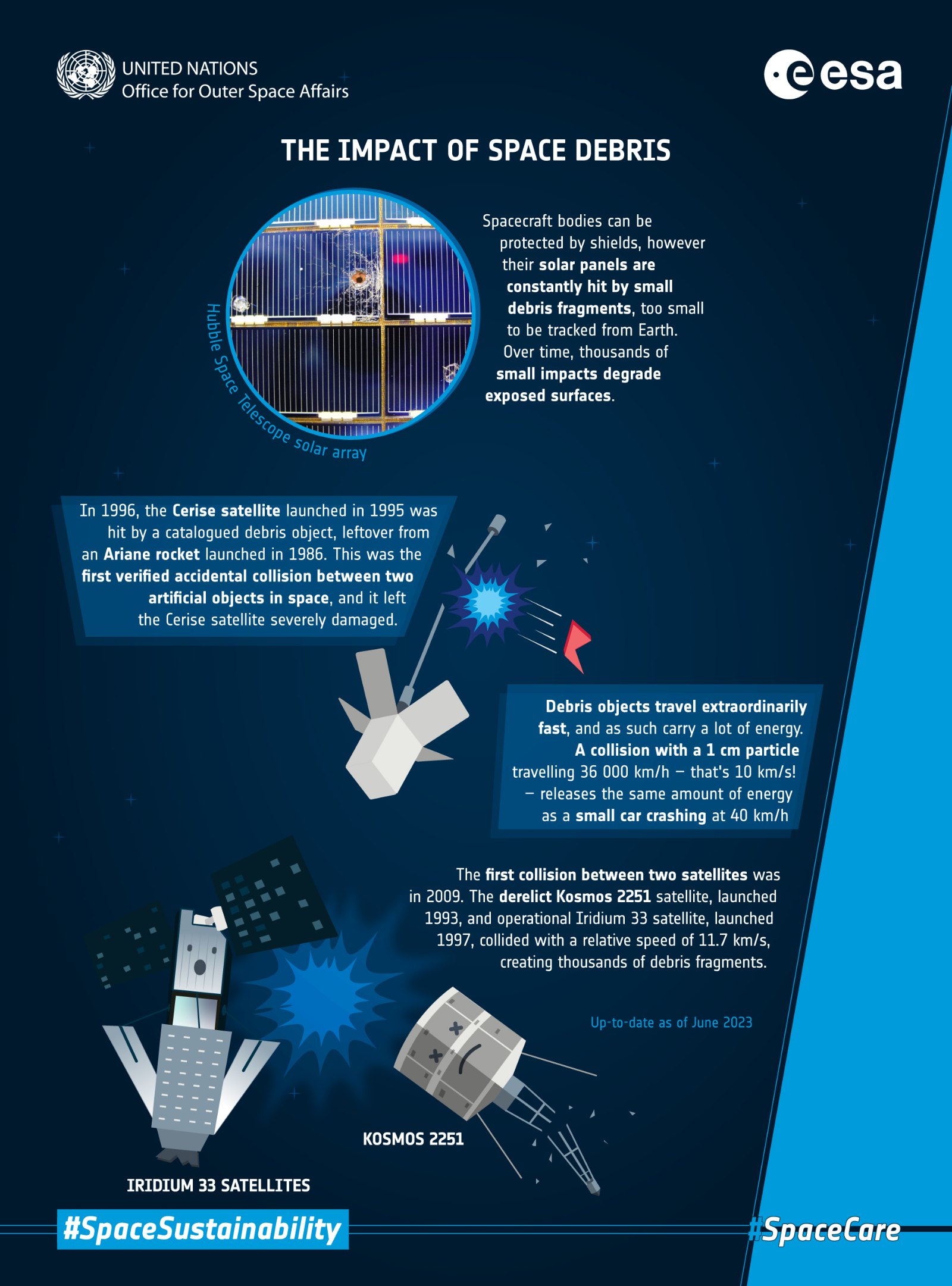
The broker Gallagher reported in July 2025 that 2023 was the worst year for space insurance losses "in over 20 years," after rates had fallen by more than half between 2012 and 2018 Gallagher. There are only about two dozen space insurers. LEO constellations mostly skip insurance and rely on spare satellites in orbit, and in-orbit third-party liability cover is "rare" Gallagher. Trade press reports that only around 300 of roughly 13,000 active satellites are insured and that several large insurers have left the market, although those figures come from secondary reporting and should be treated as estimates Insurance Business.
A concrete example: when Intelsat 33e broke apart in geostationary orbit in October 2024, the satellite was uninsured SpaceNews. When almost nobody carries liability cover, nobody is pricing the cost one operator's debris imposes on everyone else. That is a textbook externality.
Who should pay?
There are three broad answers, and they are not mutually exclusive.
The first is that governments pay, as they do today, because orbit is a shared resource and many of the most dangerous derelicts belong to states. This is how every current removal contract is funded.
The second is that operators pay for their own disposal. The SDA-Starfish contract is the first clear example of a constellation owner buying disposal as a service Breaking Defense. Design choices help: Airbus bought 100 Astroscale docking plates in March 2025, a small cost that makes future capture far easier Payload.
The third is pre-funding. The Zero Debris Charter community has set up policy working groups on "upfront funding of decommissioning," the idea that operators set money aside at launch for eventual disposal ESA Zero Debris webinar. Versions of that idea already exist in mining and nuclear power.
ClearOrbit's view
We think the economics point towards a service market, not a series of one-off national showcases. Unit costs will only fall if the same servicer designs, operations teams and ground infrastructure are used again and again. That requires a pipeline of contracts that is visible years in advance, which in turn requires governments to commit to multi-object procurements rather than single demonstrations.
We also take NASA's findings seriously. The fastest returns come from nudging and small-debris work, and those technologies deserve dedicated funding now, alongside large-object removal. A portfolio approach lets early wins justify the longer investments.
Finally, we believe disposal should be priced into every launch. Whether through bonds, pre-funded disposal accounts or service contracts, the cost of leaving hardware in orbit should sit with the organization that put it there. That is a ClearOrbit vision, and it is one of the principles set out in the ClearOrbit plan.
Reader mail
Have a better idea?Spotted something we got wrong?
We publish in public so the numbers can be checked. If a figure looks wrong, a source is missing, or you know something this piece should have said, send it over. One box, no sign-up.
Send an idea or correctionQuick question
Who should pay for cleaning up orbit?
Anonymous. You will see how others answered after you vote.
Sources
- ClearSpace-1 (Wikipedia)
- Astroscale Japan, ADRAS-J2 Phase II contract
- JAXA press release, CRD2 Phase II (Aug 2024)
- European Spaceflight, UK commits £75.6M
- Breaking Defense, SDA taps Starfish
- NASA OTPS, Cost and Benefit Analysis of Orbital Debris Remediation (2023)
- NASA OTPS Phase 2 study (2024)
- NASA technical meeting on ground-based lasers (2024)
- Gallagher, Space insurance update Q2 2025
- Insurance Business, Satellite insurance in freefall
- SpaceNews, Intelsat 33e loses power
- Starfish Space missions
- Payload, Airbus buys Astroscale docking plates
- ESA Zero Debris Charter webinar on policy and governance (May 2026)
- AFRL, SpaceWERX Orbital Prime awards