Daily briefing · · 3 min read
Orbit on 9 October 2026: a fifth morning with nothing in or out, and the seven-day reentry count fell to zero
Nothing has been booked down since 1 October. On Monday a Taurus upper stage and a Long March 4C stage, neither of them steerable, pass about a kilometre apart at 790 kilometres.
What changed
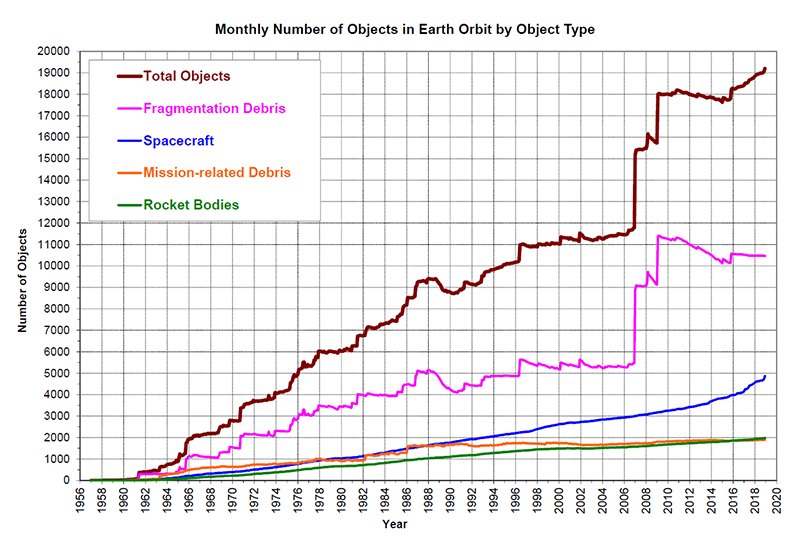
For the fifth morning in a row, nothing entered or left the catalog. There are 33,670 objects on orbit: 19,595 payloads, 2,113 spent rocket bodies, 11,962 catalogued fragments and 1,325 mission-related components. Of the 70,235 objects catalogued since 1957, 37,407 have come down, and none of those six figures has moved since 5 October GCAT.
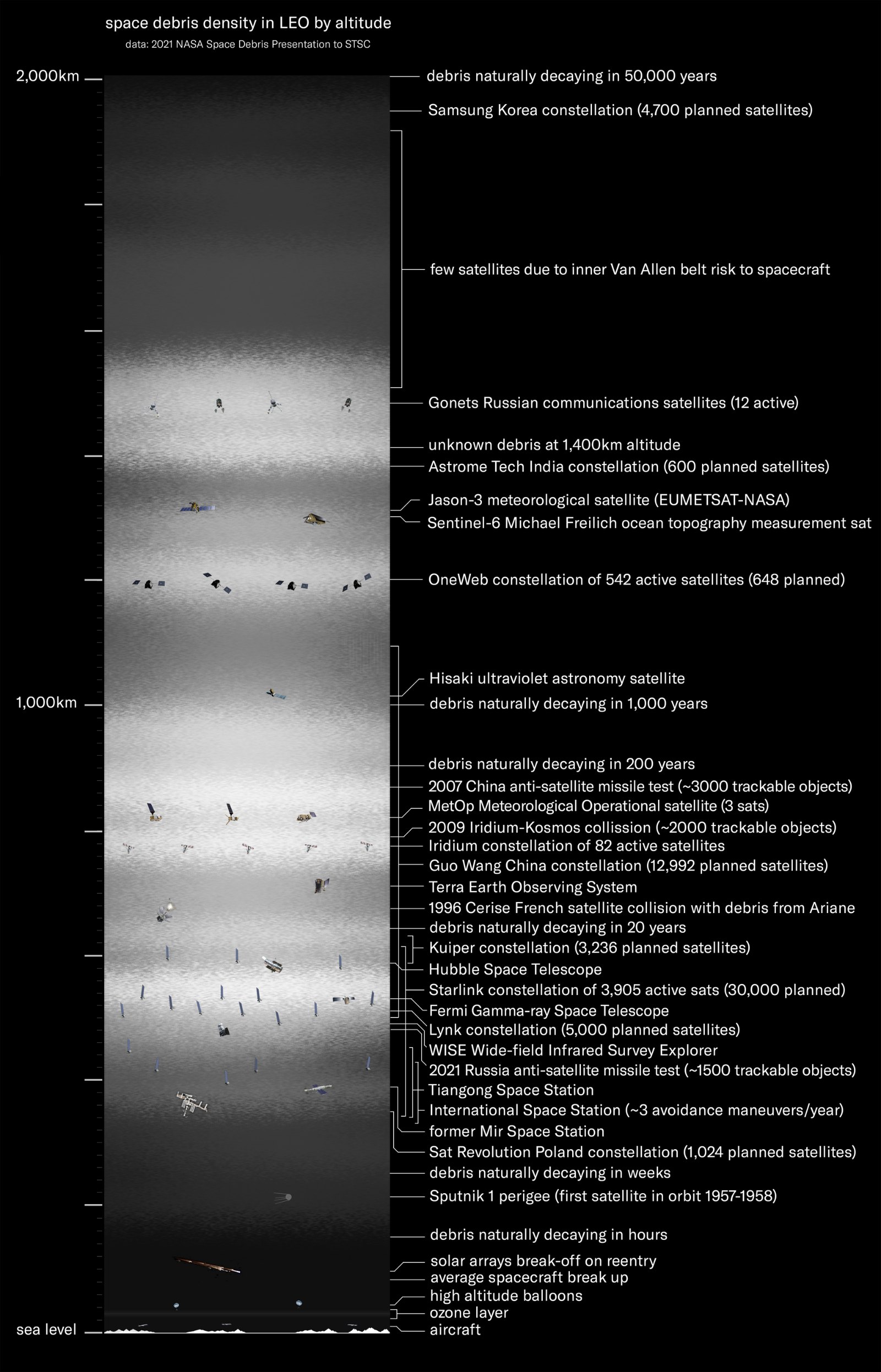
The figure worth reporting this morning is a zero. Yesterday the seven-day reentry count stood at one; today it is empty. Nothing anywhere in the catalog has been booked down since Starlink 1453 on 1 October, eight days ago. The thirty-day count slipped from 75 to 74 and the sixty-day total from 177 to 174, 46 of them Starlink, while the thirty-day launch count held at 193 GCAT. A still catalog is a bookkeeping fact, not a physical one: objects keep losing altitude whether or not a decay is posted, and the queue is visible in the element data. Sixty-five objects now have a perigee below 250 kilometres, one fewer than yesterday, and four of them are below 170: a Kuaizhou-11 third stage at 133 by 1,823 kilometres, Tianfu Dongpo 07 at 143 by 156, the Czech smallsat iSat at 150 by 162, and Starlink 3083 at 165 by 175 GCAT.
Where the catalog sits matters more than whether it moved. The 400 to 500 kilometre band holds 10,235 objects, but 10,055 of them are payloads and only 180 are fragments; the 800 to 900 kilometre band holds 2,764 objects, of which 2,499 are fragments and 265 are payloads GCAT. The crowded shell cleans itself in years; the dirty one does not. ESA's catalogue, which counts classes differently, lists 47,217 tracked objects and admits that 11,762 of them remain unidentified ESA DISCOS.
Close approach of the day
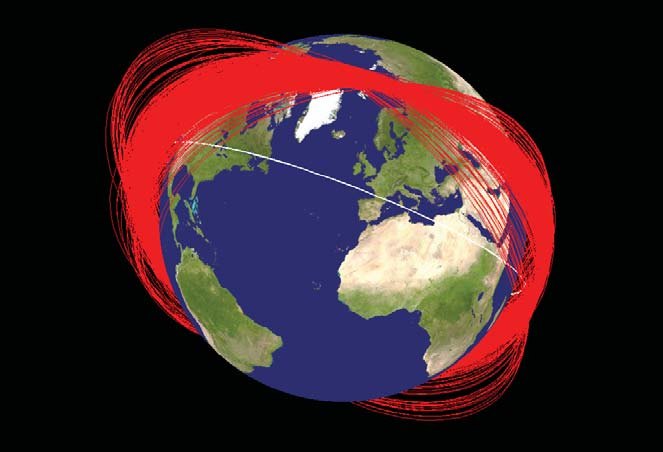
On 12 October at 10:39 UTC, two spent upper stages are predicted to pass 1.05 kilometres apart at about 790 kilometres, closing at 12.65 kilometres per second with a worst-case probability of 1 in 329,815 CelesTrak SOCRATES Plus. The prediction comes from public orbit data and from CelesTrak's 8 October screening file, because this morning's refresh could not reach CelesTrak; the figure is a kilometre-accurate estimate, not a warning. What makes it worth naming is the pair. One object is the final stage of the Taurus that launched the Geosat Follow-On from Vandenberg on 10 February 1998, still catalogued under the name of the Celestis-02 memorial container bolted to it Jonathan's Space Report 349. The other is a Long March 4C stage. Neither has a working thruster, neither has an operator on console, and nothing about this encounter can be changed by anyone. See the 3D view.
Object of the day
Tianfu Dongpo 07 sits at 143 by 156 kilometres, on element data from 1 October GCAT. At that height a satellite has days, not months. Its sibling Tianfu Dongpo 01, launched on 10 August 2022, was booked down on 27 September 2026 GCAT, and 07 is following it along the same curve. It is a useful corrective to the zero above: the reentry column is flat because nothing has been confirmed this week, not because nothing is falling.
ClearOrbit's view
A week with no reentries and five days with no catalog change is the clearest picture the data gives of the real problem. Atmospheric drag is the only removal mechanism operating today, it works on a schedule nobody sets, and above about 700 kilometres it effectively stops. That is precisely where the fragments are.
The two stages meeting over the southern ocean on Monday are the case in miniature. They are large, intact, uncontrolled, in the band that holds the most fragments, and they will keep making encounters like this one for centuries. We think the measure of a removal programme is not how many objects it can take down in total, but whether it can reach objects like these — big, dead, and in the shells where drag will not help. Nothing in orbit today can do that. Building something that can is the work.
Reader mail
Have a better idea?Spotted something we got wrong?
We publish in public so the numbers can be checked. If a figure looks wrong, a source is missing, or you know something this piece should have said, send it over. One box, no sign-up.
Send an idea or correctionQuick question
Who should pay for cleaning up orbit?
Anonymous. You will see how others answered after you vote.