Article · · 6 min read
The Fifty Most Dangerous Objects in Low Earth Orbit
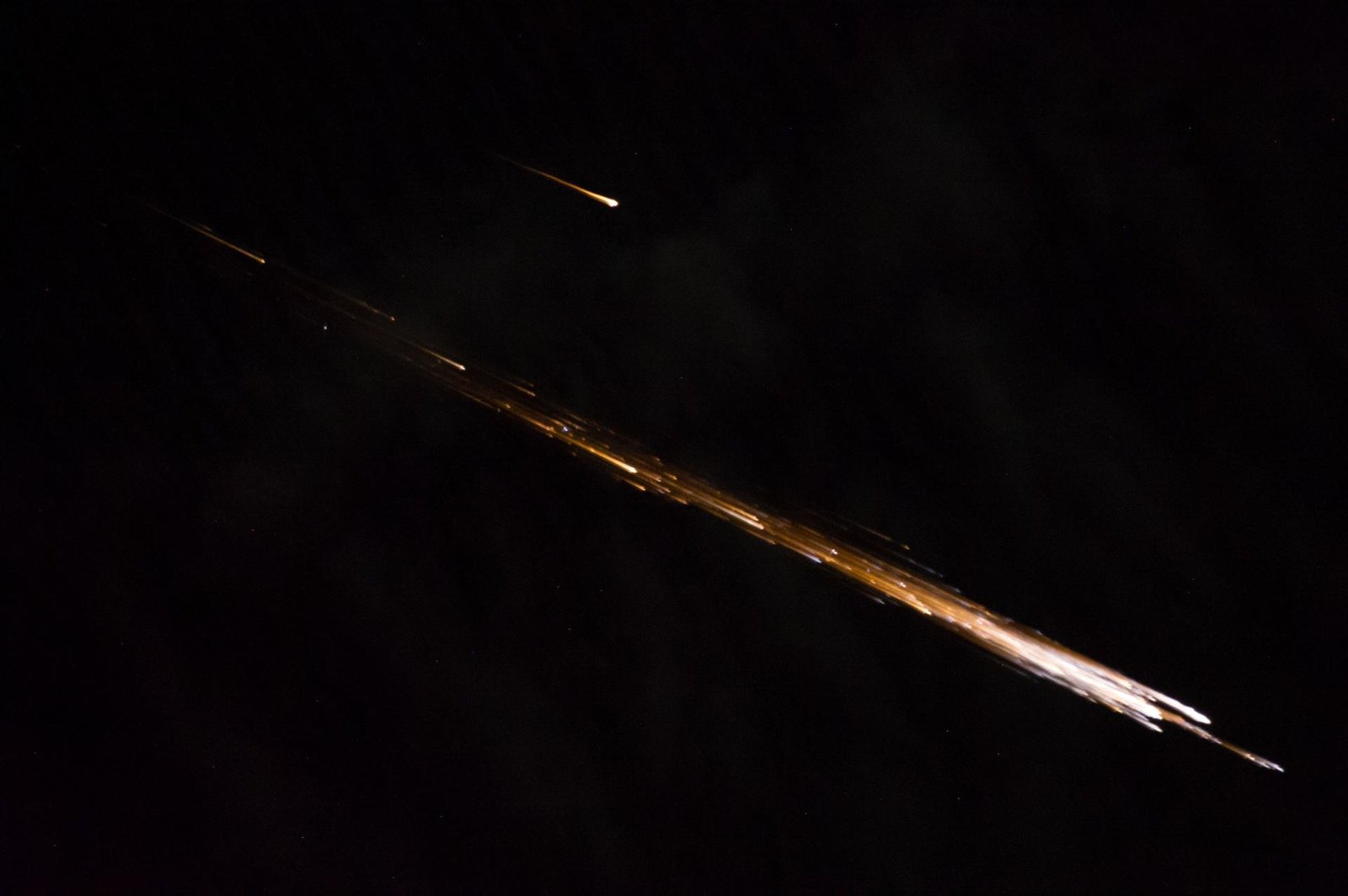
In 2021, eleven research teams ranked the derelicts most likely to seed future debris. The top 20 are all the same Soviet-era rocket stage, parked in one crowded band.
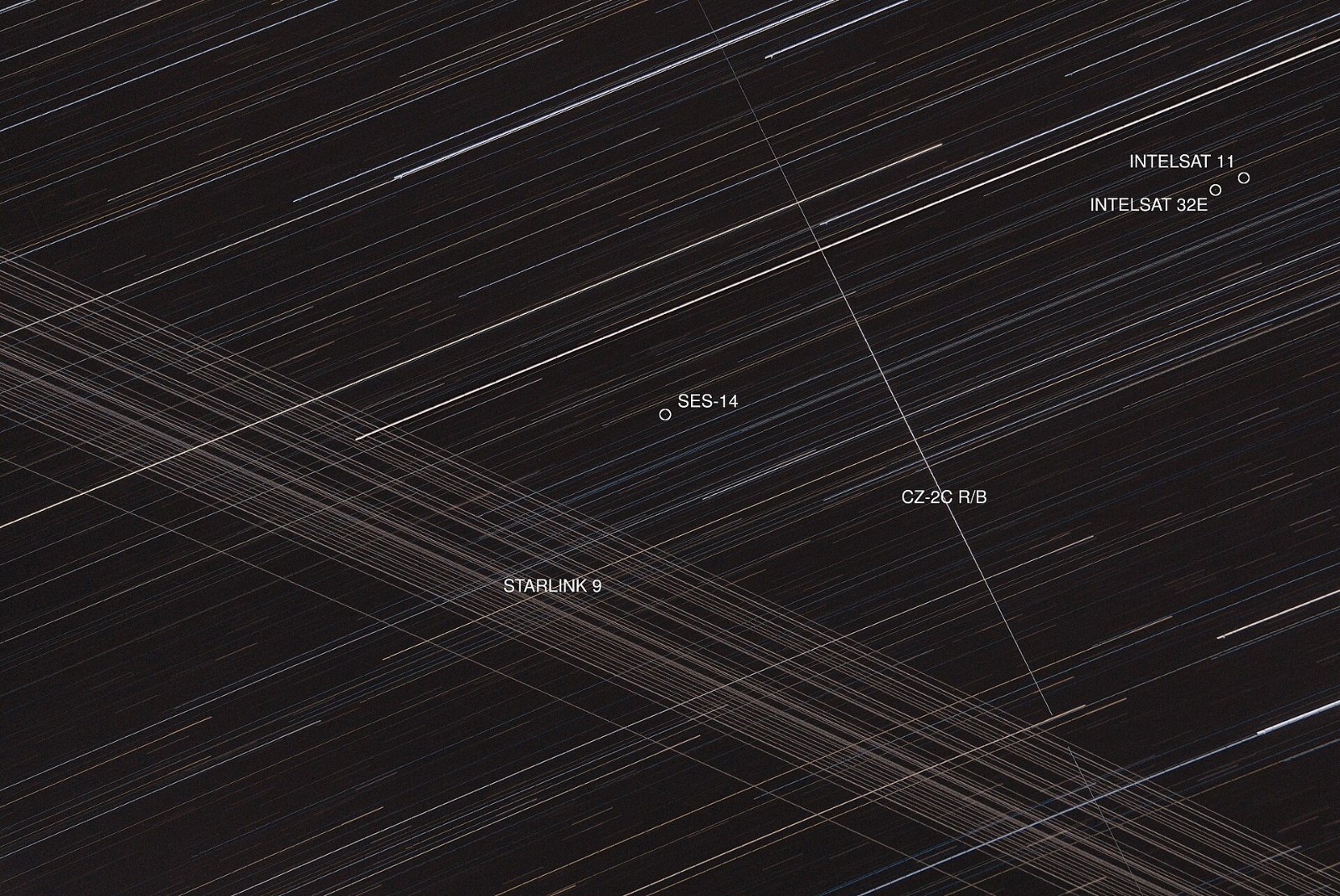
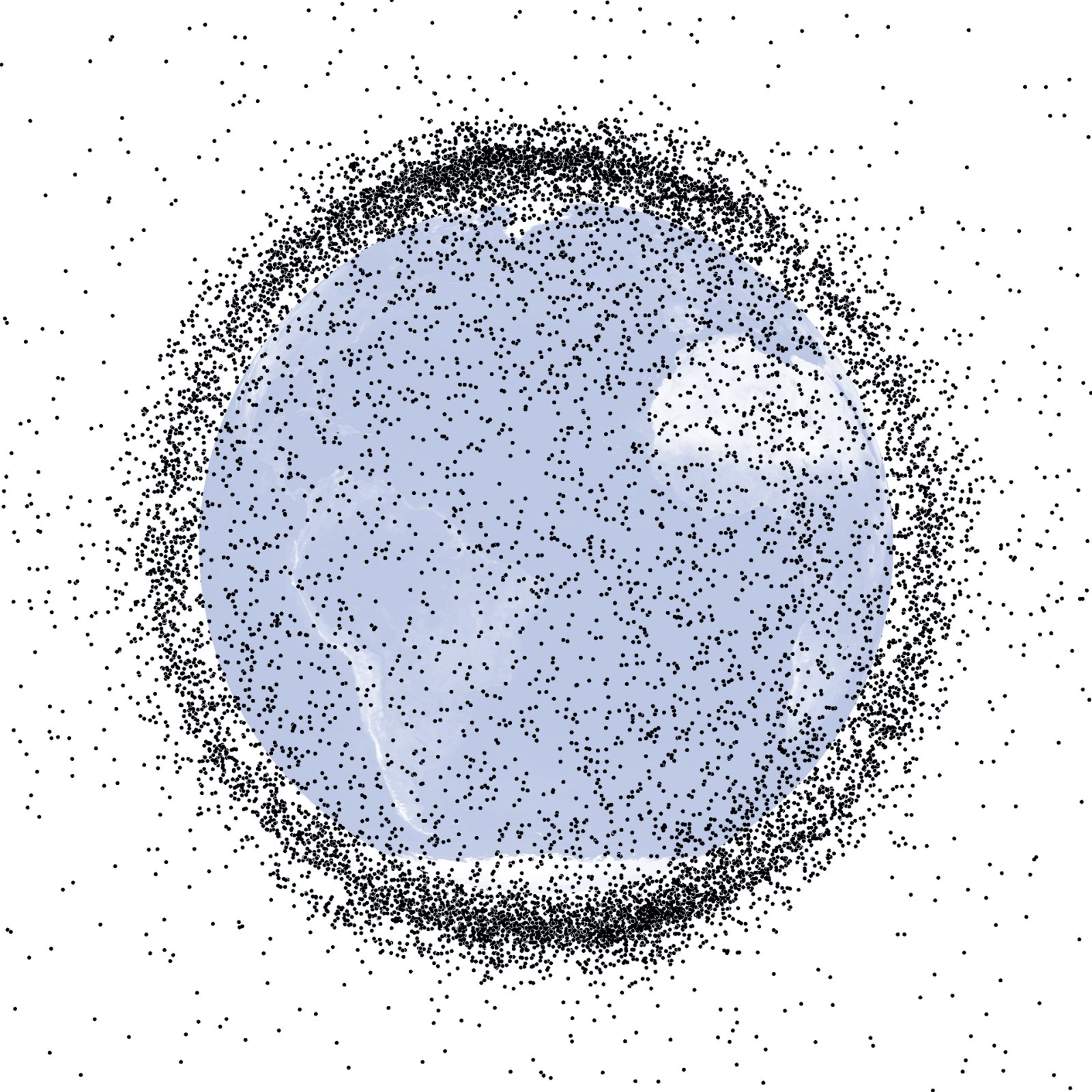
Not all debris is equal. A paint fleck can pit a window; a nine-tonne rocket stage, if hit, can fill an orbital band with thousands of fragments that stay for centuries. If removal capacity will be scarce for years, the most important question is not how to remove debris but which pieces to remove first.
In 2021 a group of researchers tried to answer that question systematically. Their result is one of the clearest maps of where the long-term collision risk in low Earth orbit actually lives.
The study
Darren McKnight and colleagues published "Identifying the 50 statistically-most-concerning derelict objects in LEO" in Acta Astronautica McKnight et al. 2021. Rather than rely on one model, they asked eleven international teams to each submit their own top-50 list, then merged those into a composite ranking. The four main factors were mass, encounter rates, orbital lifetime and proximity to operational satellites McKnight et al. 2021. The full paper and ranking table are openly available McKnight et al. 2021, PDF. Orbits in the table are from 2020, and the rows reproduced on this site were machine-extracted, so individual rows are worth checking against the paper before relying on them.
Why mass times encounter rate
The ranking logic rests on a simple idea. The damage a collision does to the environment scales with how much mass is involved, because more mass means more fragments. The chance that a collision happens scales with how often an object passes close to others. Multiply the two and you get an expected contribution to future debris.
That same logic appears in earlier NASA work, which found that holding the LEO population steady would require removing about five objects per year, with targets ranked by mass times collision probability Liou, NASA NTRS.
Orbital lifetime is the multiplier that turns a bad collision into a lasting one. Around 800 km, decay "is often measured in centuries" NASA ODPO FAQ, and at 900 km lifetimes are on the order of 1,000 years Space Academy. An object in that band that fragments will shape the environment for generations.
The Zenit cluster
The most striking feature of the composite list is how uniform the top of it is. All of the top 20 are SL-16 rocket bodies, the upper stage of the Soviet and later Russian Zenit-2 launcher, each about 9,000 kg McKnight et al. 2021, PDF.
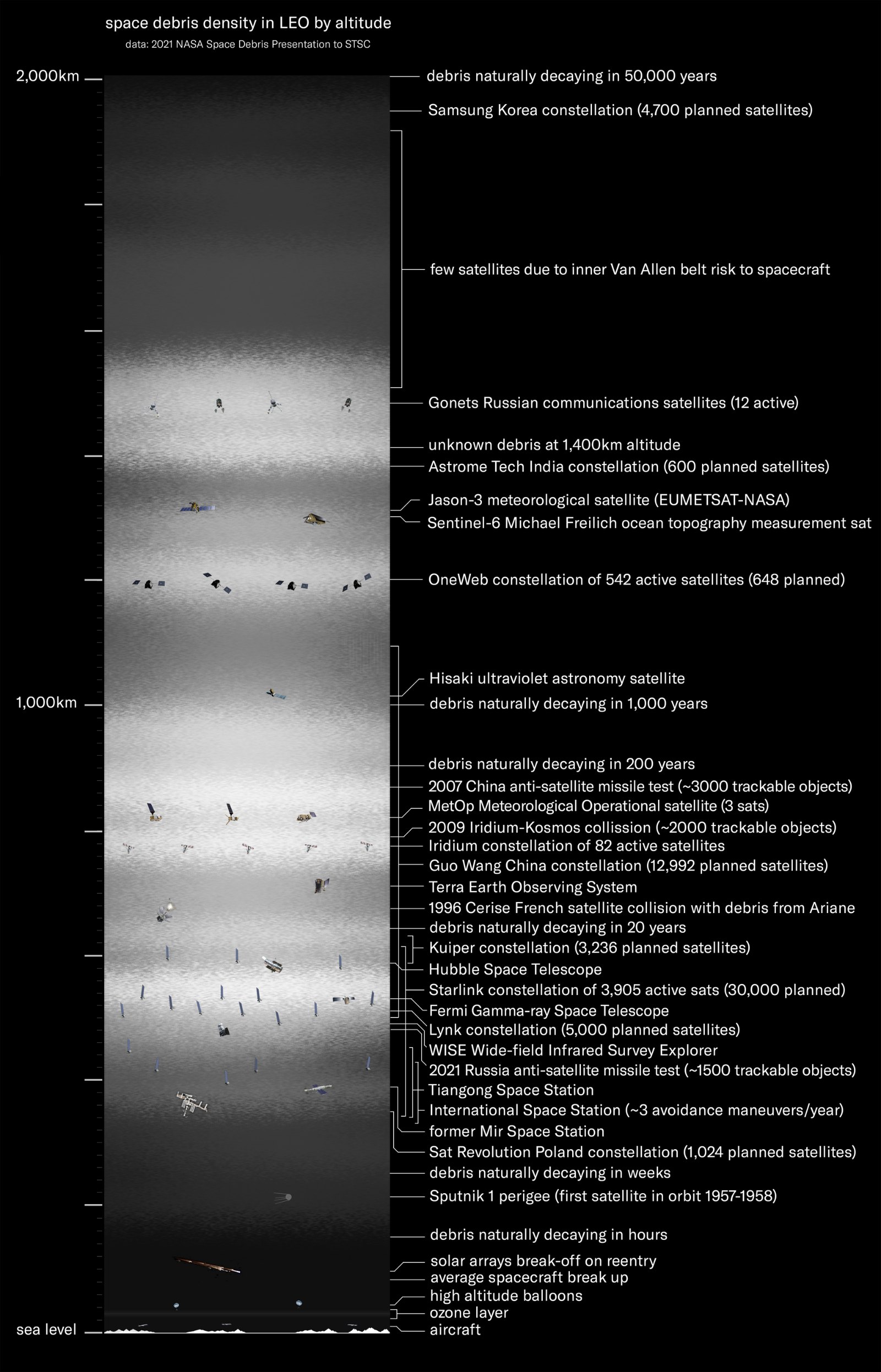
Most of them sit in a narrow shell at roughly 830 to 850 km altitude and 71 degrees inclination. The number-one object, NORAD 22566, launched in March 1993, orbits at 837 by 848 km; number two, NORAD 22220, at 827 by 848 km; number three, from 2007, at 843 by 846 km McKnight et al. 2021, PDF. Only two of the top 20 are outside that cluster: rank 7 at around 1,000 km and 99.5 degrees, and rank 20 at around 800 km and 98.6 degrees.
The cluster exists because Zenit launched a family of satellites into that orbit, and each launch left its massive upper stage behind. Several of the satellites themselves are also on the list, sharing orbits with their own stages; Cosmos 2322, at rank 29, is one of them McKnight et al. 2021, PDF.
To see why a cluster of this kind is dangerous, recall the 2009 collision between Iridium 33 and Cosmos 2251 at 790 km: two objects of 560 kg and about 900 kg produced 823 catalogued pieces within weeks NASA ODQN v13 i2. Two Zenit stages together carry more than ten times that combined mass. A collision between them, or between one of them and a smaller fragment, would be one of the worst debris events in history, in a band where the fragments would linger for centuries.
It is also a band that has already been polluted once. The 2007 Fengyun-1C anti-satellite test destroyed a satellite at around 845 to 865 km, not far above the Zenit shell NASA ODQN v11 i2.
Beyond the top 20
ENVISAT is the first non-Zenit object on the list, at rank 21. The European environmental satellite has a mass of 7,800 kg and orbits at 764 by 766 km in a sun-synchronous orbit at 98.1 degrees; it is the largest non-Soviet object in the ranking McKnight et al. 2021, PDF. It sits in one of the most heavily used orbital regimes for Earth observation.
The rest of the top 30 includes the Meteor 3M satellite, Japan's ADEOS satellite and two Japanese H-2 and H-2A rocket bodies, a 4,000 kg Chinese CZ-2D stage, and a second cluster of 1,435 kg SL-8 (Kosmos-3M) stages near 950 to 1,000 km and 83 degrees McKnight et al. 2021, PDF. The paper notes that the list is dominated by objects abandoned before 2001.
One point of care: JAXA's ADRAS-J mission inspected an H-IIA upper stage, a relative of the Japanese stages on this list JAXA. The stage it visited was launched in 2009 and is not the H-2A rocket body ranked 24th, so it is inaccurate to say a listed object has been visited.
What removing the top 20 would achieve
The study itself does not give a single number for how much risk would fall if the top 20 were removed, and none should be invented. But the structure of the list is revealing.
Removing the Zenit stages would take roughly 180 tonnes of the most collision-prone mass out of a single shell (20 objects at about 9,000 kg each McKnight et al. 2021, PDF). Because the objects are so similar, they are also an unusually good engineering target: one servicer design, one capture approach and one set of navigation models could in principle handle all of them. A campaign against a cluster is far more efficient than a campaign against scattered, dissimilar objects.
The honest counterpoint comes from NASA's cost-benefit analysis, which found that removing the top 50 large objects yields only about $3.5M of risk reduction to operators in the first year NASA OTPS 2023. Large-object removal is insurance against rare but catastrophic events, not a quick return. Its value shows up in the collisions that never happen.
ClearOrbit's view
We think the McKnight ranking should be treated as a shared public target list, updated regularly with current orbital data and published with the same transparency as the original. Debate over removal is too often abstract. A named list of objects, with owners and orbits, makes it concrete.
The Zenit cluster is the obvious place to aim a sustained campaign. Its uniformity is an opportunity, and its ownership raises a diplomatic question that should be addressed openly: removing a state's derelict hardware requires that state's consent and, ideally, participation.
Until servicers capable of handling 9-tonne stages are flying, we believe the cluster should be monitored closely and considered a priority for just-in-time collision-avoidance research, a Proposed approach today. Our longer-term ClearOrbit vision of a multi-object removal campaign against the highest-ranked derelicts is set out in the ClearOrbit plan.
Reader mail
Have a better idea?Spotted something we got wrong?
We publish in public so the numbers can be checked. If a figure looks wrong, a source is missing, or you know something this piece should have said, send it over. One box, no sign-up.
Send an idea or correctionQuick question
Who should pay for cleaning up orbit?
Anonymous. You will see how others answered after you vote.
Sources
- McKnight et al. (2021), abstract (NASA ADS)
- McKnight et al. (2021), open PDF
- Liou, NASA ODPO ADR study
- NASA ODQN v13 i2 (Iridium-Cosmos collision)
- NASA ODPO FAQ
- Space Academy, orbital lifetimes
- NASA OTPS, Cost and Benefit Analysis of Orbital Debris Remediation (2023)
- JAXA press release, ADRAS-J (Jul 2024)
- NASA ODQN v11 i2 (Fengyun-1C)