Article · · 6 min read
Four Anti-Satellite Tests, 5,703 Catalogued Fragments, and 2,125 Still in Orbit
Two tests below 300 kilometres have left nothing behind. The 2021 test at 480 kilometres is down to four fragments. The 2007 test at 860 kilometres still has 2,121 up.
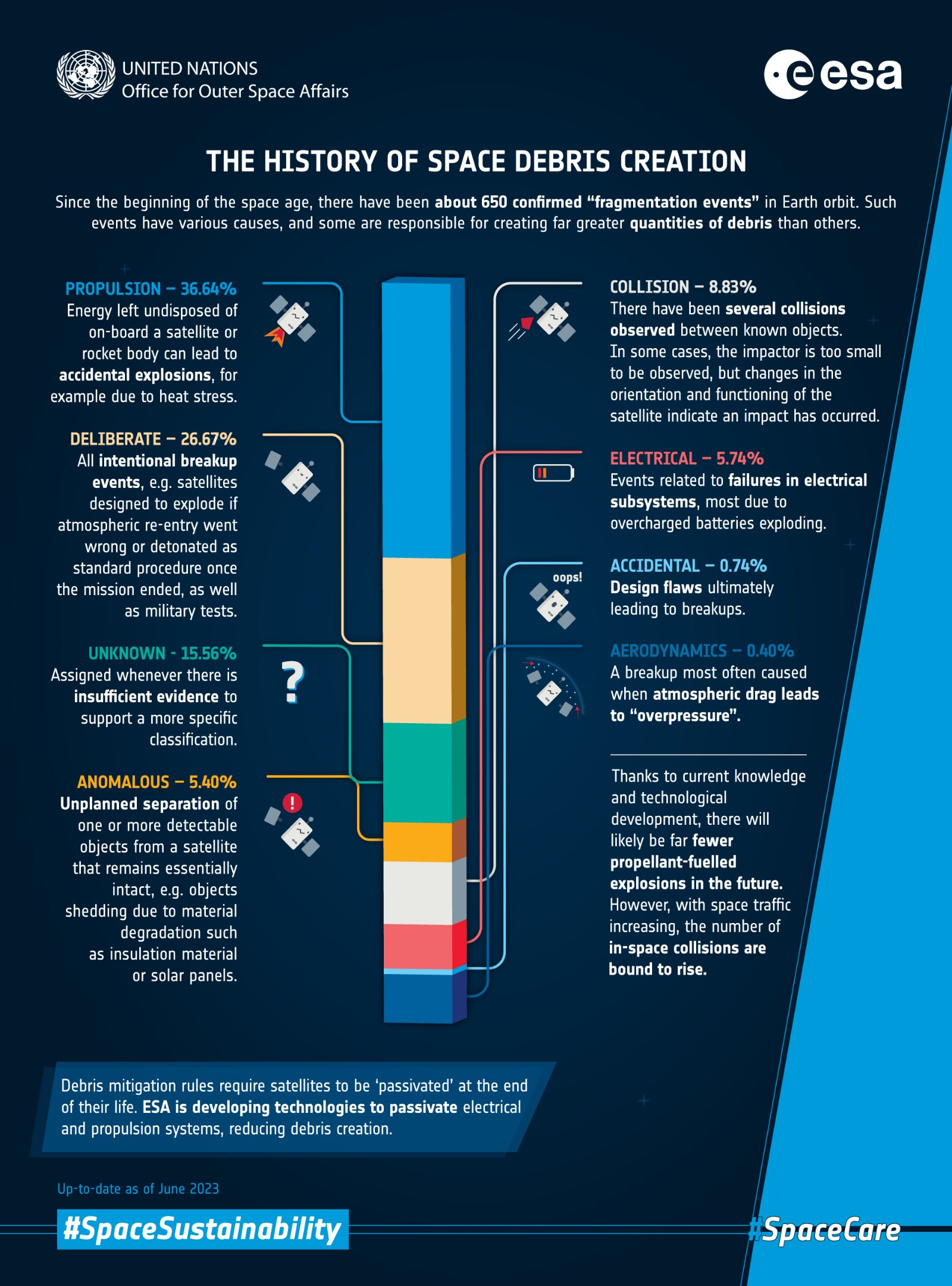
Four times, a state has deliberately destroyed one of its own satellites in orbit with an interceptor. Those four events put 5,703 catalogued fragments into the record between them. As of today, 2,125 of those fragments are still in Earth orbit, and 2,121 of the 2,125 come from a single test (GCAT).
That is the finding worth holding on to, because it is not a finding about restraint, warhead design or who conducted which test. The four clouds were created in roughly the same way. What separates them is altitude, and the separation is not a matter of degree. Two tests have left nothing measurable at all. One is down to four pieces. One will outlive everyone who authorised it.
The two tests that left nothing
On 21 February 2008 a US Navy missile destroyed the failed reconnaissance satellite USA 193 "at an altitude just below 250 km", producing a Gabbard diagram's worth of short-lived debris. Most of it fell within an hour of the breakup; NASA's Orbital Debris Program Office expected the last fragment to reenter in the summer of 2008 (NASA ODQN 12-2). GCAT today lists 175 catalogued fragments from that event, all 175 booked as reentered (GCAT).
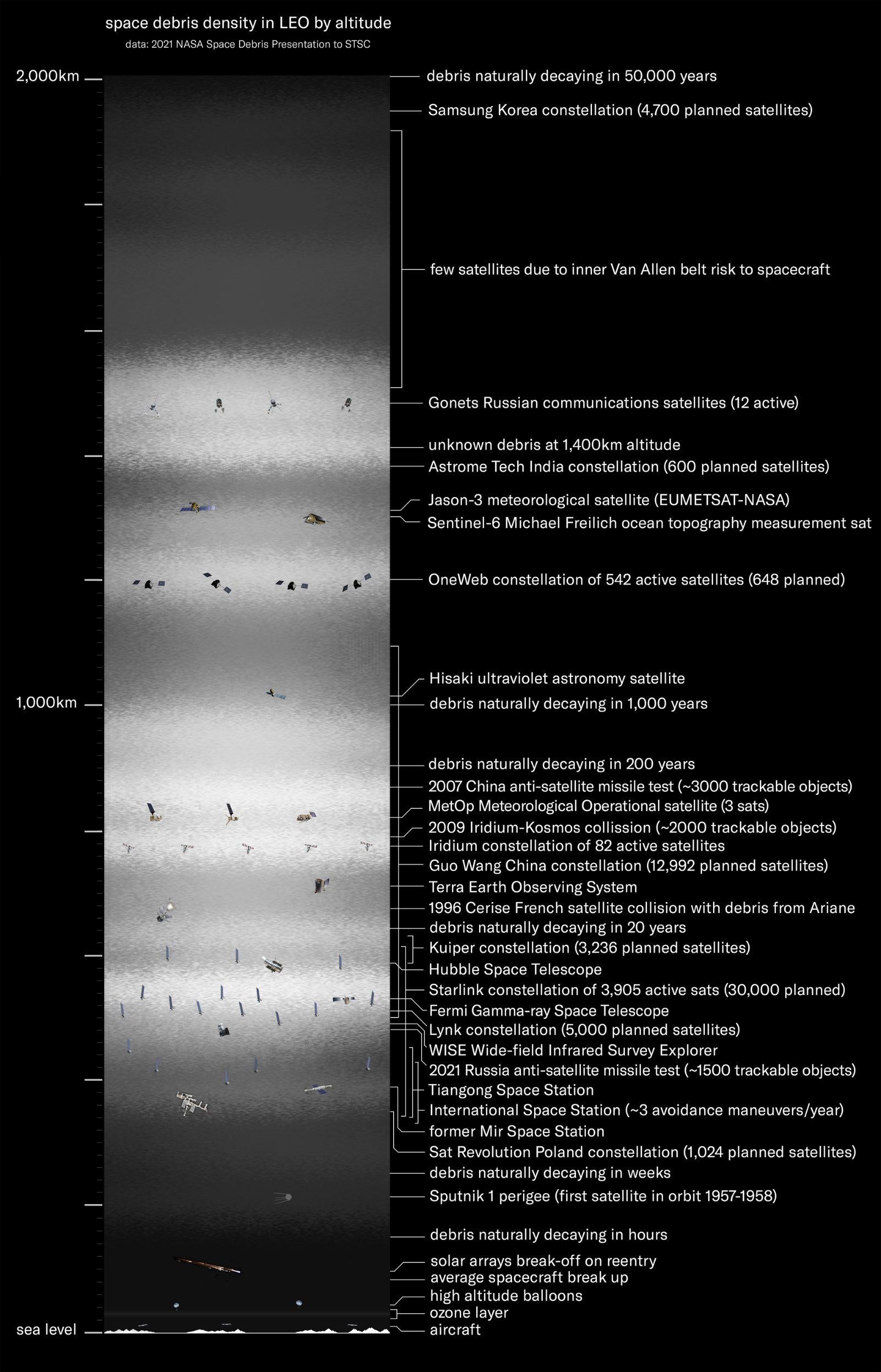
India's test on 27 March 2019 destroyed Microsat-R, which NASA's own mission table puts in a 260-by-282-kilometre orbit at an inclination of 96.64 degrees (NASA ODQN 23-1). NASA's fragmentation history is blunt about what saved that one: the event's impact was "mitigated only by the relatively low altitude at which it was conducted" (NASA, History of On-orbit Satellite Fragmentations, 16th ed.). All 131 catalogued Microsat-R fragments are now booked as reentered (GCAT).
Below about 300 kilometres, the atmosphere is thick enough that a fragment's orbit is a countdown rather than an address. Neither test was clean. Both were simply conducted in a place that cleans itself, and both still put debris briefly through altitudes other spacecraft use.
The five-year forecast that came true
Russia's test of 15 November 2021 destroyed Kosmos-1408, a Soviet signals-intelligence satellite launched on 16 September 1982 whose orbit had decayed to 490 by 465 kilometres, at an inclination of 82.6 degrees (NASA ODQN 26-1). Flight controllers had the International Space Station crew shelter in their spacecraft for two passes that night (NASA, 15 November 2021). By 7 March 2022, 1,604 fragments had been added to the US satellite catalog, and NASA expected more than ninety per cent of them to decay within five years (NASA ODQN 26-1).
Five years less a fortnight later, the forecast has been beaten. GCAT lists 1,810 catalogued Kosmos-1408 fragments: 1,800 reentered, six marked lost, and four still in Earth orbit — 0.2 per cent (GCAT). The reentry curve is the shape of a cloud being scrubbed from below: 47 fragments down in 2021, 1,379 in 2022, 299 in 2023, 62 in 2024, eight in 2025 and one so far in 2026. The four survivors sit at 211 by 220, 316 by 336, 409 by 431 and 453 by 697 kilometres, and the target's own largest surviving piece was booked as reentered on 27 October 2024 (GCAT). Today's briefing has the detail on the lowest of the four.
The hundred-year forecast that is also coming true
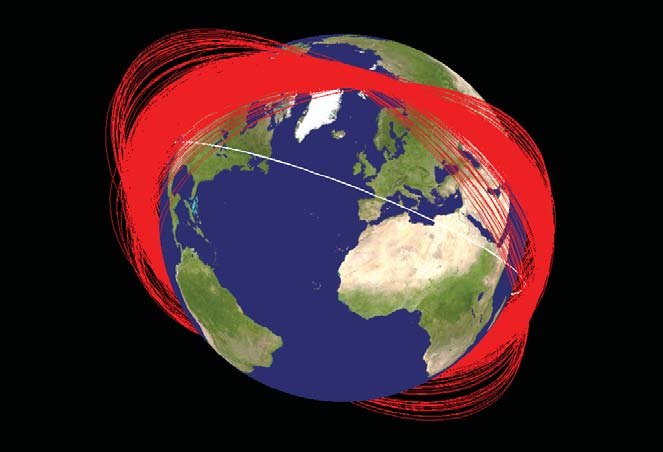
China's test of 11 January 2007 destroyed Fengyun-1C at about 860 kilometres, in a sun-synchronous orbit with a mean altitude near 850 kilometres and an inclination of 98.8 degrees. NASA's assessment at the time, six months after the event, was that "the majority of the debris will remain in orbit for decades, some even lasting more than one hundred years" (NASA, IAC-07-A6.3.01). NASA's fragmentation history still calls it the most environmentally impactful event to date (NASA, History of On-orbit Satellite Fragmentations, 16th ed.).
Nineteen years and nine months later, that forecast is holding precisely. GCAT lists 3,587 catalogued Fengyun-1C fragments. Of those, 1,223 have reentered, 243 are marked lost and 2,121 are still in Earth orbit — 59 per cent of everything the test created. Their mean altitude is 832 kilometres, and 1,344 of them have mean altitudes above 800 kilometres (GCAT). They are the reason the 800-to-900-kilometre shell is the dirtiest in low Earth orbit, with 2,501 of its 2,754 objects classed as debris rather than payloads.
The reentry rate tells you how little help is coming. Fengyun-1C fragments came down at 27 in 2021, 71 in 2022, 141 in 2023, 174 in 2024, 99 in 2025 and 41 so far in 2026 (GCAT). Our reading of the hump is that it is solar: NOAA's prediction panel put solar cycle 25's maximum at a sunspot number of 115 in July 2025, with the peak anywhere between November 2024 and March 2026 (NOAA SWPC), and a more active Sun inflates the upper atmosphere and raises drag at these heights. At the 2024 peak rate of 174 a year, clearing the surviving 2,121 fragments would take until roughly 2038. At the 2026 rate it takes past 2070, and the rate falls as the easy ones go. A weak cycle 26 would stretch it further.
What the ledger leaves out
Two caveats matter and both point the same way. The 249 fragments across these four events that GCAT marks lost are not gone: that status means no recent tracking data, with the object probably still in orbit (GCAT status values). The true surviving count is therefore above 2,125, not below it.
The larger omission is size. A catalogued fragment is one a sensor network can hold, and the networks together track about 47,300 objects, while ESA's model puts 68,450 objects larger than ten centimetres in orbit and 1.5 million between one and ten centimetres (ESA DISCOS, 23 October 2026). A one-centimetre fragment at these speeds is lethal to a spacecraft and invisible to the tracking that would let anyone dodge it. Every number in this piece is the countable fraction of a larger population, and the ratio is worst exactly where the Fengyun-1C cloud lives.
ClearOrbit's view
The honest summary of twenty years of anti-satellite testing is that the atmosphere has cleaned up three of the four messes and will not touch the fourth. That is not a policy success. It is an accident of where three of the four targets happened to be flying, and it has produced a dangerous intuition — that debris events resolve themselves — on the strength of three cases that were resolved by drag rather than by anybody's decision.
Removing a fragment of debris from orbit is still Proposed: nothing has yet done it, though rendezvous with and close inspection of a large derelict is Flown. The gap between those two facts is where the Fengyun-1C cloud sits, and it is the gap we are building ClearOrbit to close.
So our view is that the 2,121 figure should be the headline number in every debris conversation, ahead of the catalog total. It is specific, it is checkable, it comes from one afternoon's decision in 2007, and it is the clearest existing measurement of what a single breakup above 800 kilometres costs everyone who flies afterwards. The lesson of Kosmos-1408 is not that clouds disperse. It is that drag is the only removal system that has ever worked at scale, that it only works low, and that above 700 kilometres the debris we make is the debris we keep. Kessler's argument starts there.
Reader mail
Have a better idea?Spotted something we got wrong?
We publish in public so the numbers can be checked. If a figure looks wrong, a source is missing, or you know something this piece should have said, send it over. One box, no sign-up.
Send an idea or correctionQuick question
Who should pay for cleaning up orbit?
Anonymous. You will see how others answered after you vote.
Sources
- GCAT, J. McDowell
- GCAT status values
- NASA, The Characteristics and Consequences of the Break-up of the Fengyun-1C Spacecraft (IAC-07-A6.3.01)
- NASA Orbital Debris Quarterly News 12-2 (April 2008)
- NASA Orbital Debris Quarterly News 23-1
- NASA Orbital Debris Quarterly News 26-1
- NASA History of On-orbit Satellite Fragmentations, 16th Edition
- NASA Administrator statement on the Russian ASAT test, 15 November 2021
- ESA Space Environment Statistics
- NOAA Space Weather Prediction Center, solar cycle progression