Article · · 6 min read
One Rocket Type, Two Breakups, 1,182 Fragments Still in Orbit
A CZ-6A upper stage came apart over the poles in November 2022, and another in August 2024. Of 1,457 fragments catalogued between them, 1,182 are still up.
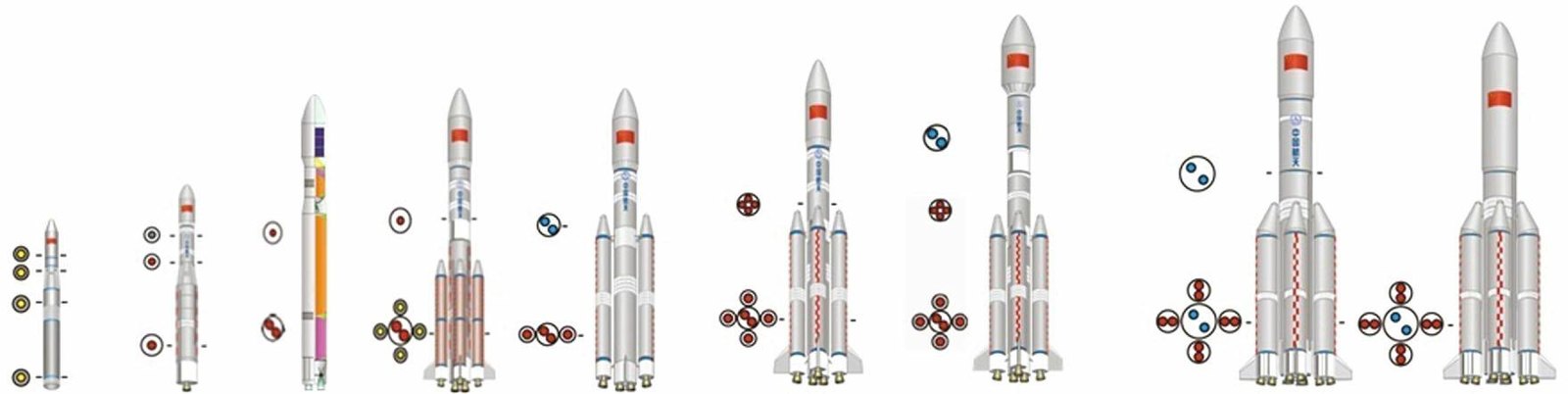
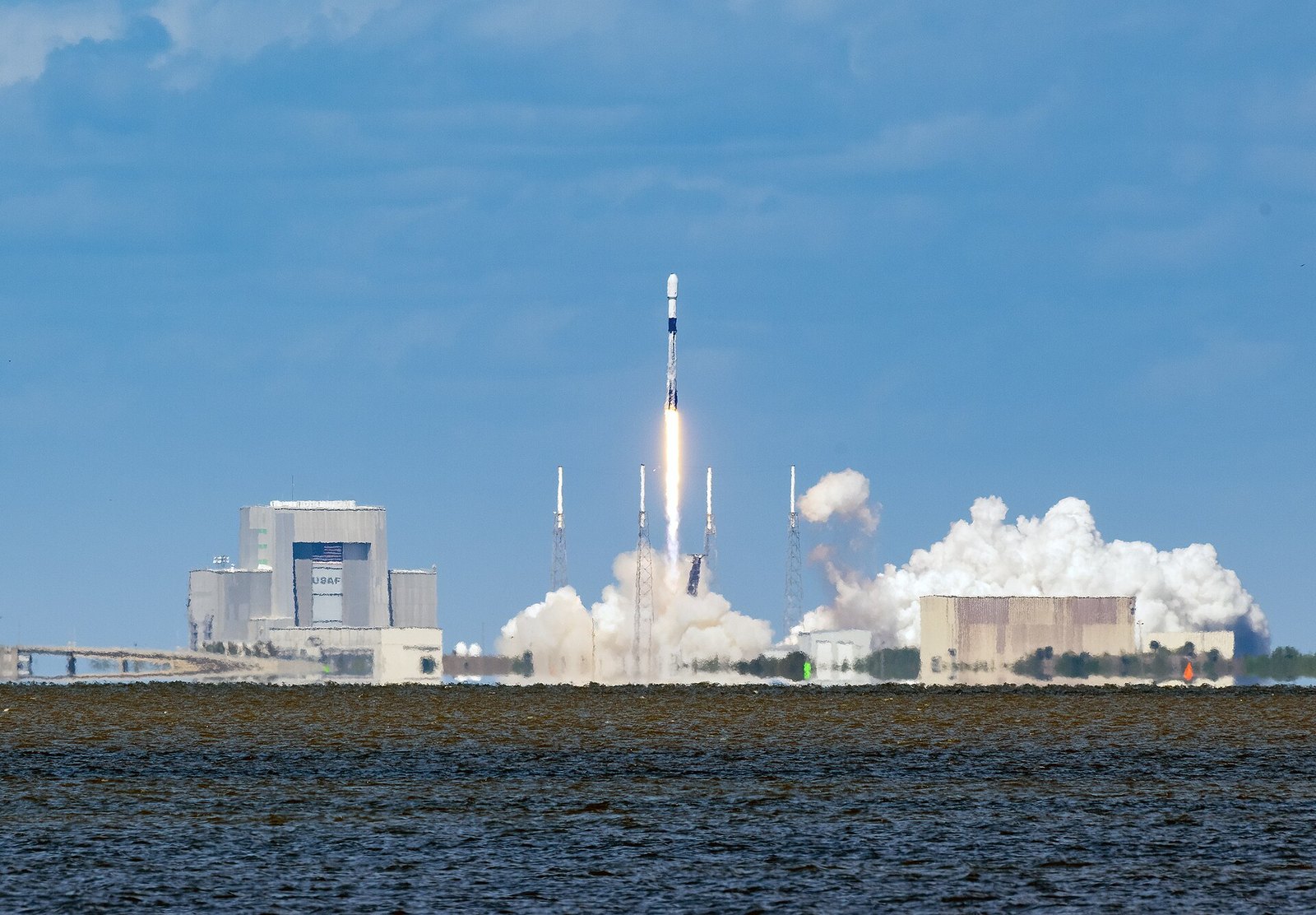
Two upper stages of the same rocket type have come apart in orbit within two years of each other, and between them they account for 1,182 of the objects being tracked this morning. The Long March 6A, or CZ-6A, is Flown: it has carried satellites to sun-synchronous orbit since 2022. It has also produced two of the largest fragmentation events of the decade, both of them at the worst possible altitude, and the public catalog now lists 1,191 objects named CZ-6A debris, 1,182 of which came from just those two launches (Space-Track.org).
November 2022: 793 fragments from a 5,800-kilogram stage
The first event happened on 12 November 2022, hours after a CZ-6A placed the Yunhai-3 satellite into a sun-synchronous orbit. The upper stage, catalogued as 2022-151B, was in a 813-by-847-kilometre orbit at 98.8 degrees inclination and had a dry mass of 5,800 kilograms. Analysts at TU Braunschweig and the German Aerospace Center who reconstructed the event put its epoch at about 05:19 UTC and model it as an unintentional explosion; 793 fragments were eventually catalogued, and their reconstruction of the fragment velocities gives a mean additional velocity of 80.2 metres per second (Wacker et al., 9th European Conference on Space Debris, 2025).
Four years on, 611 of those fragments are still in orbit, along with Yunhai-3 itself at 847 by 850 kilometres and the stage that broke up, still catalogued as an intact rocket body at 829 by 894 kilometres on an element set published on 4 November (Space-Track.org).
August 2024: a breakup after a successful deployment
The second event came on 6 August 2024 at 17:15 GMT, after a CZ-6A had successfully deployed the first eighteen spacecraft of China's Qianfan constellation. NASA's Orbital Debris Program Office recorded the stage as 2024-140U, catalog number 60397, in an orbit "close to 857 km x 797 km" at 89 degrees inclination, and reported that "As of 15 September 2024, 283 large fragments have been cataloged" — while noting that the event had probably also generated "hundreds of thousands of fragments too small to be tracked" (NASA Orbital Debris Quarterly News 28-4). The catalogued count kept climbing; by early 2025 it stood at 664, with a mean additional velocity of 64.8 metres per second, about a fifth lower than the 2022 event (Wacker et al.).
Of those 664, 571 are still in orbit. The eighteen Qianfan satellites completed their climb and sit near 1,058 by 1,079 kilometres; the stage that carried them is still catalogued at 794 by 857 (Space-Track.org).
Where the fragments went
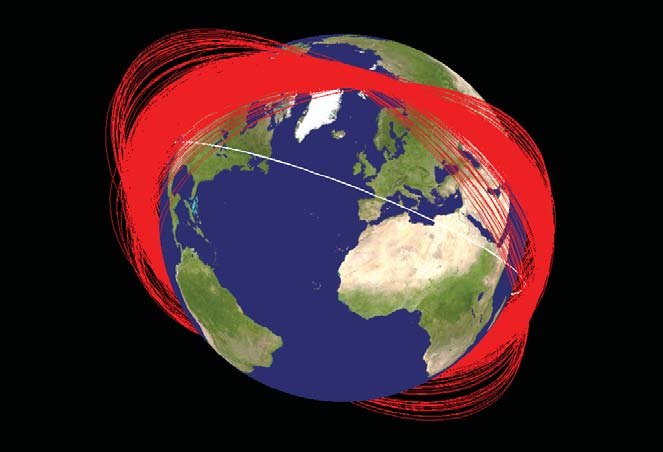
A breakup does not move objects up or down so much as it smears them. The 2022 cloud now runs from 414 to 1,212 kilometres of mean altitude with a median of 806; the 2024 cloud runs from 354 to 1,198 with a median of 776 (Space-Track.org). Eleven fragments of the first and thirteen of the second have worked their way below 500 kilometres, where the air will finish them within a few years. Fifteen and eight respectively sit above 1,000 kilometres, where nothing will (Space-Track.org).
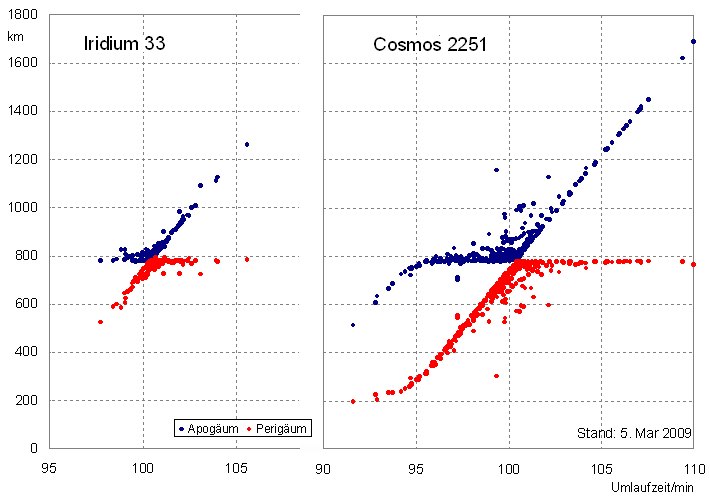
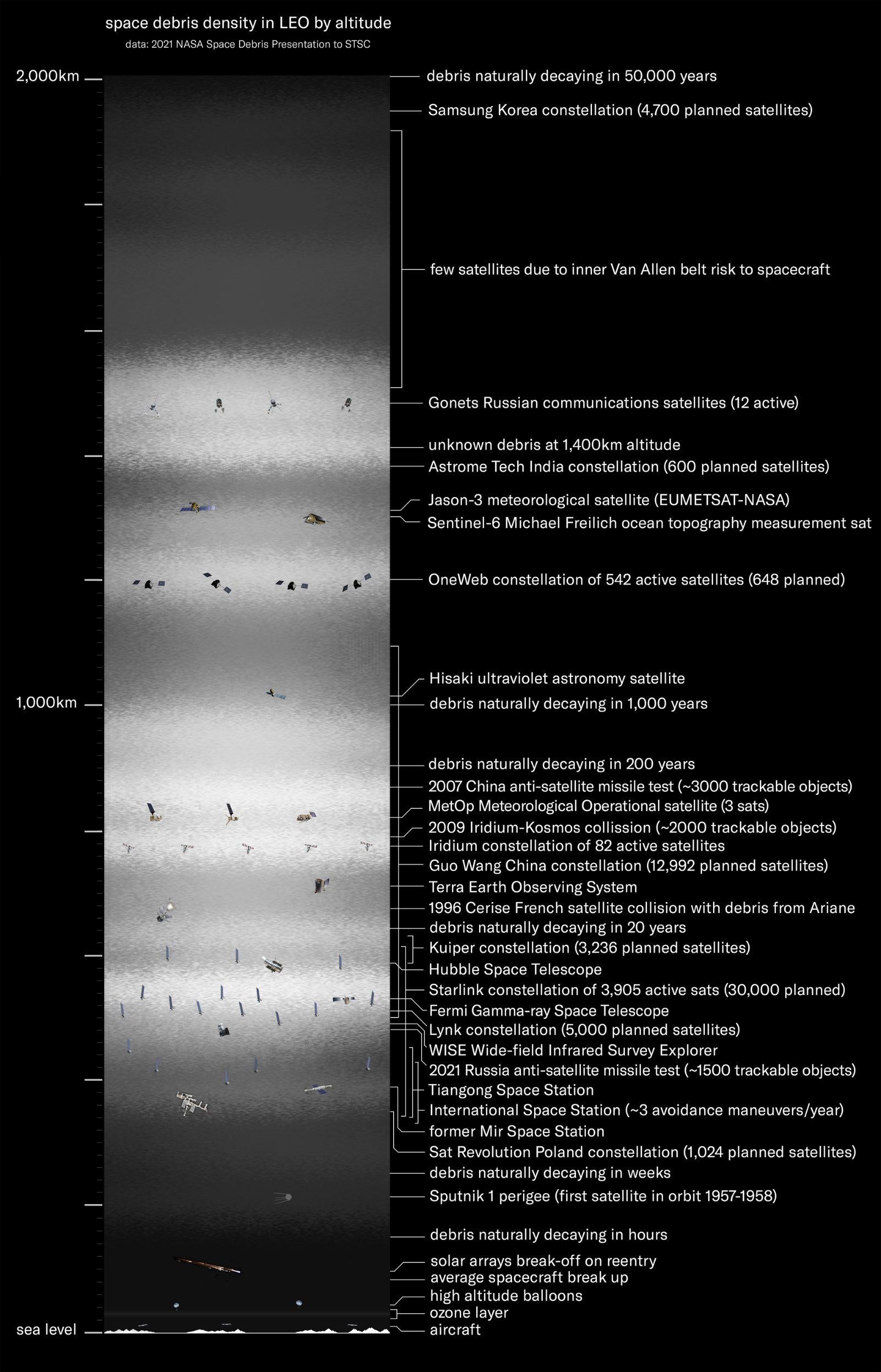
The part that matters for everyone else is the middle. Four hundred and eight fragments from the 2022 event and 317 from the 2024 event cross the 800-to-900-kilometre shell (Space-Track.org), a band which carries 2,752 catalogued objects of which 2,501 are debris and only 251 are payloads (our catalog page). That is the band where the Fengyun-1C test fragments and the Iridium-Cosmos collision debris already sit, and it is the band with the least natural cleaning.
How long they stay
The Braunschweig team ran the decay forward. About 15 per cent of the 793 fragments from the 2022 event had reentered roughly 2.35 years after the breakup. Their simulations show about 45 per cent of the initial fragments larger than a centimetre still in orbit after three years and more than 40 per cent after ten, with the 2024 cloud decaying at essentially the same rate. In spatial-density terms the first cloud added about a third of the background density near 800 kilometres at one year after the event, around 15 per cent at three years, and roughly 10 per cent at ten (Wacker et al.).
Two further CZ-6A stages are recorded as having fragmented in 2024, 2024-058B on 2 April and 2024-126D on 5 May, according to ESA's DISCOS database; at the time of the Braunschweig analysis no fragments from either had been catalogued (Wacker et al.). The public catalog today lists one piece of CZ-6A debris from the May launch. Four fragmentation events of one stage design in under two years is a pattern, not an accident, and it is the kind of pattern that passivation exists to break.
Who is obliged to prevent it
Very little, in binding terms. Passivation — venting residual propellant and discharging batteries so that a stage cannot explode once it is abandoned — is settled engineering and is written into voluntary guidelines rather than enforceable law for most operators. In the United States, the Federal Aviation Administration proposed in September 2023 to require that upper stages be removed from orbit within 25 years of launch, with controlled atmospheric disposal "within 30 days of mission completion" and a collision probability for upper stages below one in a thousand over the orbital lifetime; the agency noted at the time that it "currently only requires passivation at the end of launch". That proposal was Proposed, never adopted, and was formally withdrawn in January 2026 (FAA NPRM 23-13). It would in any case not have reached a Chinese launch. What binds whom, and where the gaps are, we set out in Rules of the Road, 2026.
ClearOrbit's view
ESA's running totals put the catalogued population at about 47,290 objects, massing more than 17,500 tonnes, produced in part by more than 660 break-ups, explosions, collisions and anomalous events (ESA DISCOS, 2 November 2026). Two of those 660 are the subject of this piece, and they alone supply more than a thousand tracked objects in the shell that can least afford them.
ClearOrbit has flown nothing and holds no contracts. Our position is that a launch vehicle's debris record should be a published, comparable number — fragments catalogued per flight, fragments still in orbit, and the altitude they were left at — in the same way that reliability is. A stage design that has fragmented four times in two years is identifiable from public data today; nothing in the current rules makes that identification consequential for the next launch.
Removing fragments once they exist is harder than any of this. A thousand pieces spread over eight hundred kilometres of altitude and several degrees of inclination is not a capture problem, it is a statistics problem, and no demonstrated technology addresses it. That is the asymmetry we keep returning to: the stage could have been passivated for a few kilograms of margin, and the cloud it left will outlive the constellation it launched.
Reader mail
Have a better idea?Spotted something we got wrong?
We publish in public so the numbers can be checked. If a figure looks wrong, a source is missing, or you know something this piece should have said, send it over. One box, no sign-up.
Send an idea or correctionQuick question
Who should pay for cleaning up orbit?
Anonymous. You will see how others answered after you vote.
Sources
- Wacker et al., Analysis of Recent CZ-6A Rocket Upper Stage Fragmentations, 9th European Conference on Space Debris
- NASA Orbital Debris Quarterly News, vol. 28 issue 4
- US Space Force public catalog, Space-Track.org
- ESA Space Environment Statistics (DISCOS)
- FAA, Mitigation Methods for Launch Vehicle Upper Stages, NPRM 23-13
- GCAT, J. McDowell