Daily briefing · · 3 min read
Orbit on 18 September 2026: 38 new objects in a day, and a 1985 satellite finally coming down
33,591 objects on orbit, up 38 in a day and 307 in 30 days; the lowest is a Soviet listening satellite from 1985 whose own rocket stage has barely moved since.
This morning's catalog refresh counts 33,591 objects in Earth orbit, thirty-eight more than yesterday. Of those, 19,546 are payloads and 14,045 are rocket bodies, fragments and discarded components, with roughly 16,347 payloads flagged as active (GCAT). Thirty-five of the thirty-eight are payloads and three are debris: the signature of a heavy launch day, not a breakup.
What changed
The catalog has gained 307 new objects in the last 30 days, up sharply from the 270 counted a day earlier, because 17 September was a busy day on the pad and a busier one in the catalog. Nine American payloads numbered USA 682 through USA 690 were entered together, alongside Russia's Kosmos-2620 and two Chinese payloads, Caiyun SAR01 and Xinglianti Tianyuan YG01 (GCAT).
Against that, 78 objects re-entered in the last 30 days and six in the last week. Starlink supplies 47 percent of the 163 objects that came down in the last 60 days. 190 catalogued objects have perigees below 250 km this morning, most of them Starlink satellites on their planned way out.
Object of the day: Kosmos-1707, and the stage that carried it
The lowest catalogued object in orbit is NORAD 16326, Kosmos-1707, at 125 by 142 km on an epoch of 17 September. It launched on 12 December 1985 as 1985-113A; GCAT records it as Ikar No. 48L, a Tselina-D electronic intelligence satellite of 1,750 kg, 3.2 m long and 13.1 m across with antennas out. Its reference orbit, taken in January 1986, was 633 by 665 km (GCAT).
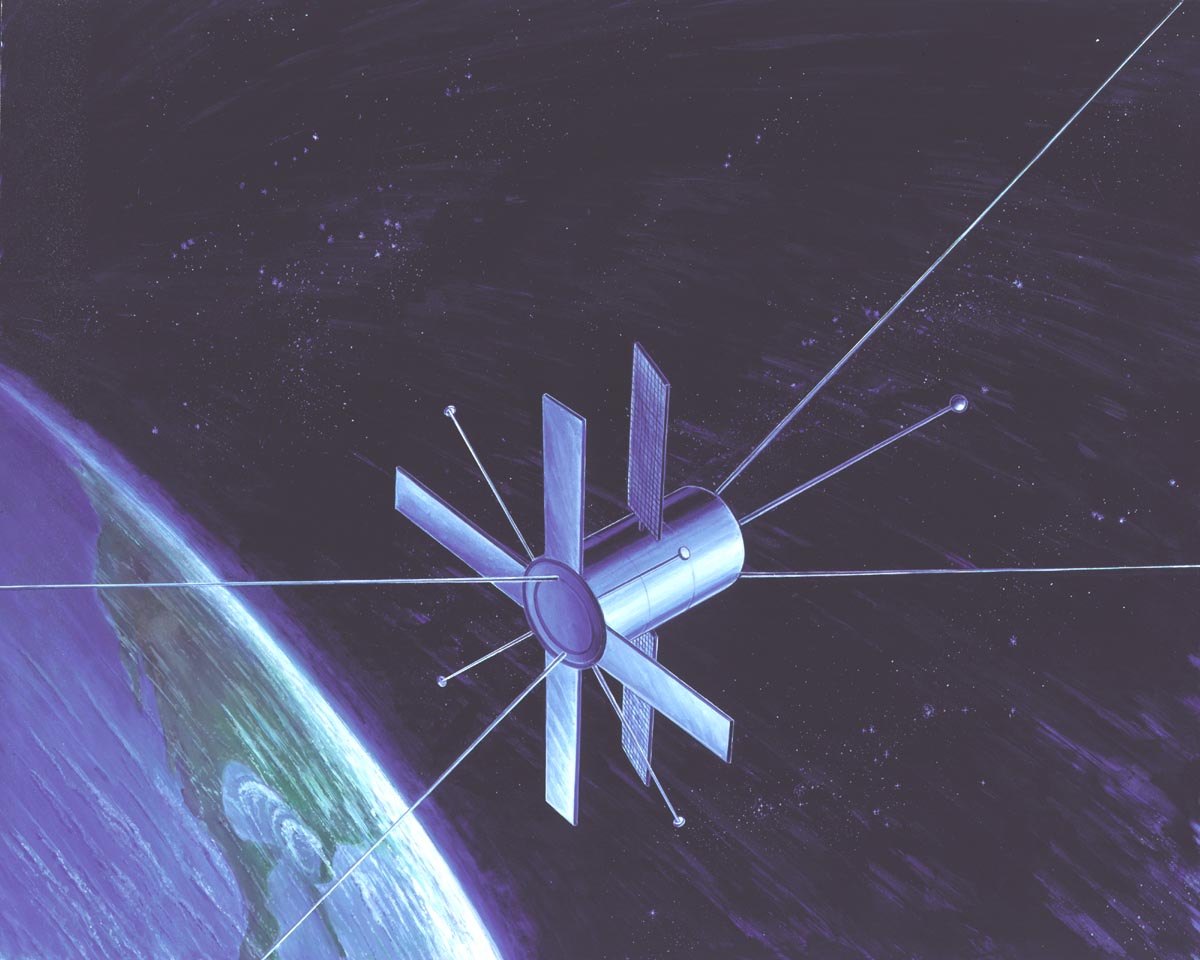
The same Tsiklon-3 launch left its third stage behind as 1985-113B, catalogue number 16327: 1,600 kg, a plain cylinder 2.8 m long and 2.2 m across. GCAT's reference orbit for the stage, from March 1991, is 623 by 656 km. This morning that stage is at 597 by 623 km (GCAT).
Two objects, one launch, the same starting altitude, forty-one years ago. The satellite has fallen more than five hundred kilometres and has days left; a perigee of 125 km cannot be sustained, and the hour of the final plunge is not predictable to better than a few hours even the day before (NASA ODPO). The stage has lost about thirty kilometres in the same time and will outlast everyone reading this. Their masses differ by nine percent. What differs is area: one is a cylinder, the other is a cylinder with a thirteen-metre antenna span, and the thin gas at six hundred kilometres pulls on area, not on mass.
Where the junk is
The most crowded band is still 400 to 500 km with 10,150 objects, 9,966 of them payloads and only 184 debris; that shell largely cleans itself. The problem sits higher. The 800 to 900 km band holds 2,763 objects, 2,486 of them debris or rocket bodies, and the 700 to 800 km band holds 2,649 with 2,248 debris (GCAT). That is where Kosmos-1707's stage is going nowhere.
Why it matters
The catalog is only the part anyone can see. ESA's modelled population, updated on 31 July 2026, puts 68,450 objects larger than 10 cm and about 1.5 million between 1 and 10 cm in orbit, with more than 17,000 tonnes of material in total (ESA DISCOS). A centimetre-class fragment is neither tracked nor avoidable, and every one of them descends from an intact object left somewhere it does not come down from.
ClearOrbit's view
Today's pair is the clearest teaching case the catalog has offered this month, and it should change how disposal is argued. The natural clock is not set by altitude alone but by altitude and shape together, which makes a compact, dense upper stage the worst thing to leave high — and it is exactly what operators leave high. We would like launch providers to publish the projected lifetime of every stage they abandon above 600 km, computed from its actual area-to-mass ratio rather than a generic figure, at the time the launch is licensed. When that number comes out in centuries, as it will for most of them, that is the moment to argue about removal, not forty-one years later.
Reader mail
Have a better idea?Spotted something we got wrong?
We publish in public so the numbers can be checked. If a figure looks wrong, a source is missing, or you know something this piece should have said, send it over. One box, no sign-up.
Send an idea or correctionQuick question
Who should pay for cleaning up orbit?
Anonymous. You will see how others answered after you vote.