Daily briefing · · 3 min read
Orbit on 20 October 2026: 139 objects dip below 250 kilometres twice a day and are not coming down
Our decay queue counts 64 objects below 250 km. Widen it to elliptical orbits and another 139 graze the atmosphere daily without falling.
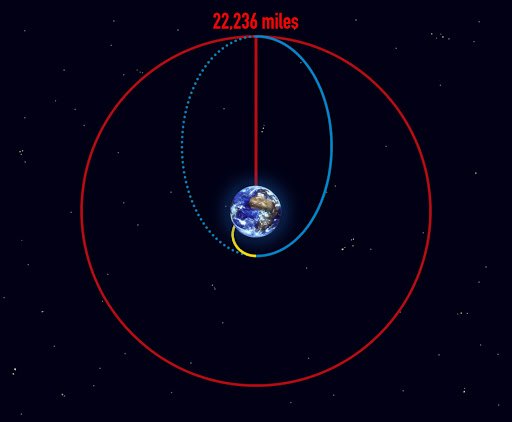
An object whose perigee has fallen below 250 kilometres is usually weeks from the end. That assumption is built into the decay queue on our statistics page, which holds 64 objects this morning and excludes anything on a stretched orbit. Apply the same test to the whole catalog and another 139 qualify — almost none of them going anywhere GCAT. The catalog itself did not move overnight: 33,759 objects on orbit, 19,681 payloads, 102 decays in 30 days and eight in seven, down from twelve yesterday GCAT.
They are the leftovers of geostationary transfer: 97 rocket bodies, 29 pieces of mission hardware such as adapters and dispensers, nine payloads and four fragments, with apogees from 2,000 kilometres to 47,153 and a median of 20,876 GCAT. Fifty come below 200 kilometres. The deepest diver is a Sea Launch Blok DM-SL stage from 19 March 2008, passing 120 kilometres at perigee and 6,693 at apogee.
Why they stay
Drag depends on the air an object actually spends time in, and an ellipse spends almost all of its time near apogee. A satellite circling at 200 kilometres is continuously in the atmosphere; a transfer stage touches it for minutes out of a six-hour circuit, then climbs back out of reach.

Twenty-five were launched before 2000 and twelve before 1990, which is the measure of how slow this is. Nor are they quietly parked: taking the orbital periods GCAT records for each, together they make roughly 1,284 passes a day through the 400-to-500-kilometre shell, the most crowded band in low orbit at 10,375 catalogued objects, 10,193 of them working payloads GCAT.
Close approach of the day
There is not one. Our screening still carries the CelesTrak SOCRATES Plus file of 8 October 2026: requests from this site's data host have been refused since 9 October and access is not yet restored CelesTrak SOCRATES Plus. That screening found 7,834 pairs inside one kilometre and 111 inside 100 metres across 174,512 conjunctions — figures that describe 8 October and nothing since. The close-approach pages say so on their face.
Object of the day: debris from Transtage 8
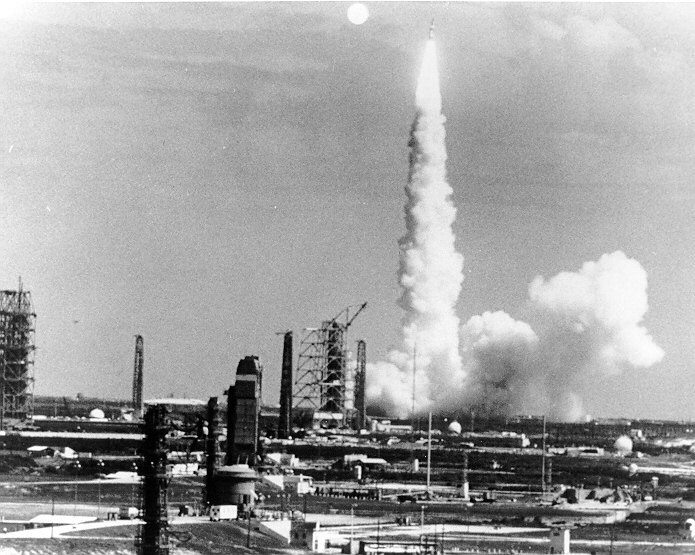
The oldest of them is fragment 36983, from 1965-108A — the Titan IIIC Transtage that carried OV2-3, LES-3, LES-4 and OSCAR 4 to transfer orbit on 21 December 1965. NASA's Orbital Debris Program Office assesses that the 2,555-kilogram stage fragmented on the day it launched, from a propulsion cause, and notes pieces still entering the catalog 49 years after the event NASA ODPO. GCAT lists 107 of its fragments still in Earth orbit, 99 with current elements, every one above 2,000 kilometres at apogee. The parent stage sits at 322 by 20,413 kilometres; fragment 36983 is at 197 by 10,008, brushing the atmosphere for 61 years now. ESA counts more than 660 fragmentation events since 1957 and models 68,450 objects larger than 10 centimetres in orbit ESA Space Environment Statistics. The 1965 event is the oldest still visibly feeding that total.
ClearOrbit's view
A policy built on perigee alone mistakes these objects for solved problems. The honest measure is not how low something goes but how long it keeps going there. By that measure a spent transfer stage at 190 by 16,000 kilometres is a worse neighbour than a dead satellite at 200 by 210: it crosses more occupied altitudes, for decades, and never appears in a reentry forecast.
So a perigee-lowering burn on an upper stage is the cheapest removal anyone can buy, and it has to happen at separation. A stage dropped to a 150-kilometre perigee with no apogee left is gone in weeks; the same stage abandoned on its ellipse is a 1,284-passes-a-day problem for whoever is flying in 2060. We have flown nothing and claim nothing flown. But this arithmetic belongs to every operator that has left a stage up there, and it is far cheaper to answer at the drawing board than with a spacecraft sent to chase it.
Reader mail
Have a better idea?Spotted something we got wrong?
We publish in public so the numbers can be checked. If a figure looks wrong, a source is missing, or you know something this piece should have said, send it over. One box, no sign-up.
Send an idea or correctionQuick question
Who should pay for cleaning up orbit?
Anonymous. You will see how others answered after you vote.