How it works · · 5 min read
How to Deorbit a Satellite at the End of Its Life
The cheapest debris to remove is the debris never left behind. Here is the end-of-life playbook: passivation, the 25-year and 5-year rules, controlled versus uncontrolled re-entry, and what reaches the ground.
The problem class: every working satellite is future debris
About 16,000 satellites were working in orbit as of July 2026 ESA DISCOS. Every one of them will die. Whether each becomes a hazard for centuries or disappears within a few years depends on what its operator planned before launch and does in its final weeks.
This is mitigation rather than removal, and it is the most cost-effective lever available. First-of-a-kind removal contracts run to tens of millions per object, such as ESA's €86M ClearSpace-1 contract for a single small satellite Wikipedia. Getting a satellite out of orbit while it still works costs a little propellant and some discipline.
Step 1: Passivation, removing the stored energy
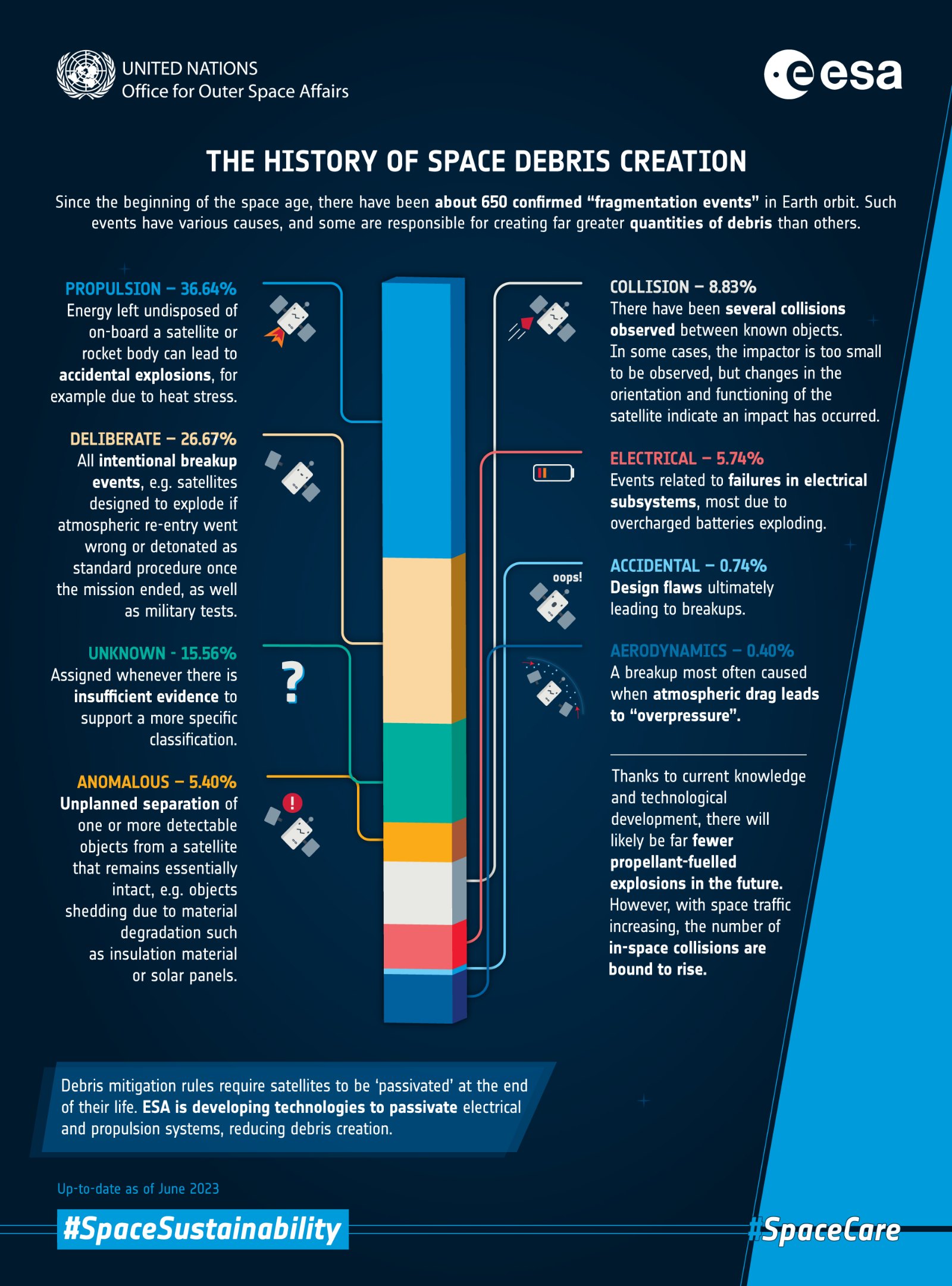
A dead satellite that explodes is far worse than one that simply drifts. Batteries, pressurised tanks and leftover propellant can rupture years after a mission ends. More than 660 fragmentation events have been recorded since 1957 ESA DISCOS, and ESA reports an average of 9.8 non-deliberate fragmentations a year over the last two decades ESA Space Environment Report 2026.
Passivation means draining that energy at the end of life, typically by venting leftover propellant and pressurant and making batteries safe. International guidelines call for passivation at end of life IADC Guidelines Rev 4.
Step 2: Get out of the protected regions
The IADC guidelines define two protected regions: low Earth orbit from the surface up to 2,000 km, and geostationary orbit within ±200 km in altitude and ±15° in latitude IADC Guidelines Rev 4. Satellites in low orbit are lowered so the atmosphere can finish the job. Satellites in geostationary orbit are usually boosted higher into a graveyard orbit, as happened when Northrop Grumman's MEV-1 servicer (Flown) left Intelsat 901 there in 2025 Northrop Grumman.
The rules: 25 years versus 5 years
The 25-year rule. For decades the international benchmark, set out by the IADC and ISO, has been that a satellite's post-mission lifetime in LEO should be "as short as practicable and no more than a maximum of 25 years", with at least a 90% probability of successful disposal and a goal of 99% IADC Guidelines Rev 4.
The 5-year rule. In September 2022 the US FCC adopted a rule requiring satellites it licenses, or that access the US market, to dispose of LEO satellites "within 5 years of completing their missions", replacing what it called a "long-standing guideline" of 25 years FCC. A two-year transition meant it applied from late 2024 FCC 22-74. ESA's Zero Debris approach also sets a residual LEO lifetime under 5 years ESA. Whether the FCC's July 2026 licensing overhaul left the 5-year rule unchanged has not been confirmed from primary text.
Why does five years matter? Natural decay gives a clue. A circular orbit at 500 km lasts roughly 10 years on average; at 700 km roughly 100 Space Academy. Above about 500 km, meeting a 5-year limit therefore often requires an active burn or a deorbit device.
Compliance is the weak point. Over the last decade, only 5-35% of payloads and 30-80% of rocket bodies complied with the 5-year standard ESA Space Environment Report 2026. Rules for rocket stages remain uneven: in January 2026 the FAA withdrew its proposed rule requiring commercial upper stages to leave orbit within 25 years Federal Register.
Controlled versus uncontrolled re-entry
Uncontrolled re-entry lets drag decide. It is fine for small satellites designed to burn up, but nobody can say precisely where the object will fall. Even a day before re-entry, the predicted time is uncertain by at least ±2 hours Bureau of Meteorology, and at orbital speed that uncertainty spans a large stretch of the globe. The Aerospace Corporation's re-entry predictions carry windows from ±1 hour to ±44 hours Aerospace CORDS.
Controlled re-entry uses a final engine burn to bring the object down over a chosen area, usually a remote ocean. It needs propellant and a working spacecraft at the end. The trend is encouraging: controlled re-entries of rocket bodies rose "from 10% to over 65% over the last decade", and outnumbered uncontrolled ones for the second year running ESA.
What reaches the ground
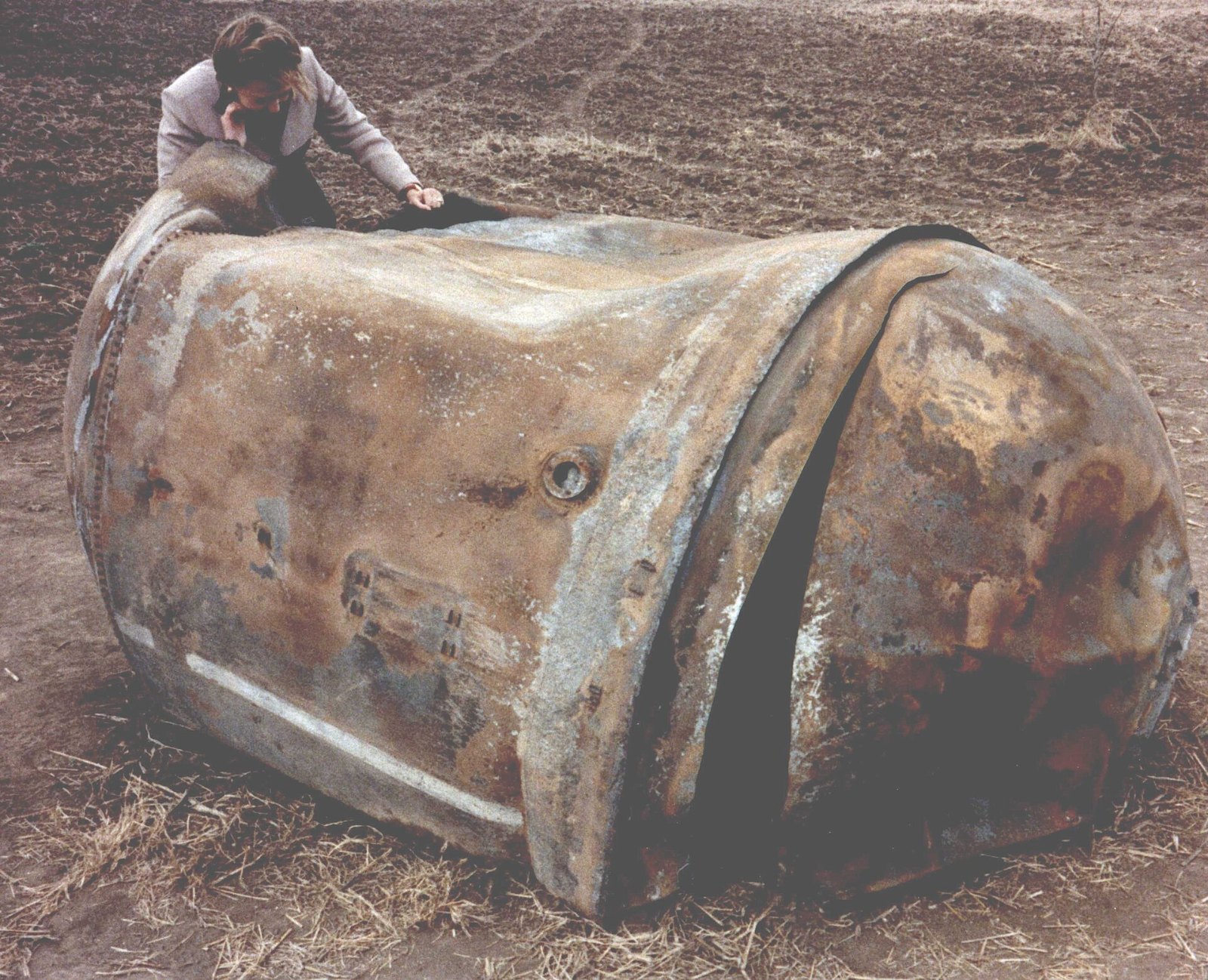
Re-entering spacecraft usually break up at 84-72 km altitude. Most material burns up, but titanium and stainless-steel parts are the most likely to survive to the ground NASA ODPO. The volume is large: about 1,200 intact objects re-entered in 2025 ESA Space Environment Report 2026. That is why large objects should come down under control, and why "design for demise", choosing materials that burn up completely, matters for small ones.
Honest failure modes
- The satellite dies first. A satellite that fails unexpectedly cannot passivate or deorbit itself.
- Propellant reserved, then spent. Operators face pressure to use disposal fuel to extend revenue-earning missions.
- Uneven rules. Different countries and vehicle types face different requirements.
- Breakups despite planning. Starlink 35956 vented its propulsion tank in an anomaly in December 2025 and released a small number of trackable objects Space.com.
ClearOrbit's view
End-of-life disposal is not glamorous, but it decides whether removal ever becomes affordable. Every satellite that leaves on time is one less target for a mission costing tens of millions. We think the 5-year standard should become the global baseline, applied equally to satellites and rocket stages.
The ClearOrbit vision goes further: disposal reliability that is measured and published, a capture interface on every LEO satellite as a backup for failures, and deorbit-as-a-service contracts, like the Planned $52.5M disposal service the US Space Development Agency bought from Starfish Space Breaking Defense, becoming routine.
Mitigation and removal belong together. Get the playbook right for everything launched from now on, and removal missions can concentrate on the legacy derelicts that no rule can fix.
Reader mail
Have a better idea?Spotted something we got wrong?
We publish in public so the numbers can be checked. If a figure looks wrong, a source is missing, or you know something this piece should have said, send it over. One box, no sign-up.
Send an idea or correctionQuick question
If you could fund one thing first to cut collision risk in low Earth orbit, what would it be?
Anonymous. You will see how others answered after you vote.
Sources
- IADC Space Debris Mitigation Guidelines Rev 4 (2025)
- FCC Second Report and Order, FCC 22-74
- FCC news release on the 5-year rule
- ESA's Zero Debris approach
- ESA Space Environment Report 2026 (article)
- ESA Space Environment Report 2026 (I10R1 PDF)
- NASA ODPO: Reentry
- Aerospace Corporation CORDS re-entry database
- Federal Register: FAA withdrawal of upper-stage rule (2026)
- ESA DISCOS statistics
- Northrop Grumman: first commercial undocking in GEO
- Australian Bureau of Meteorology: satellite orbital decay
- Space.com: Starlink satellite partial breakup
- Breaking Defense: SDA taps Starfish for satellite disposal
- Wikipedia: ClearSpace-1
- Space Academy: orbital lifetimes