How it works · · 5 min read
Nothing Falls From Geostationary Orbit: How a Satellite 36,000 Kilometres Up Is Retired
Of 117 geostationary satellites that reached end of life between 1997 and 2004, 39 reached a compliant graveyard orbit, 41 were re-orbited too low and 37 were simply switched off.
Everything we write about low orbit rests on a quiet assumption: that the air eventually settles the argument. A dead satellite at 400 kilometres is a problem with a deadline, and our reentry window explainer is about predicting when.
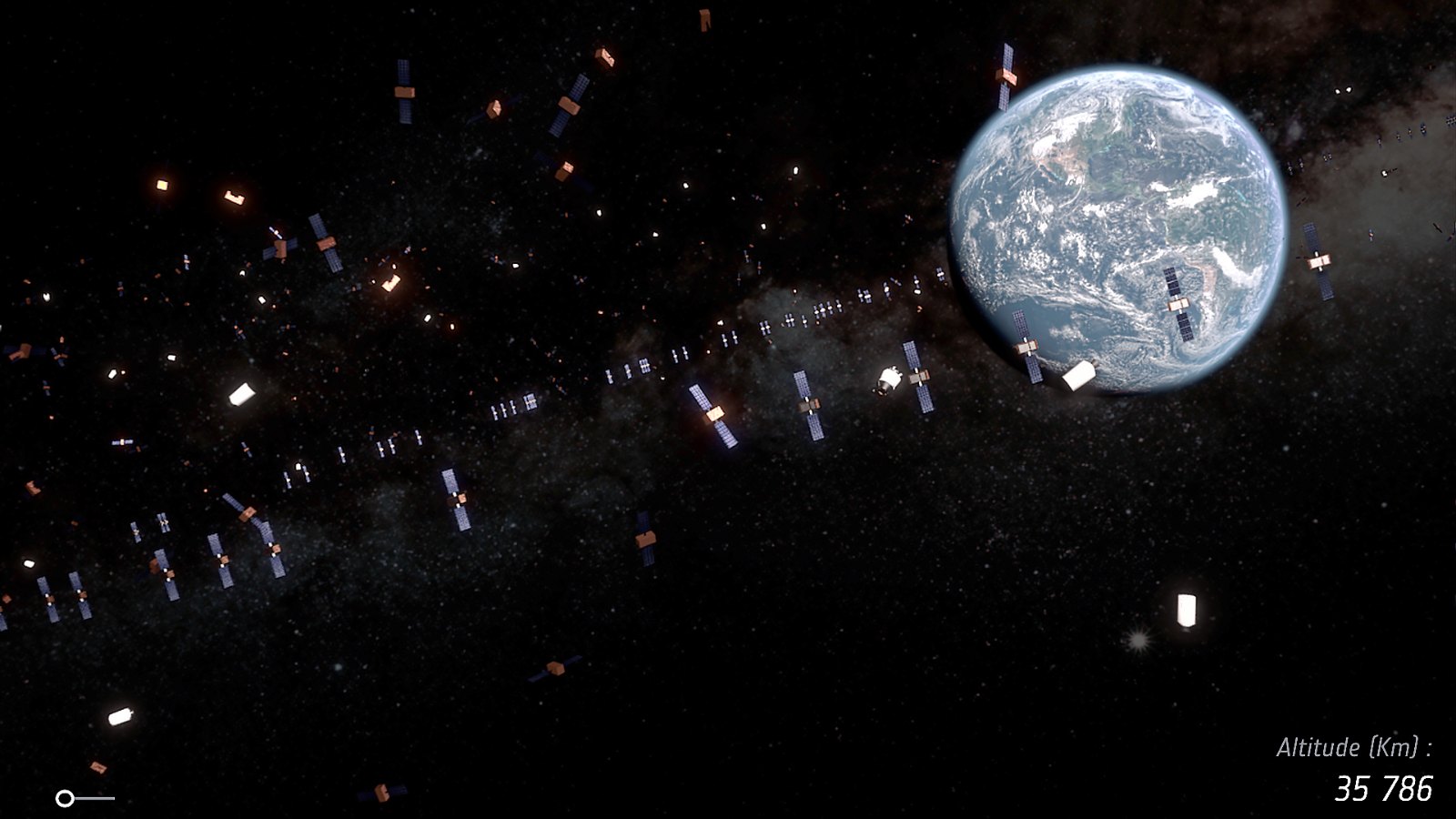
Geostationary orbit has no deadline. At 35,786 kilometres there is no meaningful atmosphere at all. As the ESA study that first surveyed this put it, "unlike in low Earth orbit there is no atmospheric drag which will remove abandoned objects over time" (Jehn et al., ESA SP-587). Whatever is left there stays, which means retirement at geostationary altitude is not a physical process. It is a decision somebody makes with the last of the propellant, and the record of that decision is the orbit.
The band you are supposed to leave
The thing a retiring satellite has to get out of is defined as a volume, not a line. The IADC protected region at geostationary altitude runs from 35,586 to 35,986 kilometres — about 200 kilometres either side of the ring — and extends 15 degrees north and south of the equator (ESA Annual Space Environment Report, Edition 10). The latitude allowance is there because uncontrolled objects do not stay on the equator: with nobody correcting it, an abandoned satellite's inclination drifts away from zero under the pull of the Sun and Moon, swinging it further above and below the ring every year.
So the disposal manoeuvre is a raise, and the standard asks for two things at once. The first is a minimum increase in perigee altitude of 235 kilometres plus a term of 1000 times the solar radiation pressure coefficient times the area-to-mass ratio; the second is "an eccentricity less than or equal to 0.003" (Walls et al., AMOS 2016). For a typical spacecraft that works out at roughly 250 to 300 kilometres above the ring.
Both halves matter, and the second is the one that gets missed. The area-to-mass term exists because sunlight pushes: a satellite with 25 metres of solar array and a tonne and a half of dry mass is shoved around hard enough that its orbit will not sit still. Solar radiation pressure pumps eccentricity up and down over a cycle the same study measures at eight to ten and a half years. Raise a satellite into a circular orbit above the band and it stays above it. Raise it into an eccentric one and the perigee comes back down into the neighbourhood every few years, which is why a single altitude number is not a sufficient test of a disposal orbit.
The burn is small; knowing you can afford it is not
The raise is not expensive by the standards of a geostationary mission. What makes it hard is that it has to be the last thing the satellite does, with propellant nobody can measure directly. There is no fuel gauge in a tank in free fall; the remaining mass is inferred from pressure, temperature and a bookkeeping record of every burn since launch, and the error bars are wide after fifteen years. Operators face a real trade: retire early with margin and throw away revenue-earning months on a working satellite, or retire late and risk discovering the margin was not there.
Both failure modes are in the record. Jehn and colleagues note that some operators "reserve only a minimum amount of propellant to free their own orbital slot," which produces satellites parked barely above the ring rather than clear of it. NASA's ACTS was moved to 105 degrees west in August 2000 only "after it was realised that the propellant reserves revealed a much lower amount than expected," then left in place until 2004.
Once the raise is done the satellite still has to be made safe, which is the same passivation problem a spent stage has: batteries disconnected, pressure vessels vented, momentum wheels stopped, transmitters silenced. We covered the mechanics of that in passivation. A derelict that explodes 300 kilometres above the ring showers the ring.
What happens when nobody does it
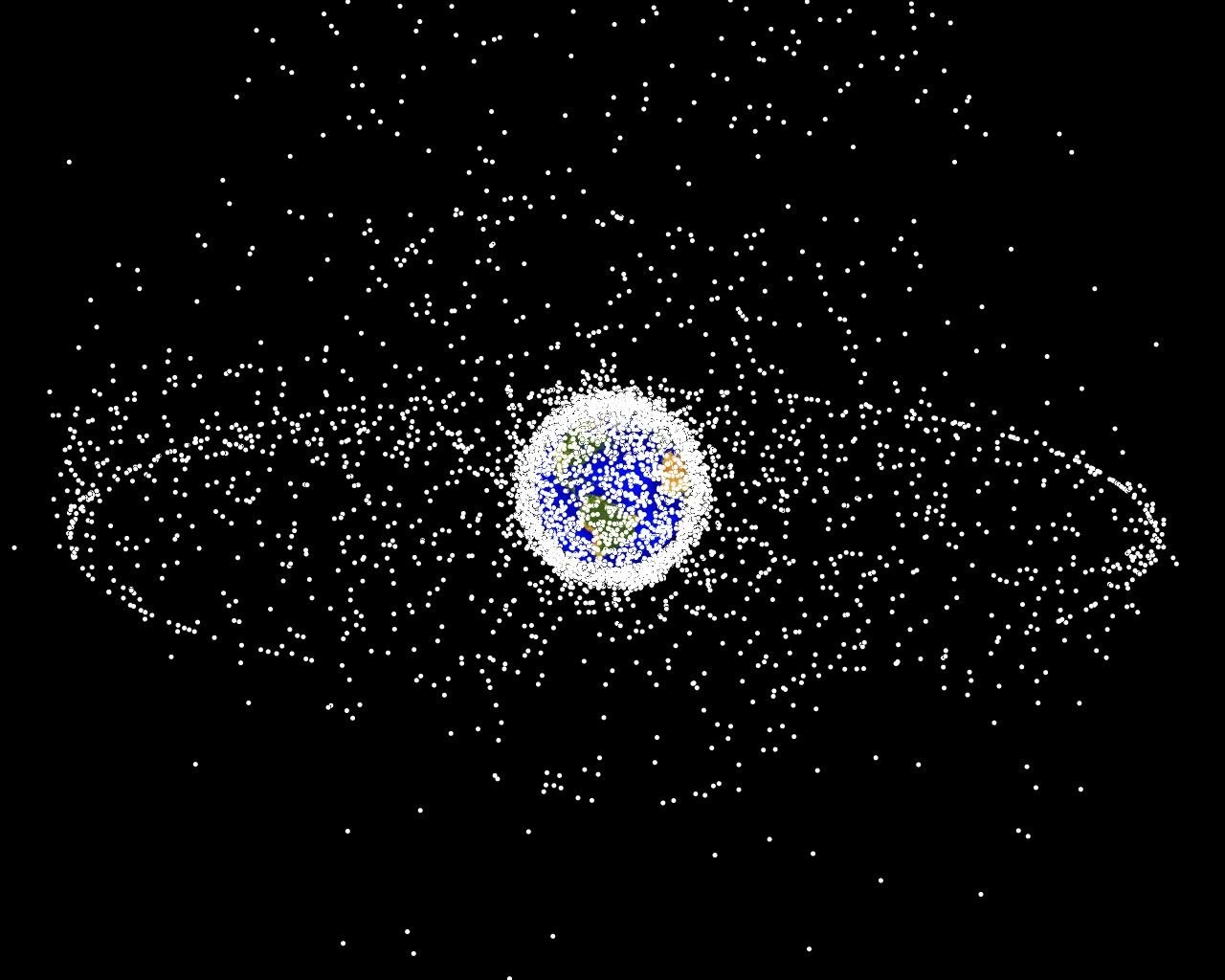
An abandoned geostationary satellite does not stay at its slot. The ring has two stable longitudes, near 75 degrees east and 105 degrees west, and anything left unattended drifts toward one of them and then librates back and forth through it for centuries. Derelicts pile up there. The 2005 survey counted 105 objects in a five-degree bin around 75 degrees east alone.
That survey is still the clearest picture of how often this is done properly. Of 117 spacecraft that reached end of life between 1997 and 2004: 39 reached a compliant graveyard orbit, 41 were re-orbited but left below the recommended altitude, and 37 were abandoned with no end-of-life manoeuvre at all — 24 of those librating around 75 degrees east, 11 around 105 degrees west. Seventy-eight of 117 stayed in or near the ring.
It has improved a great deal since. ESA's current assessment is that between 85 and 100 per cent of payloads reaching end of life in that region over the last decade attempt to comply, and between 70 and 90 per cent do so successfully. But the earlier cohort never goes away, and that is the point: ESA counts 939 catalogued objects in the geostationary region holding 2,876 tonnes, two per cent of the catalogue and sixteen per cent of all the mass humans have left in orbit (ESA DISCOS, 2 November 2026). Today's daily briefing looks at one of them, a 1998 satellite whose perigee clears the top of the band by 52 kilometres and whose eccentricity is nine times the recommended figure.
There is now a third option between working and abandoned. ESA's RISE, with D-Orbit as prime contractor, is Planned for launch in 2029: a servicer that docks with a geostationary satellite still good at its job but short of attitude and orbit control, and flies it. Removing a derelict from the ring outright remains Proposed — studied, unfunded, unflown.
ClearOrbit's view
The geostationary ring is the one regime where the clean-up argument has been won in principle and lost in practice. Everybody agrees nothing comes down on its own; the rule is written; and compliance is still a gradient, from 39 of 117 in the old cohort to perhaps nine in ten today. What is missing is not the norm but the consequence of missing it.
Two things would change that, and neither needs new hardware. A disposal orbit should be scored on where it will be in fifty years rather than on the altitude it reached the week the mission ended, which means publishing eccentricity and inclination drift alongside perigee for every retired satellite, so a near miss reads as a near miss. And propellant accounting should be a public number: an operator that cannot say how much margin it has cannot promise a compliant disposal, and the industry has treated that uncertainty as private for thirty years.
ClearOrbit has flown nothing and holds no contracts. Our ClearOrbit vision is a target list ranked by how much risk removing one object retires, and the geostationary derelicts argue for themselves on mass alone: 2,876 tonnes no atmosphere will ever collect, concentrated at two longitudes, in a band every operator of a working satellite has to share. A breakup there is the subject of one of our scenarios, and it is the one debris event that cannot be waited out.
Reader mail
Have a better idea?Spotted something we got wrong?
We publish in public so the numbers can be checked. If a figure looks wrong, a source is missing, or you know something this piece should have said, send it over. One box, no sign-up.
Send an idea or correctionQuick question
If you could fund one thing first to cut collision risk in low Earth orbit, what would it be?
Anonymous. You will see how others answered after you vote.
Sources
- Jehn, Agapov & Hernandez, End-of-Life Disposal of Geostationary Satellites (ESA SP-587, 2005)
- ESA Annual Space Environment Report, Edition 10
- Walls et al., Assessing the IADC Space Debris Mitigation Guidelines (AMOS 2016)
- ESA Space Environment Statistics (DISCOS)
- ESA, RISE: ESA's mission extender in geostationary orbit
- GCAT, J. McDowell