How it works · · 5 min read
Decayed, and Dated Afterwards: How the Catalog Decides a Satellite Has Come Down
Of 1,371 objects recorded as decayed so far in 2026, not one of the 253 debris fragments carries a time of day. The reason is a one-square-metre threshold written into how reentries are processed.
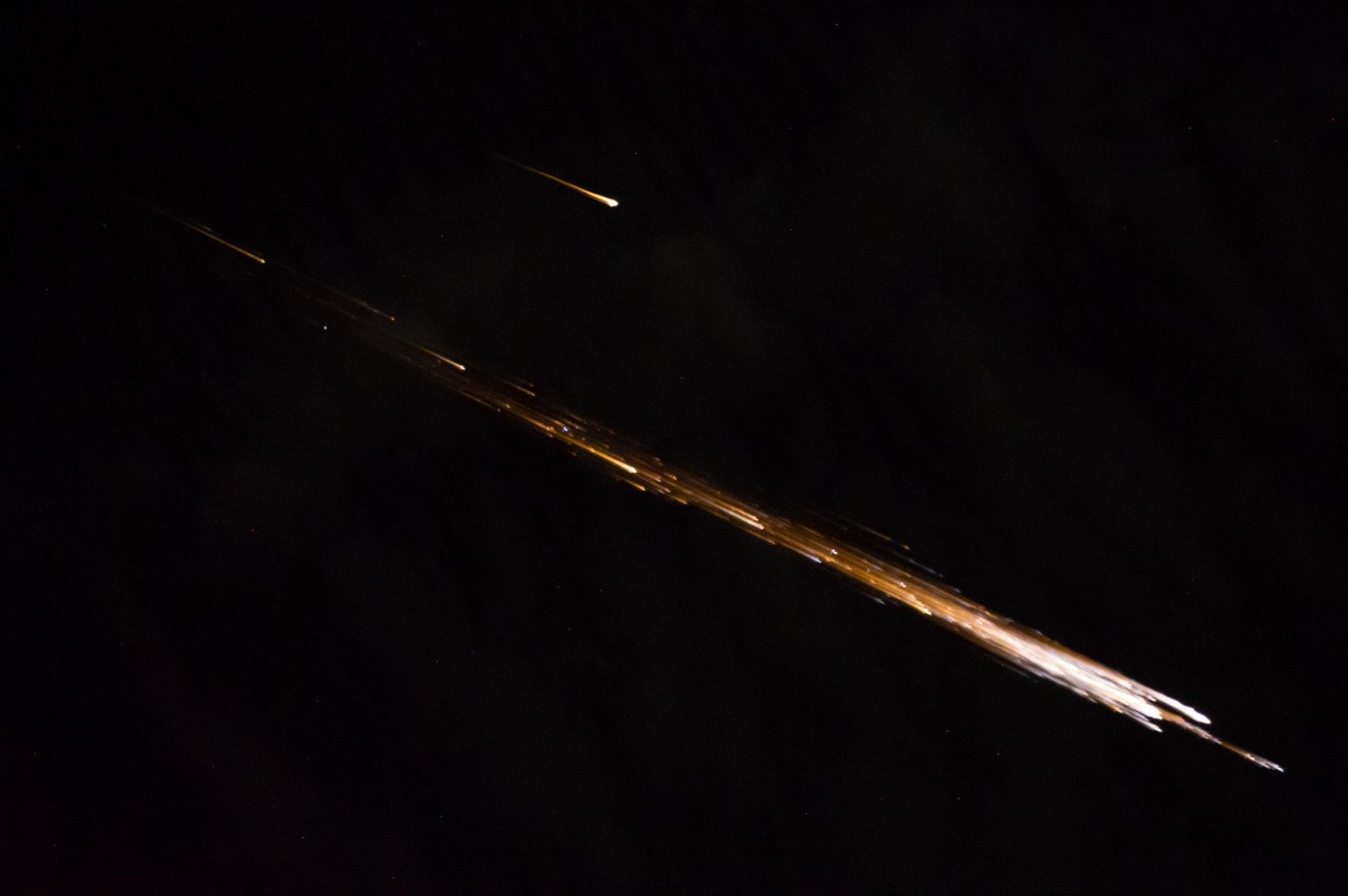
A satellite does not leave the catalog at the moment it burns. It leaves when somebody decides it has, and the date they write down is often less precise than the catalog's tidy columns make it look. This is the bookkeeping side of reentry, and it is worth understanding, because almost every strange thing a reader notices in our daily briefings — decays that appear back-dated by a week, objects still listed in the decay queue that have already come down — is this process showing through.
It is a different question from the one our explainer on reentry prediction windows answers. That piece is about predicting a reentry before it happens. This one is about ruling that it has happened, and fixing a time to it afterwards.
Nobody watches it happen
The first thing to accept is that reentries are almost never observed. An object in a decaying orbit is tracked by radar and optical sensors on each pass, each pass producing a position that feeds a new orbit solution. As the perigee drops into the denser atmosphere the orbit changes faster than the tracking can keep up: the drag acting on the object depends on its shape, its attitude and the density of air at 150 kilometres, and none of those three is known well. Eventually a pass is scheduled and the object is not where the prediction said it would be, then it is not found at all. The reentry is inferred from that absence, and from the last good orbit.

How well that inference can be pinned down is a known quantity. ESA's operational practice treats roughly 20 per cent of the remaining orbital lifetime as the state-of-the-art uncertainty on a reentry epoch at the time of prediction, falling to about 5 per cent under favourable conditions (Lemmens et al., ESA/ESOC). In the same work, automated predictions from ESA's FOCUS propagator alone produced errors spread from about minus 50 to plus 70 per cent of remaining lifetime, narrowing to roughly minus 20 to plus 30 per cent once a numerical integrator was used for the final leg. Twenty per cent of two days is most of a day. Twenty per cent of two hours is twenty-four minutes.
The one-square-metre threshold
The United States catalog produces two different products, and which one an object gets is decided by its size. Objects with a cross-section larger than one square metre are processed for reentry assessment and receive Tracking and Impact Prediction messages, generated once the object is within four days of predicted reentry, each giving a predicted latitude, longitude and decay epoch. Once the reentry is confirmed, a decay message follows. For objects smaller than one square metre, "only the decay confirmation is issued" (Space-Track briefing to UNOOSA). Space-Track holds over 14,000 of those prediction messages and more than 100,000 decay and reentry entries in total.
That threshold is visible in the public record, and it is sharper than you might expect. Take every object GCAT records as having decayed so far in 2026 — 1,371 of them — and sort them by how precisely the decay is dated. Of the 253 tracked debris fragments in that set, not one carries a time of day: every single entry is a bare calendar date. Among payloads, 378 of 824 are dated to the minute (GCAT). Rocket bodies sit in between, with 41 of 240 dated to the minute and 153 carrying an explicit uncertainty marker. A Starlink that was still being commanded when it entered the atmosphere gets a minute. A fragment of a 2022 breakup, tracked but never predicted, gets a day.
Reading a decay date honestly
GCAT is explicit about this rather than hiding it. Its date format is built around what it calls vague dates: "A Vague Date string defines a time range within which an event is believed to lie", with precision set by how many fields are written down, and an optional trailing question mark that widens the interval further (GCAT: Vague Dates). A decay logged as "2026 Oct 23 2300?" is not a claim about 23:00; it is a claim about a window around it. A decay logged as "2026 Oct 24" claims a day.
Two practical consequences follow. The first is that reentry dates get written into the catalog days after the event, because confirmation takes passes that do not find the object and then a human decision. An object can therefore sit in a published decay queue for several days after it has physically come down, which is exactly what we described in the 24 October briefing. The second is that a decay date and an orbit epoch are different kinds of fact, and mixing them produces nonsense; that distinction is the subject of how old a catalogued orbit is.
The honest version of a reentry record, then, is three things: a last good orbit with its own epoch, a confirmation that the object was not found after it, and a date whose precision is stated rather than implied. Where all three exist, a prediction can be checked. ESA's validation work treated reentries where the epoch uncertainty was reported as under ten minutes as effectively observed, and used those as ground truth (Lemmens et al., ESA/ESOC). There are not many of them.
The exception worth knowing about is a reentry somebody chooses, aims and watches. The first of the four spacecraft in ESA's Cluster mission came down that way in September 2024, after an orbit adjustment the previous January steered it to reenter far from populated areas, with any surviving fragments falling into open ocean (European Space Agency). That is Flown: a reentry recorded as it happened rather than reconstructed from an absence.
ClearOrbit's view
Removal will be judged on evidence, and the evidence for "this object is gone" is currently thinner than the catalog's presentation suggests. A debris fragment that leaves orbit with a bare calendar date attached cannot be used to validate anything: not a drag model, not a disposal design, not a removal mission's claim that it put something into a reentry corridor. The asymmetry is backwards from what the problem needs, because the small fragments are the ones whose behaviour we understand least.
We think the fix is cheap relative to its value. Publishing the last orbit solution alongside every decay entry, and stating the uncertainty on the epoch rather than leaving it to a trailing question mark, would turn tens of thousands of archived reentries into a dataset that drag models and disposal designs could be tested against. Operators can do part of this unilaterally: anyone who commands a spacecraft into the atmosphere knows the time to the second and could simply publish it.
ClearOrbit has flown nothing, and the first thing a removal mission of ours would owe the public is a verifiable end state for every object it touches — the time, the place and the orbit it was on when it was last seen. That is a commitment we can make now, before there is any hardware to make it about.
Reader mail
Have a better idea?Spotted something we got wrong?
We publish in public so the numbers can be checked. If a figure looks wrong, a source is missing, or you know something this piece should have said, send it over. One box, no sign-up.
Send an idea or correctionQuick question
If you could fund one thing first to cut collision risk in low Earth orbit, what would it be?
Anonymous. You will see how others answered after you vote.