How it works · · 5 min read
The Ion Beam Shepherd: Moving Debris Without Touching It
What if you could push a 9-tonne rocket stage down without ever grabbing it? The ion beam shepherd uses a thruster plume as a hose. Here is how it works and why it has never flown.
The problem class: the heaviest, most dangerous derelicts
If you rank the objects in low Earth orbit by how much damage they could do, one type dominates. In a 2021 study that merged top-50 lists from 11 international teams, the top 20 most concerning derelicts were all Zenit-2 second stages, known in Western catalogues as SL-16 rocket bodies. Each weighs about 9,000 kg, and most sit clustered at roughly 830-850 km altitude and 71 degrees inclination McKnight et al. (2021) PDF.
Those stages are a nightmare for contact-based removal. They are large, heavy, and their motion and structural condition after decades in orbit are uncertain. At around 800 km, natural decay "is often measured in centuries" NASA ODPO FAQ. Grabbing a possibly tumbling 9-tonne cylinder with a robotic arm means absorbing its momentum through the arm and servicer, with every contact risking damage.
The ion beam shepherd asks a different question: what if you never touch it at all?
The physics in plain language
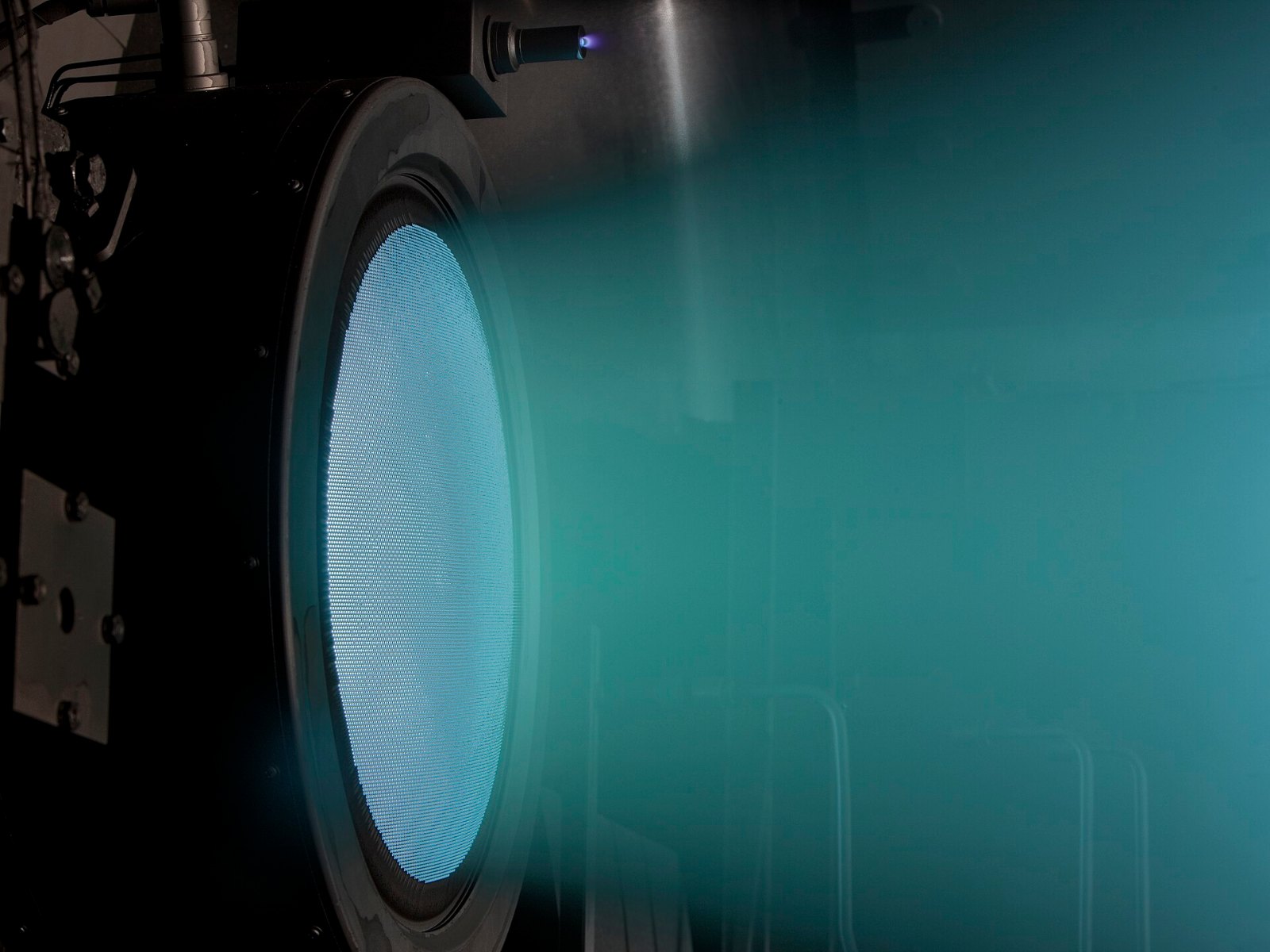
Electric propulsion engines, such as ion thrusters, work by accelerating charged particles to very high speed and firing them out as a beam. The beam pushes the spacecraft in the opposite direction. The thrust is gentle, but it can run for a very long time on little propellant.
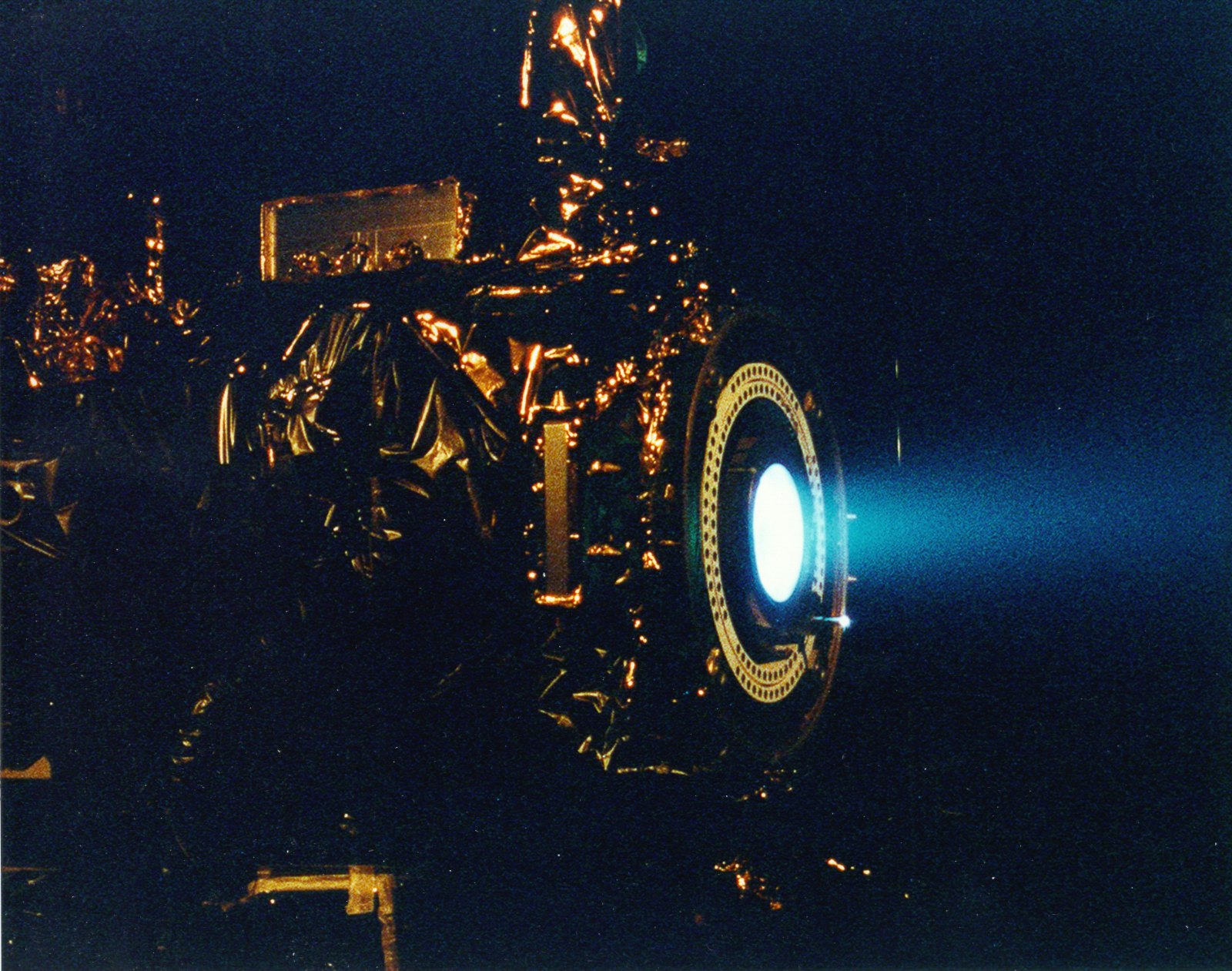
The shepherd concept turns that exhaust into a tool. A spacecraft flies alongside a piece of debris, a short distance away, and points one ion thruster directly at it. The fast-moving particles strike the debris and transfer momentum to it. Aimed against the direction of travel, that steady push slows the debris and gradually lowers its orbit.
There is a catch, and it is Newton's third law. Firing a beam at the target pushes the shepherd away in the opposite direction. To hold position, the shepherd fires a second thruster pointing the other way, balancing the reaction so it can keep station next to the debris LEOSWEEP. The result is a spacecraft hovering beside a derelict, gently hosing it downward over a long campaign, without any physical contact.
Why it is attractive for 9-tonne Zenit stages
Several features make the idea appealing for exactly those top-ranked objects.
- No contact means no capture risk. The shepherd does not need to find a strong grapple point, match a tumble perfectly, or survive a hard dock.
- Tumble matters less. A beam that hits a rotating cylinder still transfers momentum overall, whereas a mechanical grapple must meet a specific moving feature.
- Clustered targets. Because the top 20 stages share similar orbits McKnight et al. (2021), a long-lived electric-propulsion vehicle could, in principle, move from one to the next.
- The numbers that matter. NASA's orbital debris office found that removing about five objects per year, prioritised by mass and collision probability, could keep the LEO population roughly constant for 200 years, under the older assumptions of that study NASA ODPO. A reusable contactless tug is one way to reach that kind of cadence.
What has flown
Nothing. No ion beam shepherd has ever operated in orbit.
What is planned and proposed
Proposed: The concept was developed in detail through the EU FP7 LEOSWEEP project, with the Technical University of Madrid (UPM), Universidad Carlos III de Madrid (UC3M) and ESA's Advanced Concepts Team, and was also proposed separately by JAXA and CNES LEOSWEEP. Conference papers from the research team analyse the concept in more engineering detail UC3M. No mission to fly one is funded.
Honest failure modes
- Slow. Electric thrust is gentle. Moving a 9-tonne stage from about 840 km down to where drag can finish the job would take a long time, during which the shepherd must operate reliably at close range.
- Long close-formation flight. The shepherd must hold position near a possibly tumbling object continuously. A control failure could cause the very collision it exists to prevent.
- Beam spill and erosion. Part of the beam may miss the target, and ion impacts slowly erode surfaces. On old, fragile materials that could release small particles.
- Uncontrolled re-entry. Lowering an orbit gradually does not steer the final descent. For a 9-tonne stage, surviving parts could reach the ground, so a shepherd would need to lower the perigee enough to allow a more controlled end, or accept the ground risk.
- Power and lifetime. Two thrusters running for long periods need large power systems and long-life hardware.
- Dual use. Any vehicle able to move another object without consent raises security questions.
Cost and readiness
The ion beam shepherd sits at roughly TRL 3: studied and analysed, never flown. Electric thrusters themselves are mature, but using their beam as a contactless tug has not been tested in orbit. No public cost estimate for an operational mission exists.
ClearOrbit's view
The ion beam shepherd is one of the most intellectually attractive answers to the hardest problem in debris removal: the heavy, uncooperative Zenit-2 stages that dominate the 2021 composite risk ranking. We think it deserves more than paper studies, precisely because contact-based capture of 9-tonne objects remains so risky.
A sensible path starts small. A demonstrator could push a modest, well-characterised target, perhaps a spent stage or a purpose-launched test object, and measure how much momentum actually transfers. That single measurement would turn an elegant concept into an engineering number.
The ClearOrbit vision is a mixed fleet: contact capture for objects with good grapple points or docking plates, and contactless shepherds for the massive, tumbling stages clustered near 840 km. Those clusters are a known, finite target set. A removal technology designed around them could make a measurable difference to long-term risk.
Reader mail
Have a better idea?Spotted something we got wrong?
We publish in public so the numbers can be checked. If a figure looks wrong, a source is missing, or you know something this piece should have said, send it over. One box, no sign-up.
Send an idea or correctionQuick question
If you could fund one thing first to cut collision risk in low Earth orbit, what would it be?
Anonymous. You will see how others answered after you vote.