How it works · · 5 min read
Just-in-Time Collision Avoidance: Nudging Dead Objects Apart
Two dead objects cannot dodge each other. Just-in-time collision avoidance would move one of them hours before impact, using a puff of particles or a laser. Here is how, and why it pairs with removal.
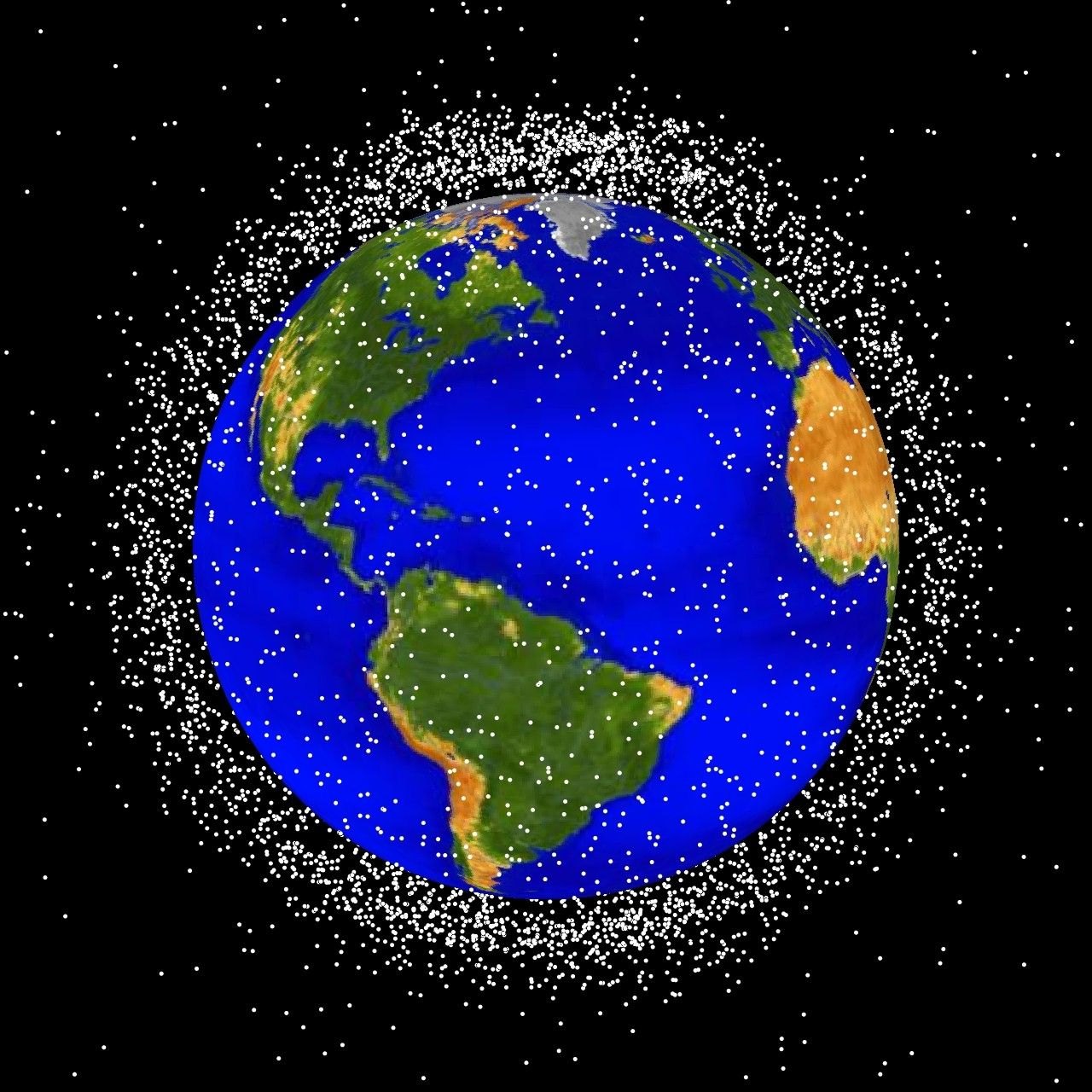
The problem class: collisions nobody can dodge
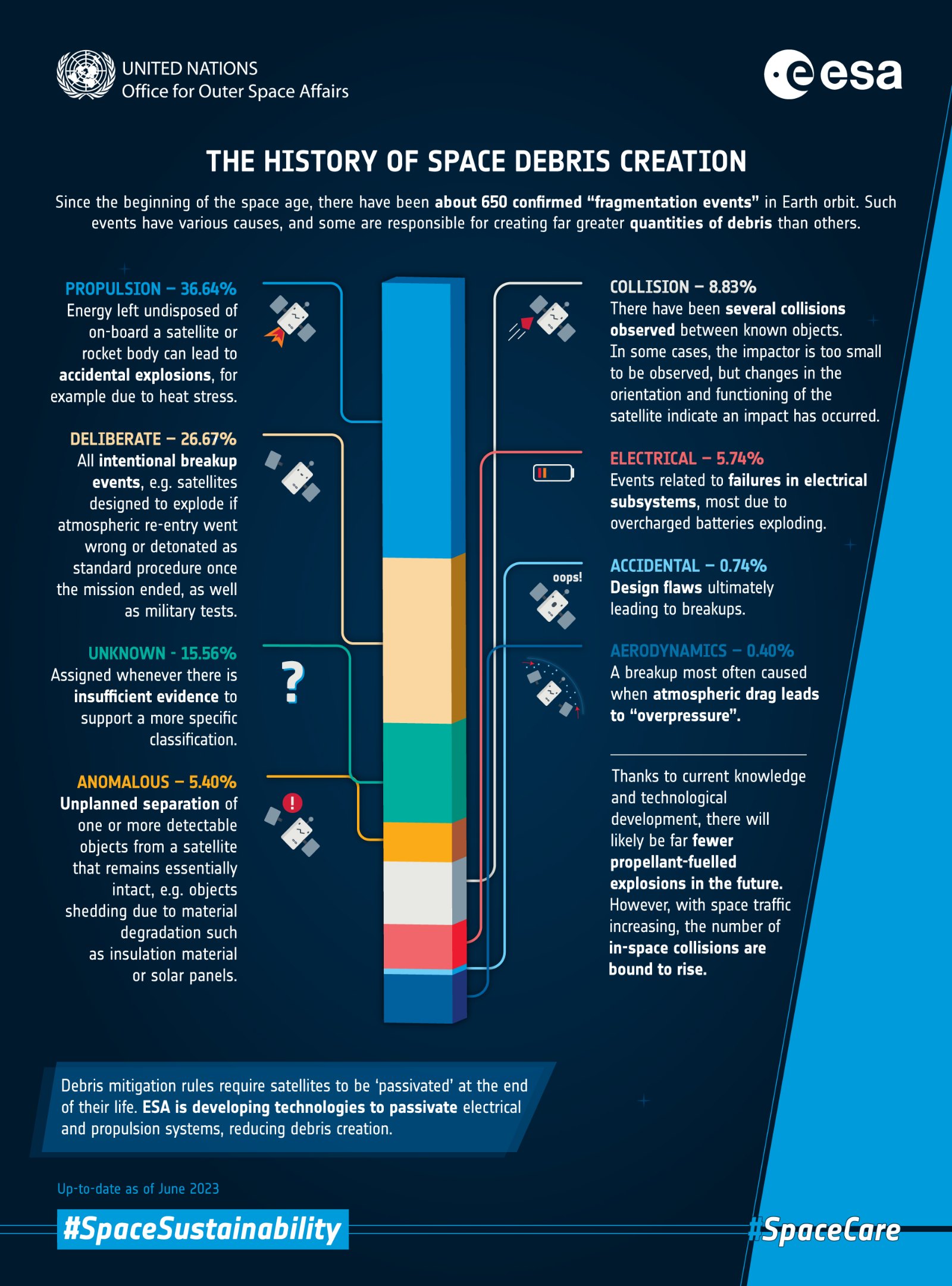
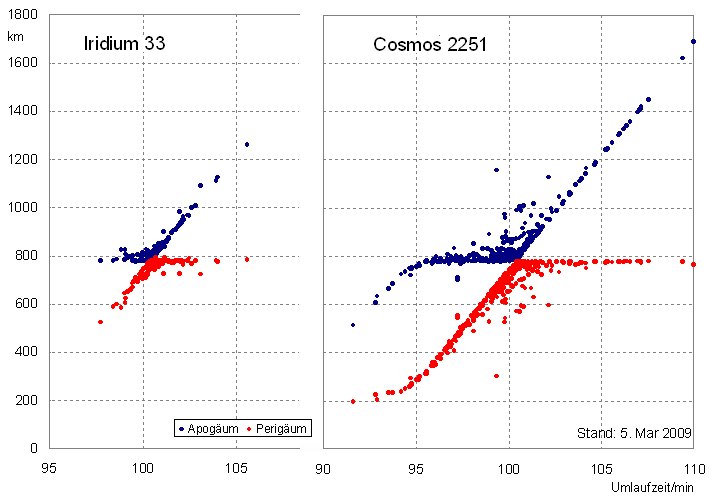
When a working satellite faces a close approach, its operator can fire thrusters and step aside. When both objects are dead, nobody can do anything. Even one derelict is enough to cause disaster. The first accidental collision between two intact satellites came on 10 February 2009, when the active Iridium 33 and the derelict Cosmos 2251 hit each other at more than 11 km/s at 790 km over Siberia, and 823 pieces had been catalogued by the end of March NASA ODQN.
Some of the most damaging possible collisions are derelict against derelict: two massive rocket stages in crowded shells. The objects ranked most concerning in a 2021 study include dozens of rocket stages weighing from about 1,435 kg to 9,000 kg McKnight et al. (2021). Removing them all will take decades. Just-in-time collision avoidance, or JCA, targets the gap: if you cannot remove an object yet, can you at least stop it hitting something on a specific day?
The physics in plain language
Collision predictions come from tracking data. Screening services compare orbits and flag close approaches in advance. CelesTrak's public SOCRATES Plus tool, for example, runs three times a day, looks seven days ahead, and reports every approach within 5 km CelesTrak SOCRATES. Most flagged approaches are misses. A small number are genuinely dangerous.
JCA works on one of those rare dangerous pairs. The key insight is that you do not need to move an object far. You need to change its speed by a minuscule amount a few hours before the predicted conjunction. In orbit, a tiny change in speed changes the object's timing along its path, and that timing error grows with every minute. Twelve hours later, the object is no longer where it would have been, and the two objects pass at a safe distance instead of colliding.
That is why "just in time" matters. Acting hours before, rather than months before, means you only act on the approaches that are still dangerous after tracking has improved. You spend effort on the few events that matter, not the many that were never going to happen.
Two ways to deliver the nudge
A sounding-rocket particle cloud. A concept from CNES and CT Ingénierie, presented in 2019, would launch a suborbital sounding rocket to release a cloud of fine particles in the path of one object. The object flies through the cloud and loses a tiny amount of speed. The study's example is striking: about 3 grams of particles, delivered 12 hours before a predicted collision, could shift a 1.4-tonne object by around 1 km Orbital Debris Conference paper. That mass is close to the roughly 1,435 kg Kosmos-3M second stages that appear in the 2021 ranking McKnight et al. (2021), though the example should not be read as a plan for any particular object. Because a sounding rocket is suborbital, the idea is that the particles do not linger as long-lived debris. The concept has been developed further in the peer-reviewed literature ScienceDirect.
A ground-based laser. Photon pressure from a powerful laser could deliver a similar small push without launching anything. Electro Optic Systems and the Space Environment Research Centre at Mount Stromlo announced a debris-manoeuvre laser capability in 2021 Space Connect, though no manoeuvre of a real debris object has been documented.
What has flown, what is planned
Proposed: Nothing has flown. No JCA nudge has been performed on a real object, and no funded mission to do so is known. The concept remains at roughly TRL 2-3.
Why it complements removal
NASA's 2023 cost-benefit study found that "the most effective remediation methods to reduce risks to operators are approaches for removing small debris and nudging large debris to avoid collisions", and that just-in-time nudging of large debris could produce net benefits "almost immediately". By comparison, controlled re-entry of large debris with a reusable servicer "might provide net benefits within three decades" NASA OTPS.
These are not rivals. Removal permanently eliminates an object and every future risk it carries. JCA eliminates one risk on one day and leaves the object in place. JCA is a fire extinguisher; removal is the building renovation. A sensible system uses both: nudge the rare dangerous conjunctions now, and remove the worst offenders as capacity grows.
Honest failure modes
- Prediction quality. JCA depends on knowing a collision is truly likely. Public screening based on general orbit data is much less accurate than the conjunction messages operators receive. A poor prediction could lead to nudging the wrong object, or nudging into a new close approach.
- Timing and geography. A sounding rocket must launch from the right place at the right moment. Weather or a launch scrub removes the option.
- Delivery accuracy. The particle cloud or laser must actually hit a fast-moving object.
- Governance. Moving another nation's object, even to prevent a collision, raises legal and political questions that have not been resolved.
- It is temporary. The object remains a hazard for every future encounter.
ClearOrbit's view
JCA is the cheapest-looking, fastest-paying idea in debris remediation, and almost nobody is funding it. We think that should change. The analysis from NASA points in the same direction: nudging large objects could deliver value almost immediately, while capturing and deorbiting large objects pays off over decades.
The next step is a real test. Choose a well-tracked inert object, announce the nudge in advance, deliver it, and publish precise before-and-after tracking. That would convert "a few grams could move a tonne" from a conference result into a demonstrated capability.
The ClearOrbit vision is a standing, internationally governed collision-response service: shared screening, clear rules on who may nudge what, and on-call laser or sounding-rocket assets, all working alongside a steady programme of removal missions for the objects that pose the greatest long-term risk.
Reader mail
Have a better idea?Spotted something we got wrong?
We publish in public so the numbers can be checked. If a figure looks wrong, a source is missing, or you know something this piece should have said, send it over. One box, no sign-up.
Send an idea or correctionQuick question
If you could fund one thing first to cut collision risk in low Earth orbit, what would it be?
Anonymous. You will see how others answered after you vote.
Sources
- Just-in-time collision avoidance, 1st International Orbital Debris Conference (2019)
- ScienceDirect: just-in-time collision avoidance paper
- NASA OTPS: Cost and Benefit Analysis of Orbital Debris Remediation (2023)
- NASA ODQN v13i2: Iridium 33 / Cosmos 2251 collision
- CelesTrak SOCRATES
- McKnight et al. (2021), open PDF
- Space Connect: EOS debris laser