Scenario · · 7 min read
Mission log: the first capture of a real rocket stage
A plausible day-by-day log of the first robotic capture and controlled reentry of a tumbling 3-tonne rocket stage, modelled on missions planned for 2027-2028.
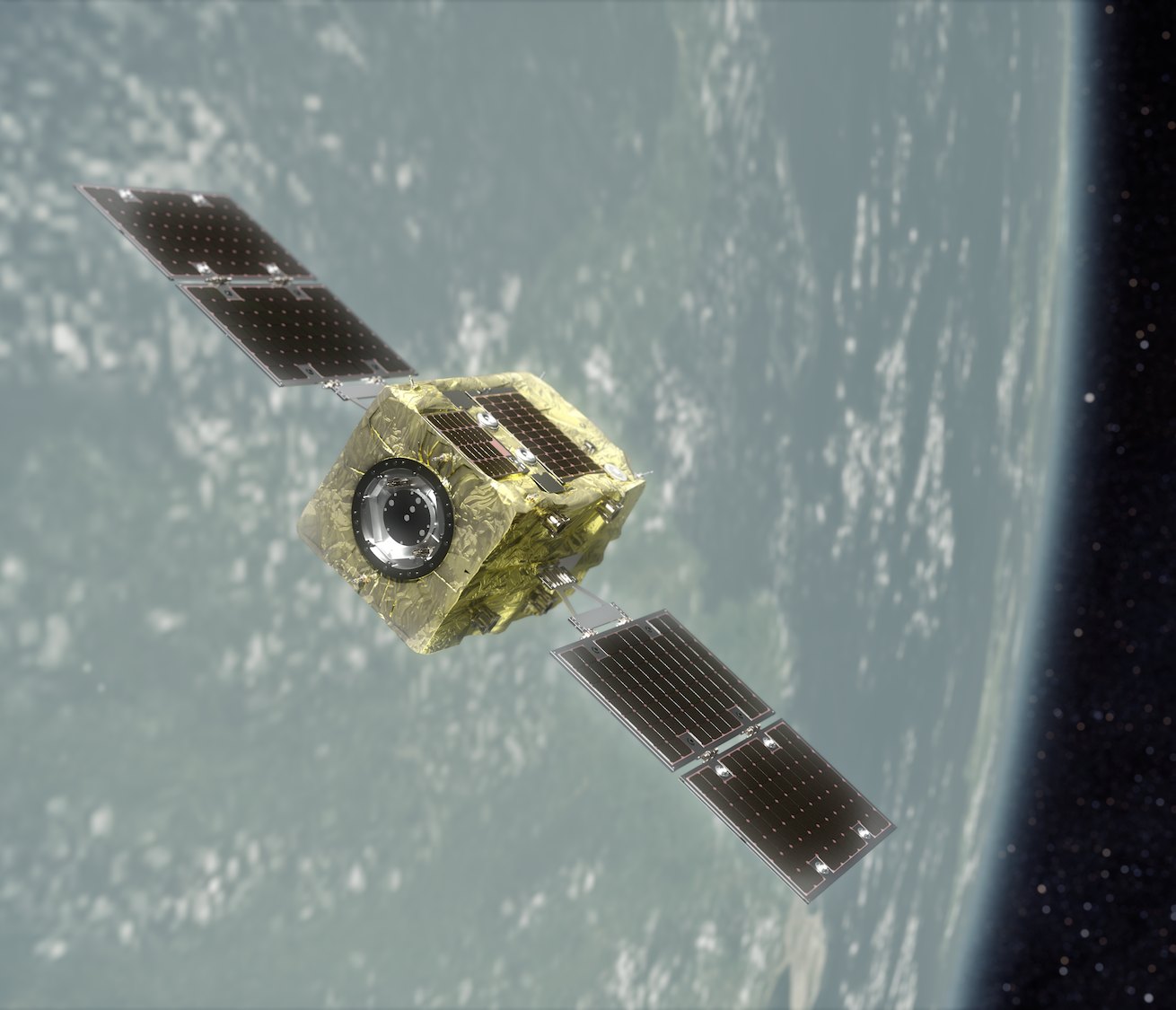
No spacecraft has ever grabbed a real, uncooperative piece of large debris and brought it down. As of September 2026, what has flown is inspection of real debris, capture of targets launched for the purpose, and docking with cooperative, working satellites. The first true captures are Planned for 2027-2028.
This log imagines how the first one could unfold. The target class and the broad mission design follow Astroscale's ADRAS-J2, contracted by JAXA for about ¥13.2 billion to capture and deorbit an H-IIA upper stage, with launch on Isar Aerospace's Spectrum in Japanese fiscal year 2027 Astroscale; Astroscale. ESA's ClearSpace-1, targeting PROBA-1 around 2028, informs the rest ClearSpace. The day numbers and specific events below are invented. In this scenario, the servicer is a generic arm-equipped spacecraft, not any company's actual flight plan.
The target
The stage is the kind ADRAS-J already visited: an H-IIA upper stage about 11 m long with a mass of about 3 tonnes Astroscale. ADRAS-J, launched in February 2024, approached a real stage to within 15 m and flew around it, then completed its own deorbit on 25 March 2026. That inspection is Flown Astroscale; JAXA.
The stage was never designed to be caught. It has no docking fixture, no reflectors and no lights. It is tumbling, and it cannot tell anyone which way.
Phase 1: launch and far approach
- Day 0. Launch. The servicer separates from the launcher and deploys solar arrays. Ground stations confirm health.
- Day 1-10. Commissioning. The team checks thrusters, navigation cameras, the robotic arm's joints and the capture end-effector. Nothing is pointed at the target yet.
- Day 11-40. Phasing. The servicer uses its thrusters to match the stage's orbital plane and close from thousands of kilometres behind. Navigation relies on ground tracking of the target, the same public-catalogue data any operator uses.
- Day 41. Onboard sensors pick up the stage for the first time. The servicer switches from ground-based to relative navigation.
What can go wrong here. The target itself can change. ClearSpace-1's original target, a VESPA payload adapter, was apparently struck by an untracked object in August 2023, creating new debris nearby ESA. The mission switched to PROBA-1 ClearSpace. A target that fragments before you arrive turns a removal into a cleanup.
Phase 2: inspection
- Day 42-55. The servicer holds at a safe distance of a few hundred metres, then steps closer. It images the stage from multiple angles to measure the tumble: which axis, how fast, and whether the rotation is steady.
- Day 56-70. Fly-arounds at tens of metres, repeating what ADRAS-J proved possible. The team confirms the grapple point, a structural feature such as the engine nozzle area or adapter ring, and checks for damage, loose insulation or unexpected fragments.
- Day 71. Go/no-go review for close approach. The team decides whether the tumble is slow and steady enough to match.
What can go wrong here. Hardware degrades. Astroscale's ELSA-d demonstrated magnetic capture with a prepared client in 2021, but an anomaly caused an autonomous capture attempt to be aborted, and the servicer lost four of its eight thrusters Astroscale. A servicer that loses redundancy during a long inspection phase may never be cleared to attempt capture at all.
Phase 3: synchronisation and capture
Robotic-arm capture of uncooperative debris is Planned; arms themselves are mature on space stations, but none has yet grabbed a tumbling derelict Astroscale.
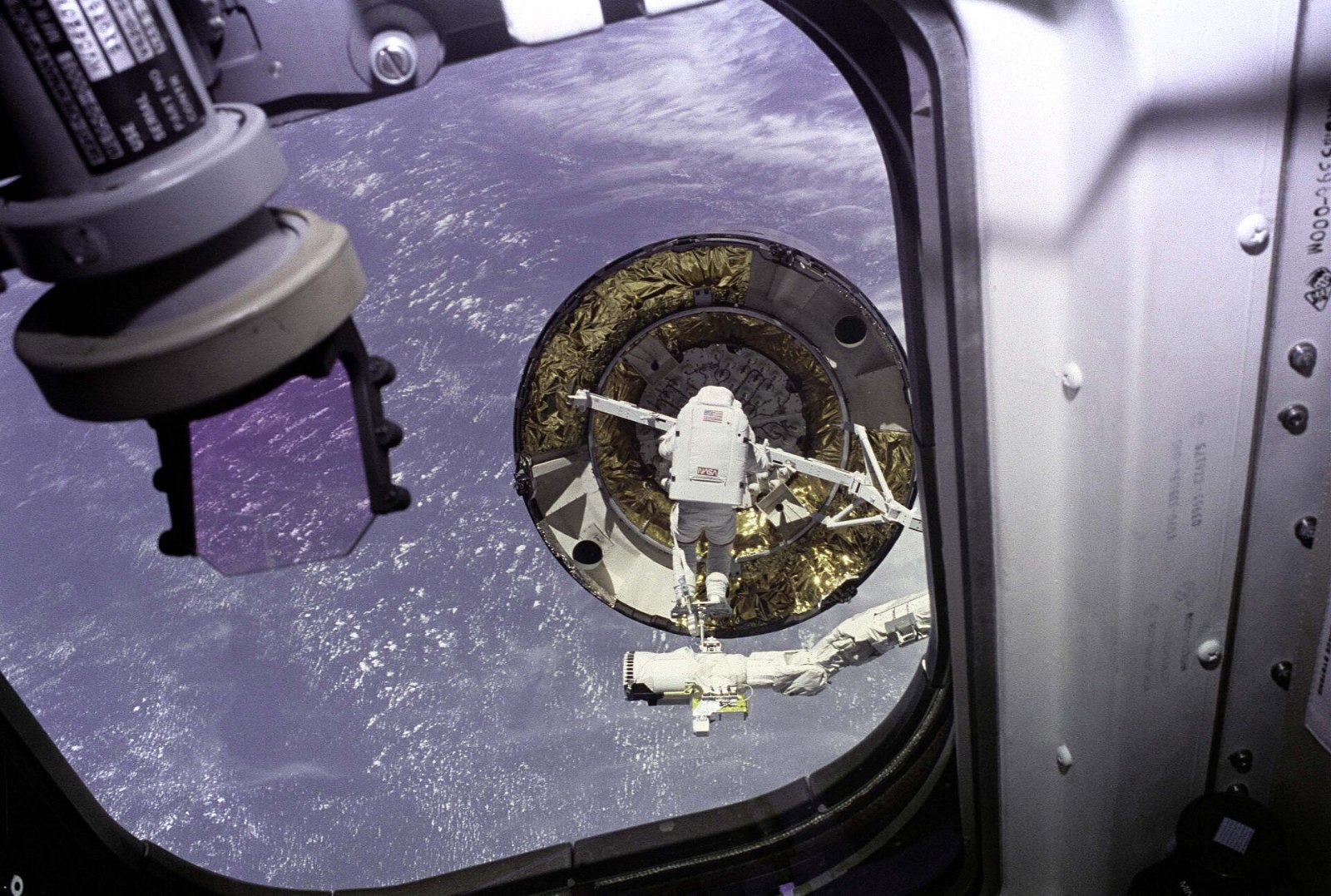
- Day 72. The servicer begins matching the stage's rotation, flying a slow circle so that, from its own point of view, the grapple point appears still.
- Day 73, 02:00 UTC. Final approach from 30 m to a few metres, fully autonomous, with the ground able to command an abort. Communication delays and short ground passes mean the spacecraft must make its own decisions in the last minutes.
- Day 73, 02:41. Arm extends. Contact. The end-effector closes on the grapple point.
- Day 73, 02:42 onward. The hardest minute of the mission. The combined spacecraft is now spinning, and the servicer must absorb the stage's momentum without breaking the arm, the grapple point or itself. Thrusters and reaction wheels bring the pair to a stop over the next hour.
- Day 73, 06:00. The stack is stable. Mission control declares capture.
What can go wrong here. The capture can create debris. A contact at the wrong speed can snap off an antenna or a piece of insulation, and a failed grab can push the target into a faster tumble. Earlier capture methods show both promise and risk: in 2018-2019, the Flown RemoveDEBRIS mission succeeded with a net and a harpoon against targets it carried itself, while its drag sail failed to deploy University of Surrey. Demonstrations against friendly targets do not guarantee success against a real one.
Phase 4: controlled reentry
- Day 74-90. The stack lowers its perigee in a series of burns, checking attitude control after each one. A 3-tonne stage attached to one side of the servicer shifts the centre of mass, so every burn is carefully planned.
- Day 91. Final deorbit burn, timed so the entry footprint falls over the remote South Pacific.
- Day 91, entry. The stack breaks up at roughly 84-72 km altitude, the usual range for re-entering spacecraft. Titanium and stainless-steel parts are the most likely to survive to the surface NASA ODPO, which is exactly why a controlled entry over empty ocean matters for an object this size.
What can go wrong here. If propulsion or attitude control fails after capture, the team faces a hard choice: release the stage, leaving it in a lower, faster-decaying orbit, or keep it and accept an uncontrolled reentry. Controlled reentry is already becoming the norm for new rocket bodies. ESA reports it rose "from 10% to over 65% over the last decade" ESA Space Environment Report 2026. The first removal mission will want to show that old stages can meet the same standard.
Why one capture matters so much
One 3-tonne stage removed does not change the debris environment. The objects in the most dangerous bands include twenty 9-tonne SL-16 stages at the top of one widely cited ranking McKnight et al., and a stage at around 800 km would otherwise stay up for centuries NASA ODPO FAQ. The first capture matters because it answers the question every funder asks: can this be done at all?
It also sets the cost curve. NASA's cost-benefit study found controlled reentry of large debris "might provide net benefits within three decades," with reusable servicers key to making the economics work NASA OTPS. A first mission that publishes what went wrong, as well as what went right, will do more to cut the price of the tenth removal than any single success.
ClearOrbit's view
We think the first real capture will be remembered the way the first commercial GEO docking is remembered: as the moment a service stopped being a concept. Whoever flies it, the whole field benefits, and we want it to succeed.
Our ClearOrbit vision is to make sure it is not a one-off. The step after a successful capture should be a second and third target contracted before the first mission has even finished. The servicer design should be reusable, and the target list should move from demonstration-friendly objects toward the massive derelicts that carry the most risk.
We also think the first missions should publish their anomalies openly. ELSA-d's lessons were valuable precisely because they were shared. The same habit, applied to the first capture, will make every mission after it cheaper and safer.
Reader mail
Have a better idea?Spotted something we got wrong?
We publish in public so the numbers can be checked. If a figure looks wrong, a source is missing, or you know something this piece should have said, send it over. One box, no sign-up.
Send an idea or correctionQuick question
If you could fund one thing first to cut collision risk in low Earth orbit, what would it be?
Anonymous. You will see how others answered after you vote.
Sources
- Astroscale: ADRAS-J completes operations
- JAXA press release on ADRAS-J (July 2024)
- Astroscale Japan secures contract for Phase II of JAXA's commercial removal
- Astroscale Japan selects Isar Aerospace to launch ADRAS-J2
- Astroscale: ADRAS-J2 mission page
- ClearSpace-1 mission changes
- ESA: Objects detected in the vicinity of ClearSpace-1 target
- Astroscale: ELSA-d finalizes de-orbit operations
- University of Surrey: RemoveDEBRIS
- NASA ODPO: Re-entry
- NASA ODPO FAQ
- McKnight et al., Identifying the 50 statistically-most-concerning derelict objects in LEO (open PDF)
- ESA Space Environment Report 2026
- NASA OTPS: Cost and Benefit Analysis of Orbital Debris Remediation (2023)