Scenario · · 6 min read
Nobody to call: a hypothetical derelict-on-derelict conjunction at 840 kilometres
In this scenario two dead satellites in the same sun-synchronous plane are screened at nine metres. Collision avoidance has worked for twenty years because somebody always had a thruster. Here nobody does.
In this scenario, nothing unusual happens. Two objects that have been in orbit for decades keep doing exactly what they have always done, a screening algorithm notices, and the warning goes out to an address that does not exist. The scenario is hypothetical. Everything it is built from is in today's catalog.
The setup
Pick a shell. Between 800 and 900 kilometres the catalog holds 2,754 objects: 2,501 fragments, spent stages and separated components, 144 dead payloads, and 109 satellites still listed as working (GCAT). Most of what flies there is in a sun-synchronous orbit near 98 degrees of inclination, because that is the geometry that keeps a camera or a radiometer crossing the equator at the same local time every day. Everybody who wants that geometry ends up in roughly the same plane at roughly the same height.
Two of the dead payloads in this scenario are a pair of retired polar-orbiting weather satellites, each about a tonne and a half, each in a near-circular orbit within a few kilometres of 840. Their planes differ by a fraction of a degree. That small difference means the two orbits intersect at two points, and the relative geometry at those points drifts slowly — weeks of nothing, then a run of encounters in the same part of the sky, then nothing again. Neither spacecraft has had a functioning attitude control system in years. Neither has propellant. Both are, as far as orbital dynamics is concerned, rocks that happen to be shaped like satellites.
Day minus seven: the screening
The warning arrives the way every warning arrives. The 18th and 19th Space Defense Squadrons screen the catalog against itself and publish conjunction data messages to Space-Track.org; operators who have registered an interest in a given object receive them automatically. In this scenario the message gives a time of closest approach seven days out, a predicted miss of nine metres, and a collision probability in the low hundredths.
For an active satellite, that is a routine morning. The sequence from warning to burn is Flown and well practised — ESA alone describes dodging debris as an ordinary part of flight operations, and we have walked through the decision chain in how a close-approach warning becomes a manoeuvre.
Here the chain stops at step one. The agency that flew the first satellite was reorganised twice and its successor has no mandate over hardware it stopped commanding in the 1990s. The second satellite's operator is a government office that still exists but has no spacecraft, no controllers and no budget line for one. Both objects are correctly catalogued and correctly screened. There is simply no one on the other end of the message who can do anything with it, and no mechanism that converts a derelict's warning into an action.
Day minus one: what the live satellites do
The 109 working satellites in the shell cannot move the derelicts, but they can get out of the way of what the derelicts might become. In this scenario a handful of operators with fuel to spare and a camera they can afford to keep closed raise or lower by a kilometre or two, which is enough to move them off the debris cloud's initial plane for a few days. The rest do the arithmetic, conclude that a one-in-ten-thousand event does not justify the propellant, and keep observing.
That is the honest shape of the response: there is no action available that reduces the probability of the collision itself. Every option on the table is about surviving the consequences.
Day zero, and the two outcomes
In the first outcome, the two objects miss. This is what happened in the real precedent. On the night of 29 January 2020 the defunct infrared observatory IRAS and the defunct US Navy experiment GGSE-4 were screened past each other at about 900 kilometres; the radar operator LeoLabs put the miss at between 13 and 87 metres, and neither satellite could manoeuvre, as reported at the time. They missed. Both are still in orbit today — IRAS at 876 by 904 kilometres, GGSE 4 at 894 by 906, on element sets dated 28 October 2026 (GCAT) — which is the part worth noticing. The encounter did not resolve. It was deferred, and it will come round again, and the same two objects will again have nobody to call.
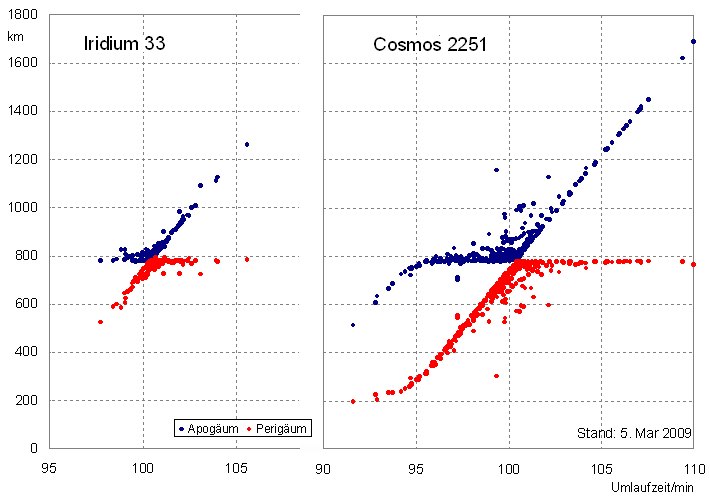
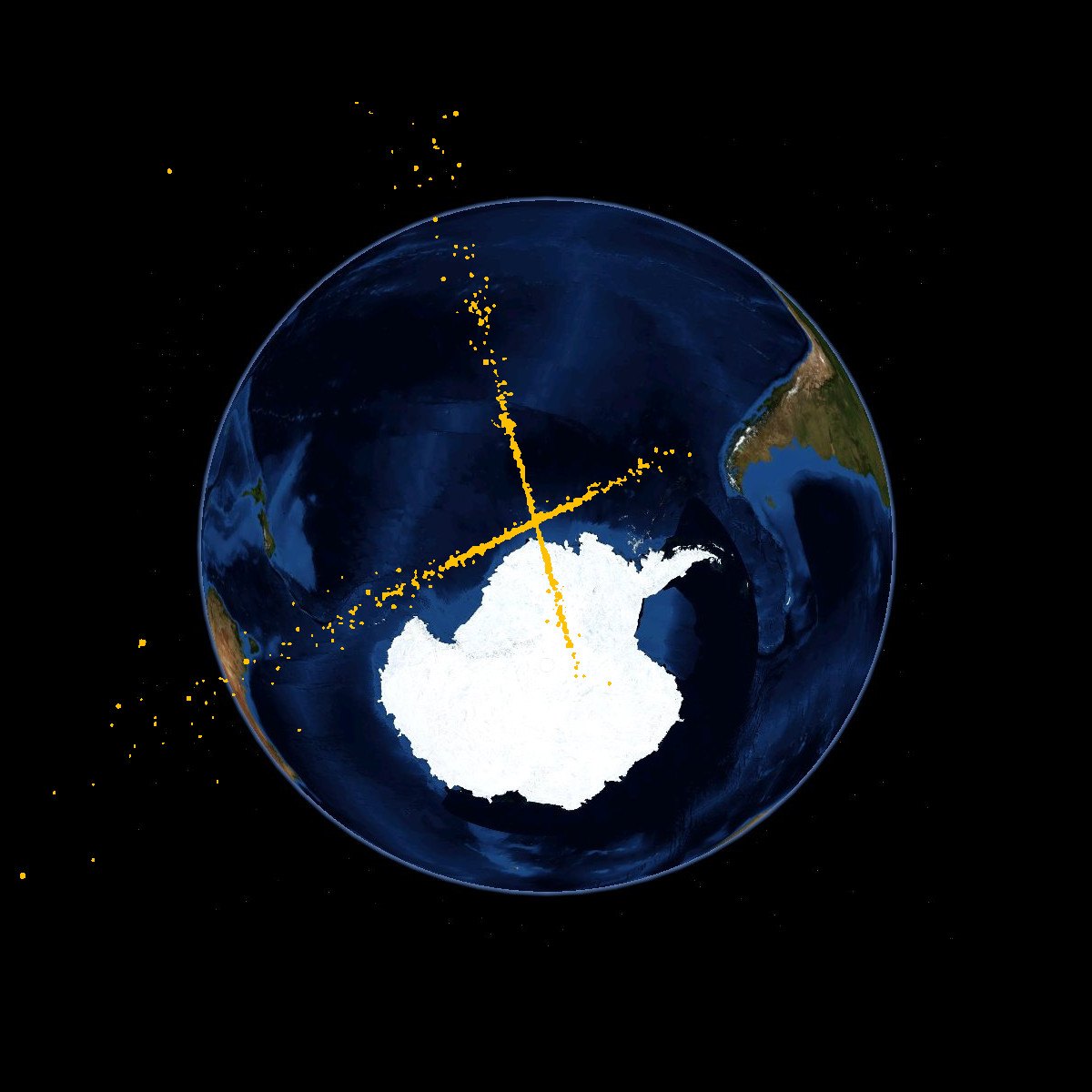
In the second outcome they hit, and the catalog has already measured what that costs. On 10 February 2009 Cosmos 2251 and Iridium 33 collided at about 780 kilometres — the first accidental collision of two large intact spacecraft. NASA catalogued 1,714 fragments from Cosmos 2251 and 657 from Iridium 33 (NASA HOOSF, 16th Edition). Seventeen years later GCAT still counts 606 Cosmos 2251 pieces in orbit at a mean altitude of 745 kilometres and 127 Iridium 33 pieces at 711 (GCAT). At 840 kilometres the air is thinner and the clearing is slower, so a comparable event in this scenario leaves a comparable cloud for longer. We have modelled what follows at an adjacent altitude in the 850-kilometre cascade.
Why this scenario is not the usual one
The familiar debris scenario is a breakup: something explodes or is struck, and the question is how the fragments spread. This one is a governance scenario, and its point is narrower. Collision avoidance as practised today is a service that works only where somebody owns a thruster. NASA's fragmentation record notes that roughly 34 per cent of payloads on orbit are no longer operational (NASA HOOSF, 16th Edition), and ESA's statistics describe the same population from the modelling side (ESA DISCOS). For that third of the population, the entire apparatus of screening, warning and manoeuvre produces information and nothing else.
The objects most likely to generate these unanswerable warnings are already named. McKnight and colleagues ranked the fifty statistically most concerning derelicts in low Earth orbit by mass, encounter rate and altitude, and the list is dominated by large abandoned stages and payloads clustered in exactly the bands this scenario uses (McKnight et al., 2021). Ours are tracked on the derelict watch, and the shell they sit in is the one you can read off the live catalog view.
ClearOrbit's view
A warning with no recipient is a design fault, not bad luck. The screening works; what is missing is anything on the other end of it. Two things would change that, and neither requires new physics.
The first is institutional. Every catalogued derelict above about 600 kilometres should have a named party of record — the launching state, by treaty, if nobody else will take it — whose job is to receive its conjunction messages and decide. Today, in most cases, the message is simply filed. A standing responsibility to answer is what turns a derelict from a fact of nature back into an object somebody is accountable for.
The second is a capability. If a warning reaches a party of record and the only available answer is still "nothing", the institutional fix is theatre. A small number of Proposed and Planned rendezvous missions could change that, and a nudge is far cheaper than a capture: shifting a derelict's orbit by a few hundred metres days in advance removes an encounter entirely, without ever grappling the thing. That is the ClearOrbit vision — not sweeping a shell, but being the number somebody can call when the object on the other side of the warning cannot move itself.
ClearOrbit has flown nothing and has no customers. What we are building is the target list, the ranking behind it, and the argument that a shell with 109 working satellites and 2,645 dead objects in it needs a responder before it needs a cleaner.
Reader mail
Have a better idea?Spotted something we got wrong?
We publish in public so the numbers can be checked. If a figure looks wrong, a source is missing, or you know something this piece should have said, send it over. One box, no sign-up.
Send an idea or correctionQuick question
If you could fund one thing first to cut collision risk in low Earth orbit, what would it be?
Anonymous. You will see how others answered after you vote.
Sources
- GCAT, J. McDowell
- GCAT derived current catalog
- NASA History of On-Orbit Satellite Fragmentations, 16th Edition
- ESA Space Environment Statistics
- McKnight et al. (2021), the 50 statistically most concerning derelict objects in LEO
- SpaceNews, Potential satellite collision shows need for active debris removal
- Space-Track.org