Scenario · · 6 min read
Sixty-eight years at 654 kilometres: a hypothetical first visit to the oldest rocket stage in orbit
In this scenario a spacecraft goes to object 16 in the catalog: 22 kilograms of 1958 rocket stage still circling at 654 by 4,211 kilometres, and the oldest hardware humanity has left in orbit.
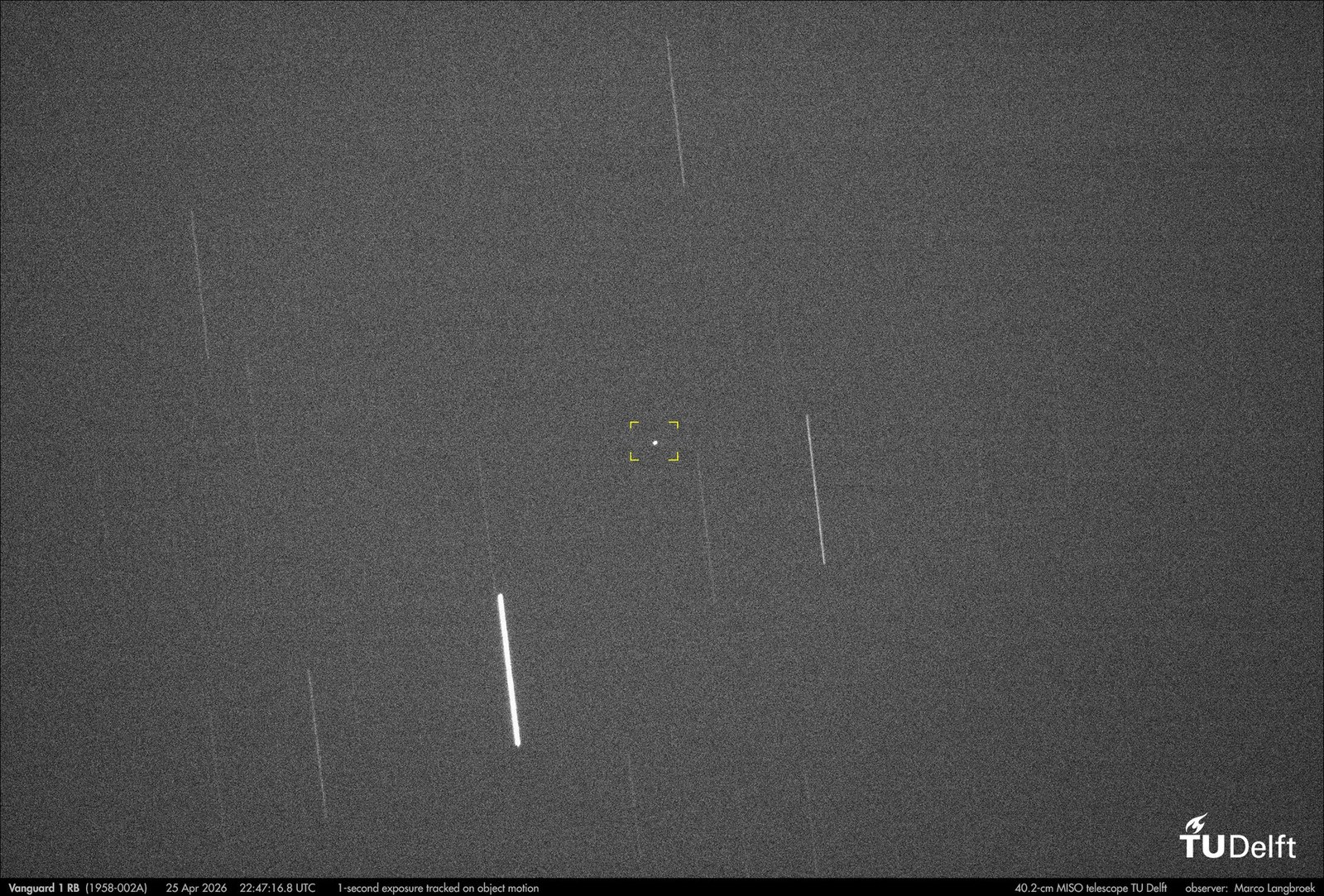
In this scenario a small spacecraft launches in the early 2030s with one job: fly alongside a cylinder of 1958 rocket hardware, photograph every surface of it, and come home with nothing but pictures. Nothing is captured, nothing is deorbited, nothing is repaired. The mission is an inspection, and the thing being inspected is object number 16 in the catalog.
That object is the Vanguard TV-4 third stage, the motor that pushed Vanguard 1 into orbit on 17 March 1958. It is a cylinder 1.5 metres long and 0.7 metres across, built by the Grand Central Rocket Company, weighing 195 kilograms fuelled and 22 kilograms empty, and it is still up there: 654 by 4,211 kilometres, inclined 34.26 degrees, going round once every 137.2 minutes, on elements dated 15 November 2026 (GCAT). It is not a historical curiosity that happens to be tracked. It is the oldest rocket stage in Earth orbit, and the next two oldest are its own siblings.
The whole of 1958, still in orbit
Four catalogued objects launched in 1958 are still in orbit, and all four came off the same rocket on the same March morning: Vanguard 1 itself, a two-kilogram sphere at 650 by 3,819 kilometres; the third stage; a clamp, catalogued as object 1576, at 663 by 3,818 kilometres; and one further fragment (GCAT). Everything else humanity put up in the first full year of the space age has long since burned. Sputnik's core stage came down in December 1957. Explorer 1 reentered in March 1970.
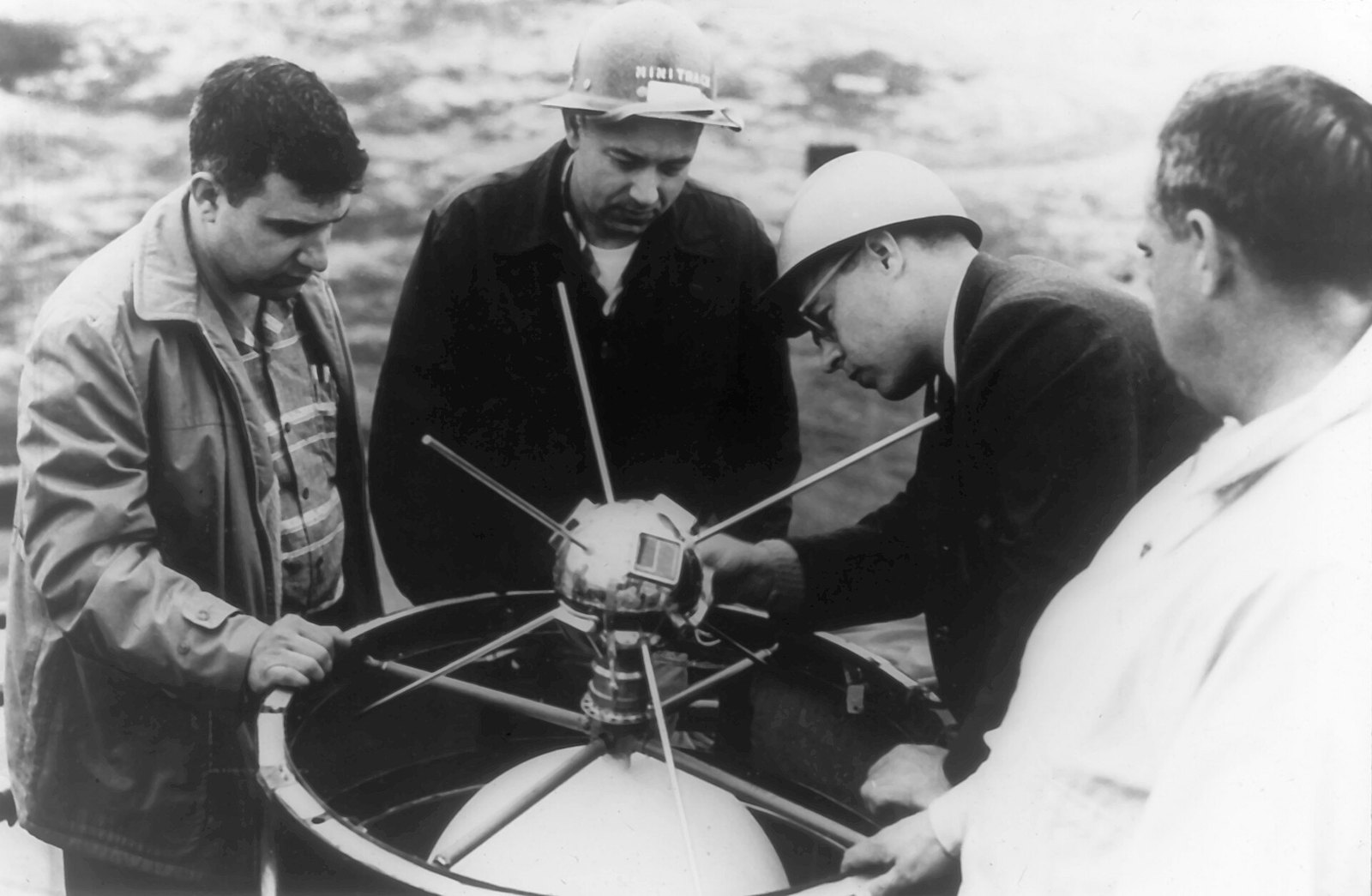
These four survived for one reason: the launch put them high and left them eccentric, and almost nothing at 654 kilometres of perigee feels enough air to care. They are the oldest members of a very large family. There are 2,120 rocket bodies in orbit this morning. Of those with current elements, 1,462 have perigees at or above 600 kilometres and 744 sit in Vanguard-shaped orbits — perigee above 600 kilometres, apogee above 2,000 — where drag will not be doing the clearing. One hundred and forty were launched before 1970, and exactly three before 1960: the Vanguard TV-4, SLV-4 and SLV-7 third stages, all three still flying.
What is actually proposed, and what is not
The idea of going to get a piece of this is Proposed, not Planned. In January 2025 three Booz Allen Hamilton engineers and analysts — Matt Bille, Chris Vanwy and Michael Ferguson — presented a paper at the AIAA SciTech Forum laying out options for retrieving Vanguard 1, the satellite rather than the stage. The authors were explicit that it was not a company proposal or a funded project. Their sketch runs in two parts: first a close-range inspection craft with cameras, because ground radars and telescopes do not have the resolution to tell you what condition the object is in; then either a semi-autonomous robotic grapple, modelled on the Naval Research Laboratory's robotic-arm work with SpaceLogistics, or a modified crewed Dragon that takes the satellite in through the capsule's nose. Bille's cost sense: "This is not a $50 million mission, but it's not a $5 million project" (Aerospace America, AIAA).
The obstacles they list are the interesting part, because they are not about propulsion. The satellite's antennas are presumed too fragile to grab. The body has no docking mechanism and no obvious grip point. It was spin-stabilised, so it may be tumbling in a way that makes capture hard or impossible. Nobody knows what sixty-eight years has done to the metal, and finding out is a prerequisite for everything else.
In this scenario, the target changes
This scenario keeps their phase one and changes the target. The spacecraft goes to the stage, not the satellite, and it goes to look rather than to grab.
The stage is the better target for three reasons. It is eleven times the mass of Vanguard 1 and fifteen times the length, which makes it a realistic stand-in for the things removal missions will eventually have to handle rather than a grapefruit-sized special case. It is in essentially the same orbit as the satellite, so the trajectory work transfers. And it is representative: 744 stages in Vanguard-shaped orbits are waiting on the same answers about aged aluminium, aged bolts and unknown spin states.
What the inspection returns, in this scenario, is a surface. Sixty-eight years of atomic oxygen at perigee, of ultraviolet, of a hot-and-cold cycle every 137 minutes, of micrometeoroid and debris strikes. Whether the paint is gone. Whether the skin is intact or crazed. Whether the interstage ring that a future gripper would clamp is still structurally a ring. Whether it tumbles slowly enough to be approached at all. Every one of those answers applies to hundreds of other objects, and none of them can be had from the ground.
Who has to say yes
The stage is not abandoned property. Under Article VIII of the 1967 Outer Space Treaty, the state on whose registry an object is carried "shall retain jurisdiction and control over such object… while in outer space", and ownership "is not affected by their presence in outer space" (Outer Space Treaty, 1967). GCAT lists the owner as the Naval Research Laboratory and the state as the United States. A visit needs American permission; a capture would need rather more than that, and a decision about whether a 1958 rocket stage is debris, an artefact, or both.
That question is not unique to Vanguard, which is precisely the point. Every one of the 744 stages in high, eccentric orbits belongs to somebody under the same article, and most of those somebodies are states that no longer launch, agencies that have been reorganised twice, or companies that no longer exist. The legal work is the same work whether the object is famous or anonymous, and doing it once on the most-documented object in orbit would be the cheapest possible rehearsal. We have written before about what happens when there is nobody to call.
ClearOrbit's view
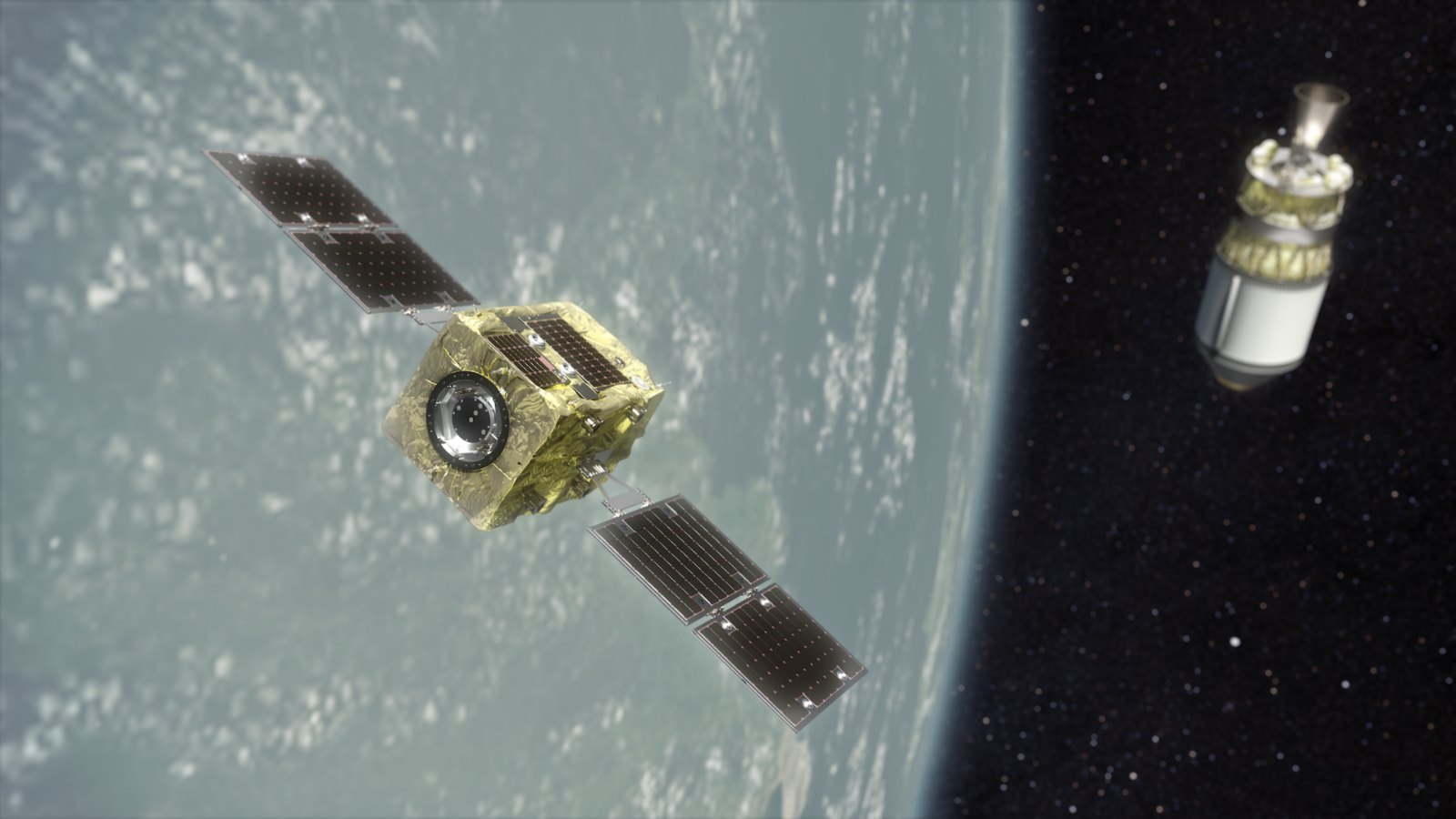
Nobody has removed a piece of debris from orbit yet, and we have written about why that is still true. What has happened is inspection: ADRAS-J flew around a spent H-IIA stage and on 30 November 2024 held station about 15 metres below its payload attach fitting (Astroscale), which proved that approaching an uncooperative, uninstrumented object is an engineering problem rather than a research question. The next step is not a bigger grab. It is a second inspection, of something much older, to find out what time does to hardware that nobody designed to be visited.
We would fly this mission for the data, not for the souvenir. A removal programme that has never seen a sixty-eight-year-old stage up close is guessing about the condition of the population it intends to clear — and 744 of those stages sit where drag will never help. ClearOrbit has flown nothing and has no customers; what we can do is say which measurement comes first. This one is cheap, it is legal to arrange, the target has a known owner and a known address, and it would be the best-documented object any removal programme ever practised on.
The stage went up on a Monday in March 1958 to spend a few minutes doing its job. In this scenario, the first time anyone looks at it closely is the most useful thing it has done since.
Reader mail
Have a better idea?Spotted something we got wrong?
We publish in public so the numbers can be checked. If a figure looks wrong, a source is missing, or you know something this piece should have said, send it over. One box, no sign-up.
Send an idea or correctionQuick question
If you could fund one thing first to cut collision risk in low Earth orbit, what would it be?
Anonymous. You will see how others answered after you vote.
Sources
- GCAT, J. McDowell
- GCAT derived current catalog
- GCAT satellite catalog
- Bringing home a piece of space history, Aerospace America (AIAA), 10 January 2025
- Treaty on Principles Governing the Activities of States in the Exploration and Use of Outer Space, 1967
- Astroscale, ADRAS-J achieves 15-metre approach to space debris, 11 December 2024
- US Space Force public catalog, Space-Track.org