Scenario · · 6 min read
Orbit 2035: with removal
The same operator, the same Tuesday in 2035, but in a world that began removing 5-10 large derelicts a year from 2028 and raised disposal compliance.
This is the companion to "Orbit 2035: business as usual". The launch rate is the same. The megaconstellations are the same. Maya, our fictional flight-dynamics lead at a forty-satellite Earth-observation company, is the same. Two things are different: from 2028, the world removes five to ten large derelicts a year, and disposal compliance climbs steadily for everyone. In this scenario, we follow the same Tuesday in 2035.
We want to be clear about what this scenario is. The timeline below is ClearOrbit vision, not a forecast of what is funded. It is built from real 2026 starting points.
Where the real starting line is
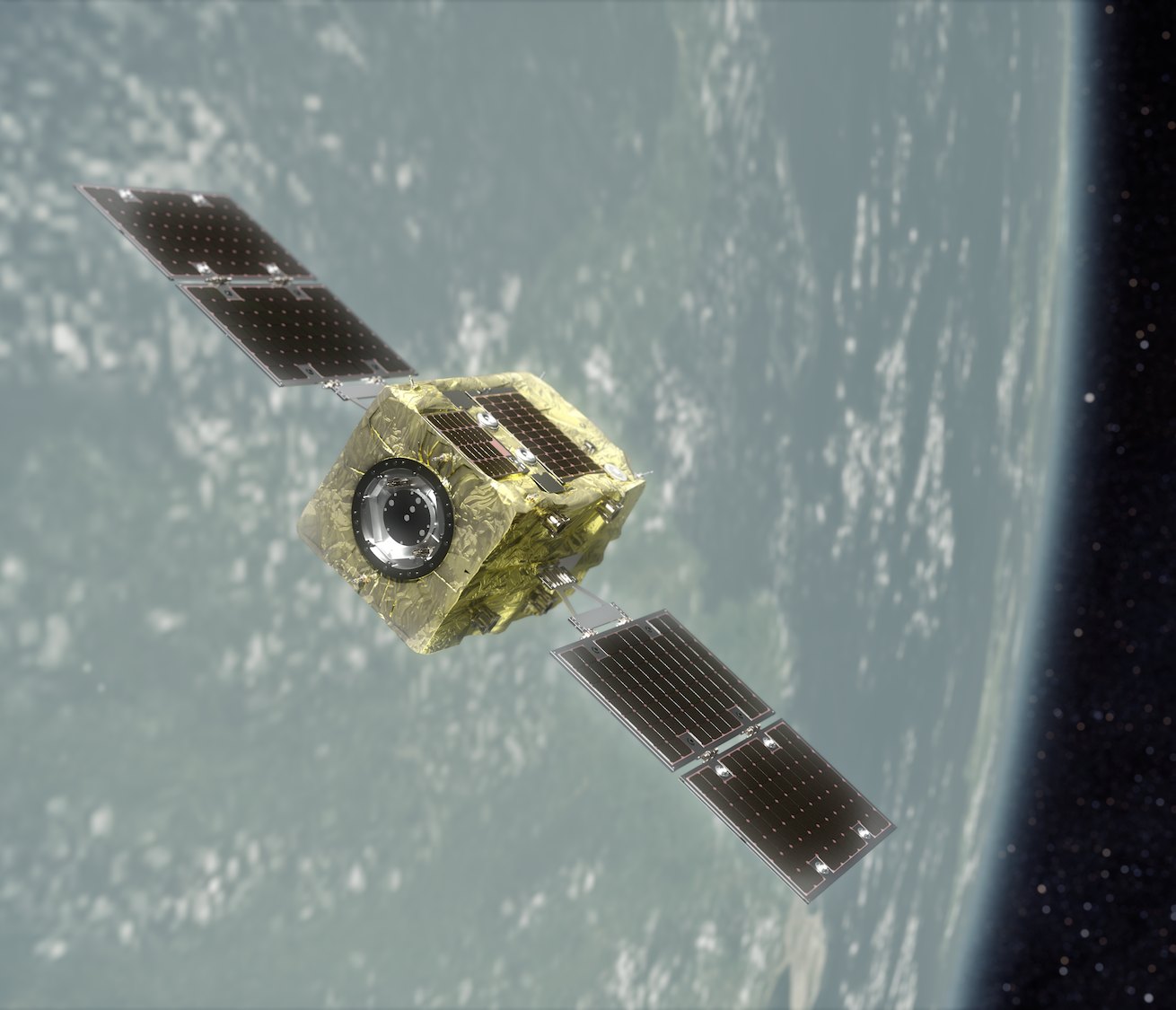
As of September 2026, no mission has captured and removed an existing, uncooperative piece of large debris. The first attempts are Planned for 2027-2028. Astroscale says its ADRAS-J2 mission, contracted by JAXA for about ¥13.2 billion, aims to "become the world's first mission to capture and remove an existing piece of large orbital debris" Astroscale; Astroscale contract. ClearSpace-1, now aimed at PROBA-1, and Astroscale's ELSA-M are also Planned ClearSpace; Astroscale.
Why five to ten a year? NASA's Orbital Debris Program Office found that removing about five objects per year, chosen by mass and collision probability, could hold the LEO debris population roughly constant for 200 years NASA NTRS. That study assumed about 90% compliance with disposal rules, far above today's 5-35% for payloads ESA Report PDF. With today's launch rates, five is likely a floor, not a target. That is why this scenario uses five to ten and pairs removal with higher compliance.
Year by year to 2035
- 2027-2028. The first capture-and-removal missions fly. At least one succeeds, and at least one hits a serious problem. Both results are published in detail, which is what turns demos into an industry.
- 2028. Governments and operators agree a ranked target list based on the McKnight et al. composite, in which the top twenty are all 9-tonne SL-16 Zenit stages McKnight et al.. The first multi-object removal contract is signed. Removal rate: five per year.
- 2029-2030. Servicers become partly reusable, which is what NASA's cost-benefit study said controlled re-entry of large debris needs in order to pay off; it found such removals "might provide net benefits within three decades" NASA OTPS. ESA's Zero Debris goal of demonstrated removal services by 2030 is met ESA Zero Debris.
- 2030-2032. Capture interfaces become standard. Airbus had already bought 100 Astroscale docking plates in 2025 Payload. By now most new satellites fly with a plate or similar fixture, so a failed satellite is a scheduled pickup rather than a permanent hazard. Disposal-as-a-service contracts, pioneered by the Space Development Agency's $52.5 million award to Starfish Space in 2026, are common Breaking Defense.
- 2033-2035. Removal rate reaches ten per year. In this scenario, roughly fifty to sixty of the most massive derelicts have been taken out of the most crowded bands since 2028. Compliance with 5-year disposal is high across new missions, not only at the largest operators.
Removal does not undo breakups that already happened. Fragments from Fengyun-1C and the 2009 collision are still in orbit in 2035. Removal prevents the next big clouds. It does not clean up the old ones.
The same Tuesday in 2035
- 06:00. Maya opens the overnight queue. The number of conjunction notices is still high, because launch traffic is still high. Automated screening dismisses most of them, as before.
- 06:30. Nine remain above the action threshold instead of eleven. The difference is not dramatic. What has changed is their quality: most involve objects with good orbit data, because the number of new, poorly tracked fragments has fallen. She plans one burn.
- 07:15. A conjunction with a large constellation satellite is resolved automatically through shared ephemerides, just as in the other timeline.
- 09:00. In the business-as-usual world, a derelict rocket stage forced a burn that cost a customer's imaging pass. In this world that stage was removed in 2031. The slot is clear.
- 11:00. Planning reports avoidance propellant roughly on budget. Satellite working-life forecasts hold.
- 14:00. The insurance broker calls with something new: a policy priced partly on whether the operator's satellites carry capture fixtures and a contracted disposal service. The market has found a way to reward good behaviour.
- 16:30. A new fragmentation is announced two shells up, as in the other timeline. Breakups still happen. But one of Maya's own satellites failed last month, and a servicer is already scheduled to collect it, so she is not adding to the problem.
- 18:00. She hands off to the night shift. Tomorrow's queue is about the same as today's.
Once again, Maya's specific counts are invented for this scenario. What matters is the shape of the day. In the business-as-usual world, each Tuesday is a little worse than the last. In this world, each Tuesday is roughly the same as the last, even as traffic grows.
What this future costs, and what it saves
First-of-a-kind removals are expensive. Existing contract values suggest roughly $50-100 million per object today; that range is our own estimate from contracts such as ADRAS-J2 and the SDA-Starfish award, not a published figure. Ten a year at that price is a real budget line.
The savings are harder to see because they are costs that never arrive: collisions that did not happen, clouds that did not form, propellant that did not burn. NASA's 2024 follow-up study measured debris risk in dollars and found that remediation may be as valuable as mitigation, and that deorbiting defunct spacecraft quickly is cost-effective NASA OTPS Phase 2. The political support is also forming: ESA's Zero Debris Charter had 228 signatories from 34 countries by May 2026 ESA Space Safety blog.
This scenario does not claim the space environment is "fixed" by 2035. ESA's 2026 health index was about 50 times its first threshold ESA Space Environment Report 2026, and a decade of removal will not erase that. It claims something narrower and more important: the trend stops getting worse.
ClearOrbit's view
We think the difference between these two Tuesdays will be decided before 2030, not in 2035. The removal missions that start the campaign need to be contracted within the next two years to fly by 2028. The satellites that will carry capture fixtures in 2032 are being designed now.
Our ClearOrbit vision is exactly the path in this scenario: a ranked target list, a steady removal cadence that grows from five to ten a year, reusable servicers that bring the cost per object down, and standard capture interfaces on every new satellite. We are building the roadmap and the coalition to get there. We have not flown hardware, and we say so. What we bring is the plan and the partners.
The next step is a commitment from agencies and large operators to buy removal as a recurring service, not a one-off demonstration. Demonstrations prove it can be done. Only a steady order book makes it happen every year.
Reader mail
Have a better idea?Spotted something we got wrong?
We publish in public so the numbers can be checked. If a figure looks wrong, a source is missing, or you know something this piece should have said, send it over. One box, no sign-up.
Send an idea or correctionQuick question
If you could fund one thing first to cut collision risk in low Earth orbit, what would it be?
Anonymous. You will see how others answered after you vote.
Sources
- ESA Space Environment Report 2026
- ESA Space Environment Report 2026 (Issue 10 Rev 1 PDF)
- NASA ODPO: removal of about five objects per year (Liou)
- McKnight et al., Identifying the 50 statistically-most-concerning derelict objects in LEO (open PDF)
- Astroscale Japan selects Isar Aerospace to launch ADRAS-J2
- Astroscale: ELSA-M launch contract
- ClearSpace-1 mission changes
- Payload: Airbus buys Astroscale docking plates
- Breaking Defense: SDA taps Starfish for satellite disposal
- NASA OTPS: Cost and Benefit Analysis of Orbital Debris Remediation (2023)
- NASA OTPS Phase 2 study (2024)
- ESA Zero Debris approach
- ESA Space Safety blog: Zero Debris webinar 4
- Astroscale: ADRAS-J2 contract