Daily briefing · · 3 min read
Orbit on 12 October 2026: 41 objects joined the catalog overnight, and every one of them works
The on-orbit count rose by 41 and the debris total did not move at all. Twenty-one of the new entries are a military communications batch; the encounter worth watching involves a stage nobody has touched since 2002.
What changed
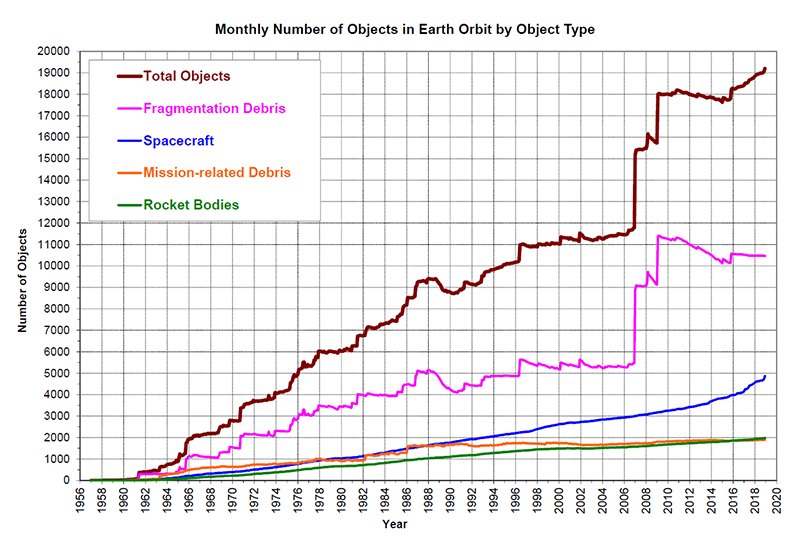
There are 33,681 objects in Earth orbit this morning, 41 more than yesterday, and all 41 are payloads. The catalog holds 19,614 payloads, 2,113 spent rocket bodies, 10,629 tracked fragments and 1,325 mission-related components; the debris-and-rocket-body total is 14,067, unchanged. Of 70,289 objects catalogued since 1957, 37,449 have come down GCAT. The current close-approach screening is here.
Twenty-one of the new entries carry the designator 2026-231 and are registered to the US Space Development Agency, launched on 10 October GCAT. Northrop Grumman delivered them to Vandenberg Space Force Base on 28 September for the Tranche 1 Transport Layer of the Proliferated Warfighter Space Architecture Northrop Grumman. Nine more are WHDW 27-01 to 27-09, registered to Zhongguo Xingwang, launched 9 October on a Chang Zheng 12; the rest are late entries from the 1 October rideshare. The thirty-day launch count jumped from 169 to 212, against 102 reentries in thirty days and 22 in seven. Fifty-eight objects sit below 250 kilometres, the lowest on current element data Starlink 4464 at 149 by 159 kilometres GCAT.
Close approach of the day
On 14 October at 23:42 UTC the working Orbcomm messaging satellite FM20 is predicted to pass 3.43 kilometres from a derelict Japanese H-2A second stage at about 761 kilometres over Saudi Arabia, crossing at 140.5 degrees and closing at 14.08 kilometres per second, with a worst-case probability of 1 in 1,856,321 CelesTrak SOCRATES Plus. See the 3D view. The figures are propagated from public orbit data and CelesTrak's screening file, both dated 8 October, because the refresh has not reached CelesTrak for four mornings running; they are kilometre-accurate estimates, not warnings. No earlier prediction reached a verdict in the last three days, and this morning's follow-up check could not run either.
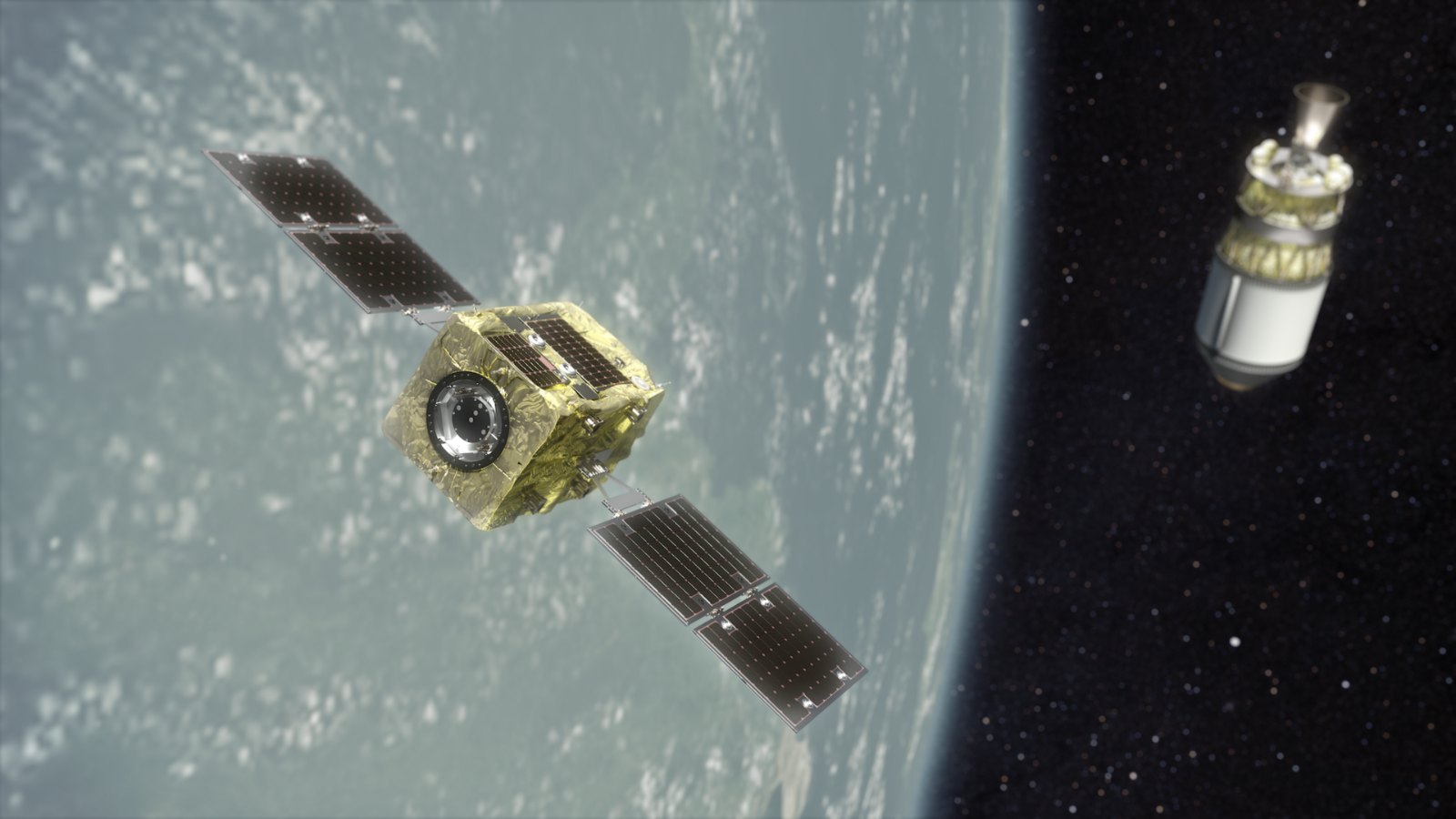
Orbcomm FM20, catalogue 25416, is a 42-kilogram Microstar bus launched on 2 August 1998, still active at 762 by 765 kilometres. The other object, catalogue 27601, is the second stage of H-2A flight 4, launched on 14 December 2002: 9.2 metres long, 4.0 metres across, four tonnes on the books, inclined at 98.35 degrees and drifting between 729 and 828 kilometres ever since GCAT. Forty-two kilograms meeting four tonnes at 14 kilometres per second is not a near-miss between equals.
Object of the day
Forty-nine H-2A second stages are still in orbit, and one is the only derelict upper stage any spacecraft has ever flown up to. JAXA's Commercial Removal of Debris Demonstration picked catalogue object 33500, the stage that launched the GOSAT satellite in January 2009 — approximately three tonnes, eleven metres long, four metres across, at about 600 kilometres JAXA CRD2. Astroscale's ADRAS-J reached about 15 metres from it on 30 November 2024: Flown, and still the closest a commercial spacecraft has come to large debris Astroscale. It photographed the stage and left. At three to four tonnes apiece the forty-nine come to roughly 150 to 200 tonnes, out of the more than 17,400 tonnes ESA counts in Earth orbit ESA DISCOS. The other forty-eight have never been visited, and 27601 is one of them.
ClearOrbit's view
Today's figures contain the argument in miniature. Launch added 41 working satellites and no debris. The risk was added decades ago and has not moved: four tonnes of 2002 rocket stage crossing a working satellite's path at an angle no operator chose, with nobody able to do anything about the derelict half.
ADRAS-J proved the approach is solvable. What it did not do, because Phase I was never meant to, was move anything, and the gap between inspecting a stage and lowering one is where this industry still sits as we have written.
We would start with the class of object the data keeps naming. Forty-nine stages, one manufacturer, several sharing a sun-synchronous plane, one already photographed from fifteen metres: that is the shortest distance between a demonstration and a service. The hardware question has been answered once. Who pays to answer it forty-nine times has not.
Reader mail
Have a better idea?Spotted something we got wrong?
We publish in public so the numbers can be checked. If a figure looks wrong, a source is missing, or you know something this piece should have said, send it over. One box, no sign-up.
Send an idea or correctionQuick question
Who should pay for cleaning up orbit?
Anonymous. You will see how others answered after you vote.