Daily briefing · · 3 min read
Orbit on 4 November 2026: 28 years after launch, Intelsat 8 sits 52 kilometres above the band it had to clear
Catalog number 25522 went up on 4 November 1998 into a circular slot. It now runs 36,038 by 38,512 kilometres, 52 above the protected band's ceiling, at nine times the advised eccentricity.
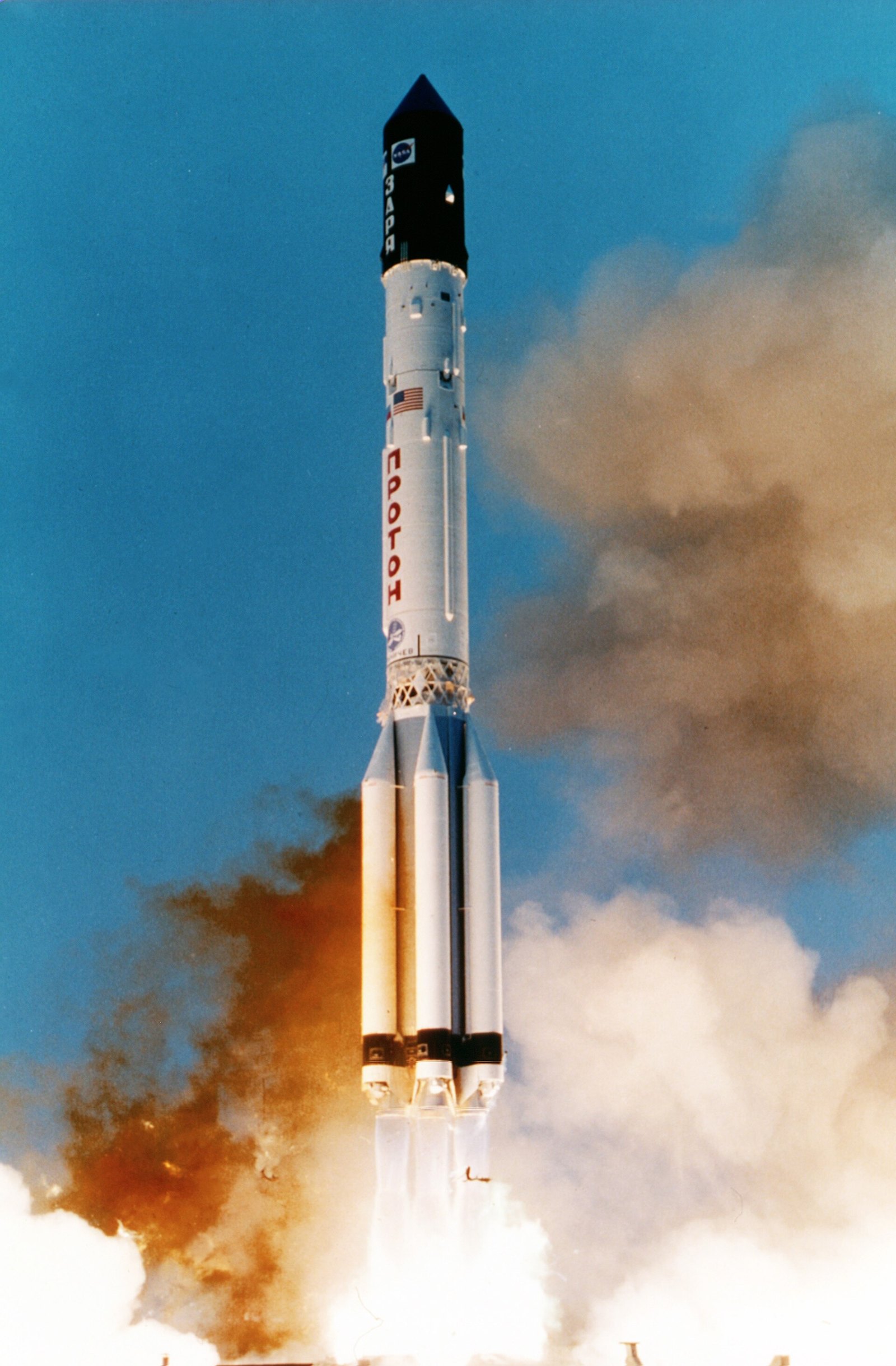
Twenty-eight years ago this morning a Proton-K lifted a communications satellite out of Baikonur into a geostationary slot so precisely circular that its first recorded orbit reads 35,774 by 35,800 kilometres, inclined 0.07 degrees (GCAT). It is still up there, and it is the clearest thing in today's data, because the catalog is otherwise frozen.
The counts have not moved a single object overnight: 33,877 on orbit, 19,797 payloads, 14,080 spent stages and debris, 1,574 in the geostationary region (GCAT). Every day-over-day difference is structurally zero, because the published catalog file has not been refreshed since yesterday's run. What moves is the arithmetic around it: 87 reentries in 30 days against 91 counted yesterday, six in seven days against seven, both falling because the windows slid past decays already on the books rather than because anything came down. Nothing has for three days, the last being Starlink 1283 on 1 November. Against that, 221 objects went up in 30 days, and the 800-to-900-kilometre band still holds 2,752 objects of which 2,501 are debris (our catalog page).
Close approach of the day
There is not one, for the twenty-seventh day. The screening behind our close-approach pages still carries the file of 8 October 2026, which found 7,834 pairs inside one kilometre across 174,512 conjunctions. Today's refresh did run, against USSPACECOM's public conjunction data on Space-Track.org, but publishing those encounters is held pending a redistribution check on that source. An empty forward list is a supply problem, not quiet traffic.
The object of the day: PAS 8, launched 4 November 1998
Catalog number 25522 launched as PAS 8 at 11:52 UTC on 4 November 1998, a Loral FS-1300 of 3,800 kilograms, about 1,400 of that dry, with 26 metres of solar array across (GCAT). It became Intelsat IS-8 in February 2007, when GCAT records the name and owner changing hands. The element set published on 31 October 2026 puts it at 36,038 by 38,512 kilometres, inclined 9.49 degrees.

Read against the rulebook, that orbit is a near miss in both senses. The IADC protected region at geostationary altitude runs from 35,586 to 35,986 kilometres and 15 degrees either side of the equator (ESA Annual Space Environment Report, Edition 10). The satellite's perigee clears that ceiling by 52 kilometres, and its 252-kilometre rise above geostationary altitude falls just short of the roughly 260 the standard formula asks for: 235 kilometres plus a term scaling with area over mass (Walls et al., AMOS 2016). The same studies ask for an eccentricity at or below 0.003 so the perigee stays put; this orbit's is 0.0283, nine times that. Its inclination has drifted from 0.07 degrees to 9.49 in 28 unattended years, carrying it back through the latitudes the band protects.
The upper stage from the same launch never left at all. Blok DM3 No. 10L, catalog number 25525, 2,560 kilograms dry, was recorded in December 1998 at 6,795 by 35,878 kilometres and sits today at 6,802 by 35,871, with an apogee inside the protected band that it reaches nearly four times a day. One launch, four tonnes, both pieces still on the same region 28 years later.
ClearOrbit's view
Low orbit gets the attention because the air eventually settles the argument there. At geostationary altitude it never does, which is the subject of today's companion explainer on retiring a geostationary satellite: ESA counts 939 catalogued objects in that region holding 2,876 tonnes, two per cent of the catalogue and sixteen per cent of all the mass in orbit (ESA DISCOS, 2 November 2026). None of it comes down on its own.
What PAS 8 shows is that compliance is a gradient, not a yes or no. Somebody spent real fuel raising it above the ring, and the orbit they left it in still brushes the ceiling of the region and drifts back across its latitudes. ESA's figures say between 85 and 100 per cent of geostationary payloads reaching end of life in the last decade attempted to comply and between 70 and 90 per cent succeeded; the gap between those numbers is thirty years of satellites like this one. ClearOrbit has flown nothing and holds no contracts. What we argue for is that a disposal orbit be judged on where it will be in fifty years rather than on the day the last burn ends, and that near misses be catalogued as carefully as failures.
Reader mail
Have a better idea?Spotted something we got wrong?
We publish in public so the numbers can be checked. If a figure looks wrong, a source is missing, or you know something this piece should have said, send it over. One box, no sign-up.
Send an idea or correctionQuick question
Who should pay for cleaning up orbit?
Anonymous. You will see how others answered after you vote.