How it works · · 6 min read
Plus or Minus Twenty Per Cent: How a Reentry Time and Place Are Predicted
Fifty-eight catalogued objects are below 250 kilometres today and none of them has a reentry date. Here is why the answer is always a percentage, and why it only collapses in the last few hours.
The problem class: fifty-eight objects, no dates
Fifty-eight catalogued objects were circling with a perigee below 250 kilometres this morning, the altitude at which a decay becomes a matter of days GCAT. Not one of them has a reentry date. The lowest, a 5.7-kilogram Planet Labs Dove at 150 by 166 kilometres, will come down within days; the catalog will record the day afterwards, not before GCAT.
This is not a gap in the data. Predicting when an uncontrolled object will reenter, and where it will be when it does, is one of the few routine problems in spaceflight where the error bar is a fraction of the answer rather than a fixed number of minutes — and it stays that way almost to the end.
What a prediction is actually made of
An uncontrolled object has one force acting on it that matters: drag. How much drag it feels is captured by a single quantity, the ballistic parameter B, which is the drag coefficient multiplied by cross-sectional area and divided by mass ESA Space Debris Office. Everything else — shape, materials, what it used to do — enters only through that number.
B is not measured. It is fitted, by watching how fast the orbit's semi-major axis is actually shrinking and solving backwards for the value that would produce it Pardini and Anselmo. That quietly absorbs a great deal of ignorance: if the object is tumbling, so that its exposed area changes from orbit to orbit, the fit averages over it.
The second input is the atmosphere, supplied by a density model — ESA's operational chain has used MSIS90 with low-altitude bridging — driven by solar and geomagnetic proxies, principally the F10.7 radio flux and the daily Ap index ESA Space Debris Office. This is where most of the error lives: thermospheric density days ahead responds to solar activity that is itself forecast rather than known.

ESA has run an automatic reentry prediction service on this basis since 1999, processing some 170,000 objects in under ten hours on a single processor core ESA Space Debris Office. The scale is not the hard part. The accuracy is.
Why the answer is a percentage
The convention is a window of plus or minus twenty per cent of the remaining lifetime, also described as the state of the art for short-term prediction near reentry ESA Space Debris Office. Ten days out, that is plus or minus two days; ten hours out, two hours.
How well does it hold? Pardini and Anselmo measured 316 predictions made during the IADC reentry test campaigns against what actually happened. The mean error was 9.7 per cent of residual lifetime, falling to 7.0 per cent once four pathological cases were set aside; a twenty per cent bound contained 89.2 per cent of predictions and a thirty per cent bound 94.6 per cent Pardini and Anselmo. Spent rocket stages, dense and compact, did better at 5.2 per cent.
Two details in that paper are worth keeping. First, the official campaign windows failed to contain the true reentry time in 29 of the 316 cases, about nine per cent — the window is a ninety-per-cent statement, not a guarantee. Second, and counter-intuitively, the relative error gets worse at the end: it rose to 15.0 per cent in the last six hours and 23.1 per cent in the last three Pardini and Anselmo. The absolute window still shrinks, because twenty-three per cent of three hours is forty minutes. But the model is least trustworthy exactly where the object is deepest in the air it was never calibrated for.
ERS-2: sixteen days, eighteen predictions
ESA published every prediction it made for the reentry of ERS-2 in February 2024, which makes it the cleanest public worked example there is. On 5 February the answer was a window: some time between 16 and 22 February. On 8 February it became 02:39 on 20 February, plus or minus 62.91 hours. On 14 February, plus or minus 31.23 hours. On 19 February, plus or minus 15.06 hours. At 20:30 on 20 February, plus or minus 4.61 hours. At 12:30 the next day, plus or minus 1.44 hours ESA.
The final pre-reentry estimate, issued at 17:45 on 21 February, was 17:05 plus or minus 0.55 hours; ERS-2 reentered at 17:17 UTC over the North Pacific between Alaska and Hawaii, twelve minutes late and comfortably inside the window ESA. Note what the nominal time did along the way: it moved between 20 and 21 February across almost every update. The window was converging; its centre was not stable until the last day.
ESA was explicit about why. Atmospheric density is hard to forecast; the satellite's attitude changes how much area meets the air; and a prediction can only be refreshed after the object passes over a ground sensor ESA. That last constraint is easy to overlook — the limiting factor is sometimes not the physics but the next radar pass.
Where is a harder question than when
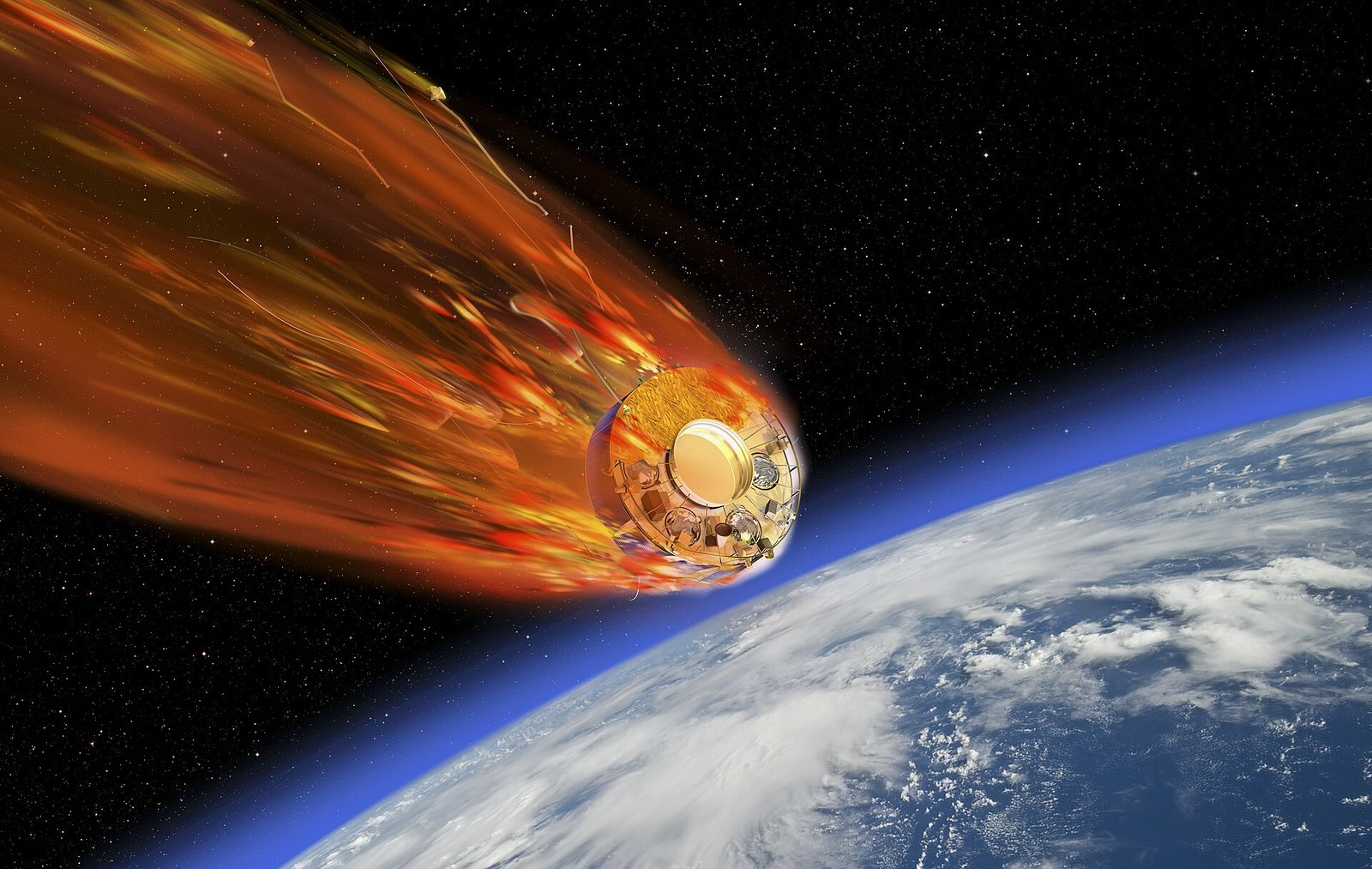
A reentry time with a window of plus or minus one hour is not a location. The object is still at orbital speed when the window opens, so an hour of timing uncertainty smears the impact point along most of the ground track; in the final hours the along-track uncertainty can exceed one full revolution Pardini and Anselmo.
What is tight is the cross-track direction: the ground track is known to within tens of kilometres, because the orbital plane barely changes. That is why civil protection agencies plan around a corridor and a time band rather than a point; for a single country the risk window is typically thirty to forty minutes long Pardini and Anselmo. Once the object is coming apart, events move fast: an intact body takes roughly seven minutes to fall from 80 kilometres to 10.
None of this is academic, because the objects do not all burn up. Between 10 and 40 per cent of a large object such as a rocket body or a satellite can survive to the ground ESA Space Debris Office. What reaches the ground, and what the atmosphere keeps, is the other half of this story.
ClearOrbit's view
The state of the art says an uncontrolled object will come down, says roughly when as a fraction of the time it has left, and cannot say where until it is nearly over. The agencies handle that limitation responsibly. Read the other way it is an admission: uncontrolled reentry is the disposal method for most of what is up there, and nobody controls its timing, its location or how much of it arrives.
Every improvement available within this framework improves the description of the problem. A better density model narrows the window; more sensor passes refresh it more often. Neither changes the fact that a four-tonne stage is falling on a schedule set by the Sun.
We think the measurement effort is worth it, and that the nine per cent miss rate on official windows should be quoted more often, because it sets the realistic bar for anyone promising certainty about a falling object. But prediction is the consolation prize. The objects that matter most are the ones drag will not reach for centuries, where there is no window to narrow because there is no reentry to predict. For those, the only thing that changes the answer is going up and bringing them down — ClearOrbit vision, and still nobody's flown hardware.
Reader mail
Have a better idea?Spotted something we got wrong?
We publish in public so the numbers can be checked. If a figure looks wrong, a source is missing, or you know something this piece should have said, send it over. One box, no sign-up.
Send an idea or correctionQuick question
If you could fund one thing first to cut collision risk in low Earth orbit, what would it be?
Anonymous. You will see how others answered after you vote.
Sources
- GCAT, J. McDowell
- C. Pardini and L. Anselmo, Assessing the Risk and the Uncertainty Affecting the Uncontrolled Re-entry of Manmade Space Objects, 7th European Conference on Space Debris (2017)
- S. Lemmens et al., ESA Space Debris Office, From End-of-Life to Impact on Ground
- ESA Rocket Science blog, ERS-2 reentry live updates