How it works · · 6 min read
Orbital Planes: Why the Debris Next Door Is Out of Reach
Two derelicts at the same altitude can be effectively unreachable from one another. The reason is geometry, and it decides which debris a removal mission can afford to visit.
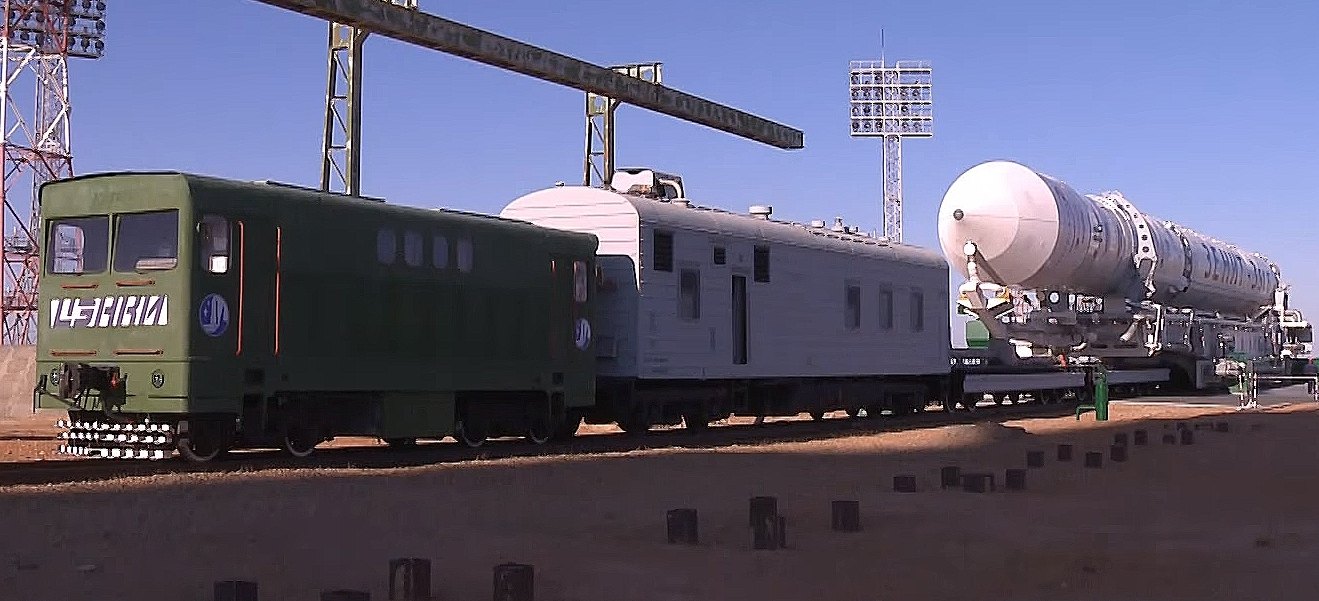
Picture two spent rocket stages, each around nine tonnes, both circling at about 850 kilometres. On a chart of altitude they are neighbours. To a spacecraft sent to remove one, the other may as well be at Mars.
The reason is that an orbit is not a height. It is a plane: a flat ring through the centre of the Earth, fixed in space while the planet turns underneath it. Two objects at the same altitude on differently tilted rings never share a path. A servicer that has matched one ring is no closer to the other.
This is the constraint that shapes debris removal economics.
Turning costs more than climbing
Changing the size of an orbit is cheap. Changing its tilt is not.
A satellite in low Earth orbit travels at roughly 7.8 kilometres per second, and about 7.5 km/s at an altitude of 800 km (ESA). To rotate that velocity vector by an angle, you have to add a velocity change of 2v sin(Δi/2) — the third side of a triangle whose two long sides are your speed before and after. At 7.5 km/s, one degree of turn costs about 130 metres per second, and ten degrees costs about 1.3 kilometres per second (our arithmetic, from the speed above).
Compare that with climbing. Raising a circular orbit from 800 to 900 kilometres, the standard two-burn transfer, costs about 50 metres per second in total. A hundred kilometres of altitude, in other words, costs roughly what four tenths of one degree of turn costs. Ten degrees of plane change is comparable to the entire propellant budget of a small servicing spacecraft, spent before it has touched anything.
That asymmetry is why a removal mission is built around one orbital plane.
The manoeuvre Earth performs for free
There is one exception, and every serious multi-target removal concept is built on it.
The Earth is not a sphere. Its equatorial bulge, described by the gravity term J2, tugs on an inclined orbit and makes the whole plane rotate slowly around the polar axis. The rate depends on the orbit's altitude and inclination, and it is the mechanism that keeps a sun-synchronous satellite's local crossing time fixed all year (Duck, NASA NTRS).
For a circular orbit at 815 km and 71 degrees of inclination, the standard J2 expression gives a drift of about 2.1 degrees a day. Drop to 715 km at the same inclination and the drift becomes about 2.24 degrees a day (our calculation, from that formula). The difference is small — roughly nine hundredths of a degree per day — but it is free, and it accumulates. A servicer that lowers itself 100 kilometres, waits, and climbs back swings its plane about ten degrees sideways in roughly four months, for perhaps 100 m/s of propellant instead of 1,300.
The catch is what precession does not do. It rotates the plane about Earth's axis; it does not change the inclination. A servicer can wait its way from one right ascension to another. It cannot wait its way from 71 degrees to 83.
Which is why the clusters matter
If inclination is effectively fixed for the life of a mission, then removal is only affordable where many heavy derelicts already share one.
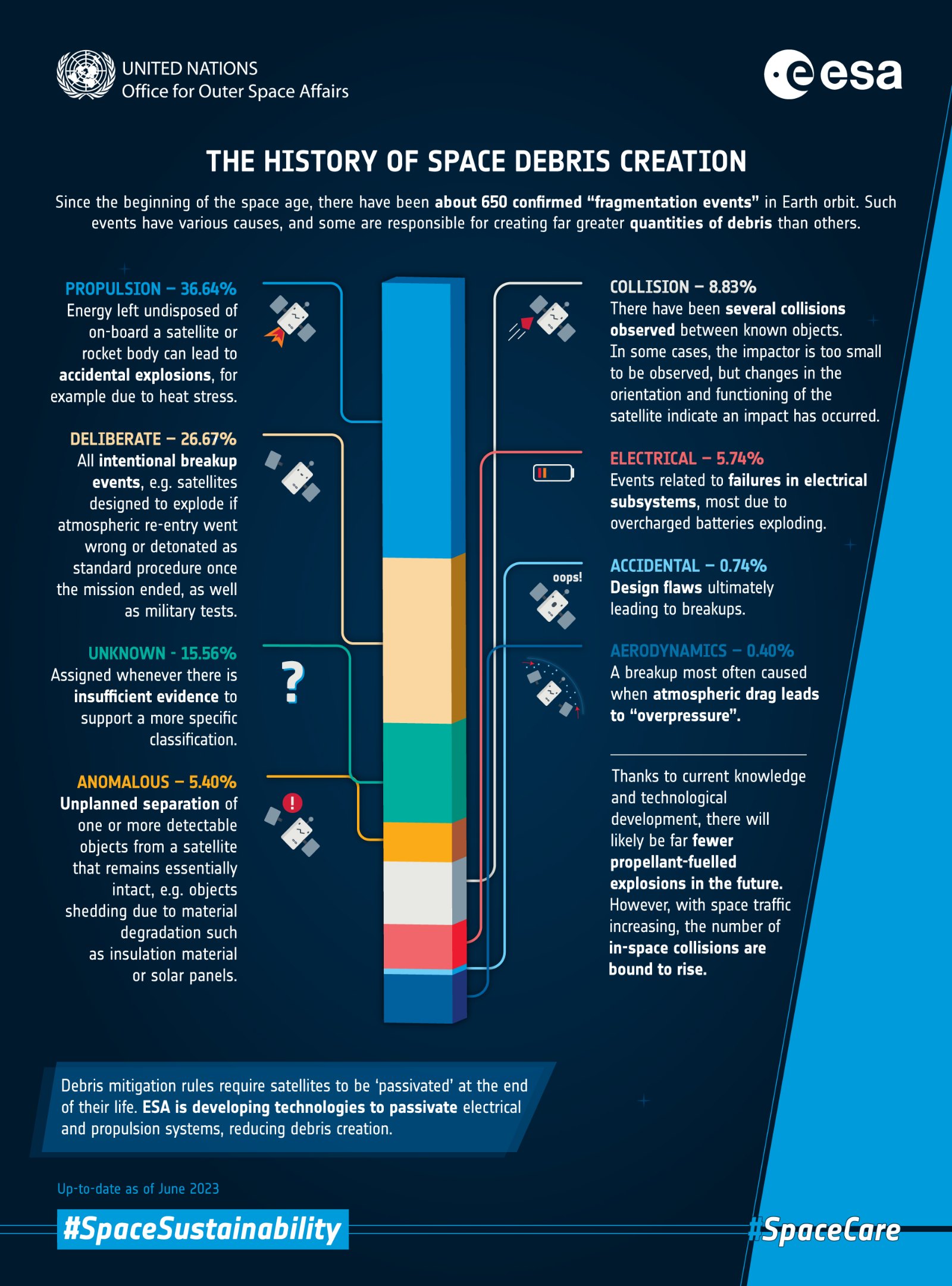
They do. The 2021 study ranking the fifty statistically-most-concerning derelicts in low orbit found them grouped into families by inclination (McKnight et al., PDF). Twenty-three objects sit near 70 to 71 degrees with semi-major axes of 7,193 to 7,281 kilometres — roughly 815 to 900 km of altitude — eighteen of them Zenit-2 second stages of up to 9,000 kg. Fifty-two more sit near 83 degrees, twenty-eight near 81 degrees, and forty-six in the sun-synchronous band between 97 and 100 degrees (McKnight et al., PDF).
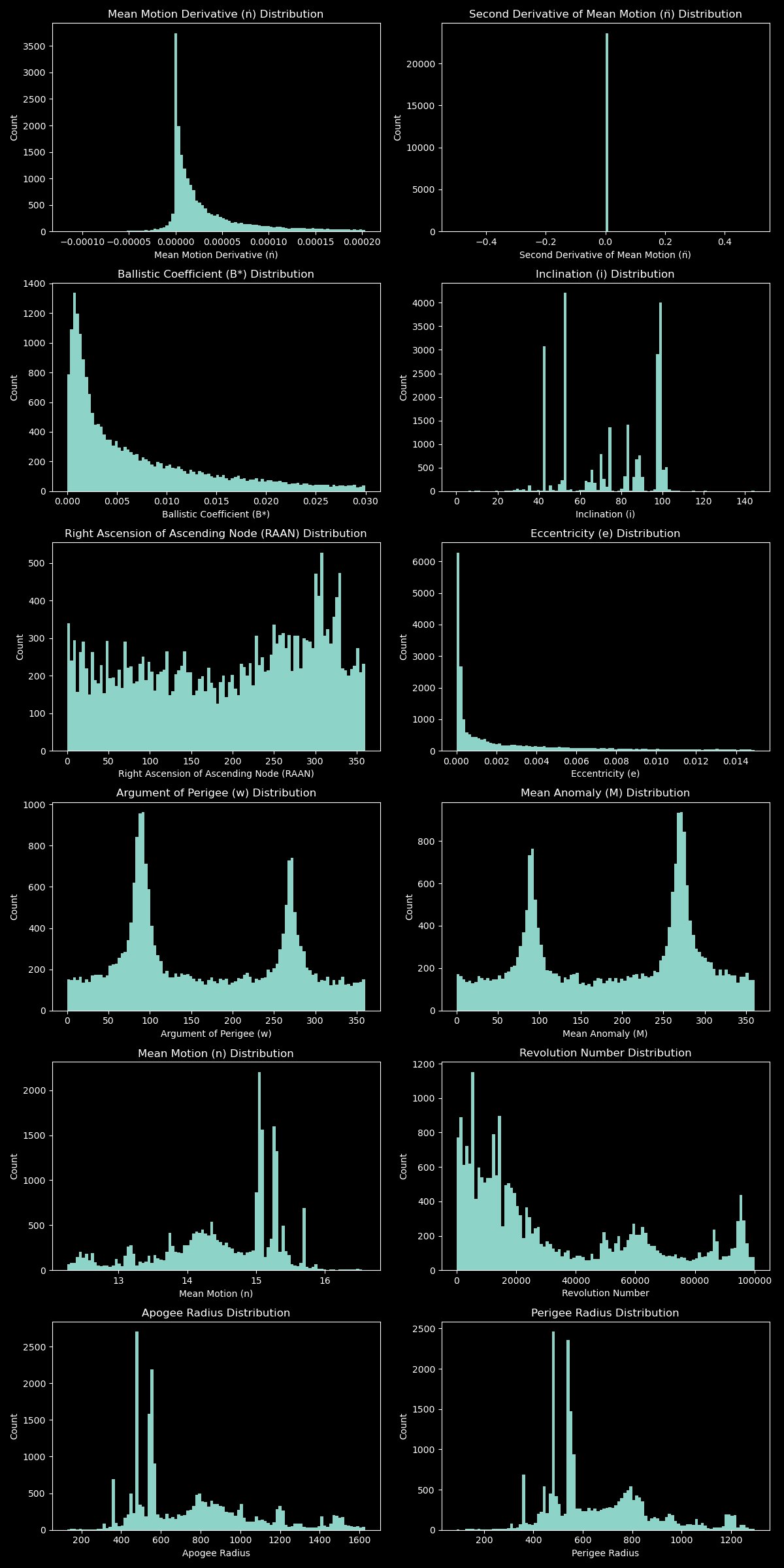
The paper draws the obvious conclusion. Because inclination is constant within each group, a removal system needs only to correct differences in right ascension, using natural precession rather than propellant (McKnight et al., PDF). That is what makes a multi-target tug arguable at all — a Proposed architecture, not a flown one. It also explains why those bands are the crowded ones in today's catalog: the 800 to 900 km shell holds 2,765 objects, 2,487 of them debris or spent hardware (GCAT). We wrote about the ranking itself in the fifty most dangerous objects.
What has actually been flown
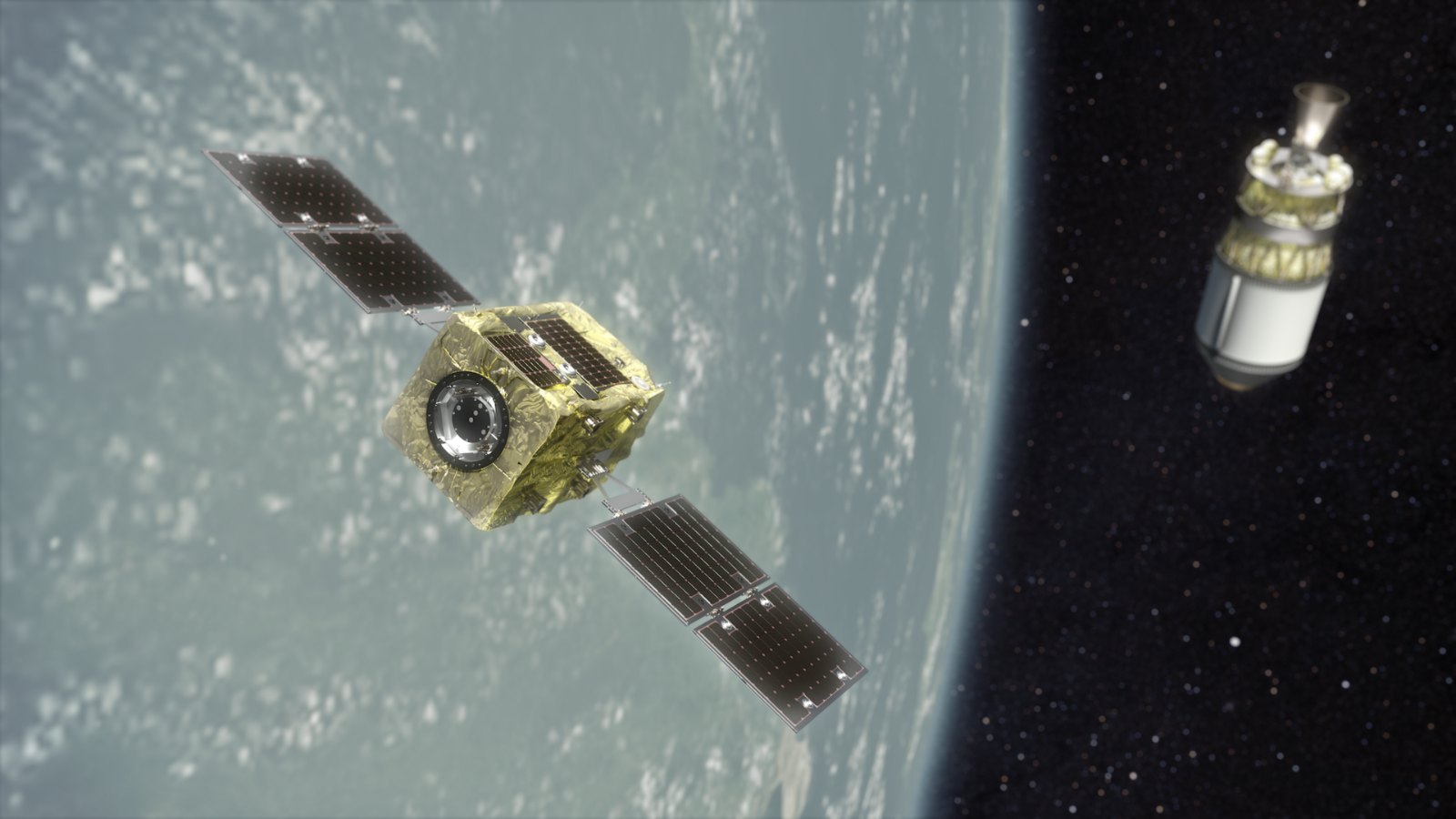
Flown. Astroscale's ADRAS-J launched in February 2024 and rendezvoused with a non-cooperative upper stage of roughly three tonnes, about 11 metres long and 4 metres wide, closing to within 15 metres and flying around it to inspect it. The mission operated for 293 days and began its deorbit on 25 March 2026 (Astroscale). One launch, one plane, one object — with a follow-on, ADRAS-J2, planned for fiscal 2027 against the same piece of debris (Astroscale).
Planned. ESA's ClearSpace-1 shows the other side of the constraint: how hard it is to change your mind. Its original target was VESPA, a 113 kg conical adapter at 660 by 790 km and 98.72 degrees of inclination, which shed fragments after a hypervelocity impact reported on 10 August 2023 (ESA). In April 2024 the mission switched targets to the veteran ESA spacecraft PROBA-1, to be captured and given a perigee-lowering manoeuvre, with launch in the second half of 2026 (ClearSpace). Changing the target meant changing the mission.
Planned. Astroscale's ELSA-M is designed to remove multiple prepared satellites in one flight, and passed its critical design review on 16 March 2026 (Astroscale). The "multiple" is affordable for exactly the reason above: a constellation's satellites already share planes. Nobody has flown a servicer that visits two unrelated derelicts.
ClearOrbit's view
The public conversation about debris removal is mostly about capture: arms, nets, harpoons, magnetic plates. Capture is the last ten metres. The first thousand kilometres is an accounting problem in velocity change, and it is settled years earlier, when someone chooses an inclination.
That reframes target selection. The right question is not "which object is most dangerous" but "which plane contains the most dangerous tonnage that one vehicle can reach in sequence". The second is the one a funder can price (ClearOrbit vision). We would like to see removal programmes tendered by orbital plane — a band of inclination and altitude, a named list of derelicts in it, and a price for clearing a stated mass from it — rather than object by object.
It also raises the value of designing for removal before launch. A satellite that carries a docking plate and dies in a constellation plane is a cheap customer for a servicer already working that plane. A nine-tonne stage abandoned alone at an inclination nobody else uses is the expensive case, and there are a great many of them. The economics of cleaning orbit turn on that difference more than on any piece of hardware.
Reader mail
Have a better idea?Spotted something we got wrong?
We publish in public so the numbers can be checked. If a figure looks wrong, a source is missing, or you know something this piece should have said, send it over. One box, no sign-up.
Send an idea or correctionQuick question
If you could fund one thing first to cut collision risk in low Earth orbit, what would it be?
Anonymous. You will see how others answered after you vote.
Sources
- McKnight et al. (2021), Identifying the 50 statistically-most-concerning derelict objects in LEO (open PDF)
- ESA, Types of orbits
- K. I. Duck, Long Period Nodal Motion of Sun Synchronous Orbits (NASA NTRS)
- Astroscale, ADRAS-J mission completes operations, begins deorbit
- ESA, Objects detected in the vicinity of the ClearSpace-1 target
- ClearSpace, ClearSpace-1 mission changes in response to space debris collision
- Astroscale, ELSA-M mission
- GCAT, General Catalog of Artificial Space Objects, J. McDowell