Scenario · · 6 min read
The decade the air stopped helping: a hypothetical weak solar cycle 26
In this scenario the next solar cycle comes in weak, the thermosphere stops clearing debris above 700 kilometres, and a decade of disposal promises quietly fails.
In this scenario it is the early 2030s, and solar cycle 26 has come in weak. Nothing below has happened. The numbers used to set the stage are real and current, the mechanism is measured and documented, and the only invented element is the strength of a solar cycle that nobody can yet forecast.
The premise is worth stating plainly, because it is the least dramatic disaster in this whole series. No satellite explodes. No shell goes dark. Nothing collides. The Sun simply does less than the models assumed, for about eleven years, and at the end of it there is more mass in orbit than anyone planned for and no single event to point at.
The only removal service anyone has ever had
Start with what the last cycle did. The collision of Iridium 33 and Cosmos 2251 on 10 February 2009 put 2,374 catalogued fragments into low orbit, and 726 of them are still there GCAT. The rate at which the rest left is not a story about engineering. Over the last solar minimum the two clouds lost nine fragments in 2019 and 13 in 2020; through the recent maximum they lost 191 in 2023 and 205 in 2024; this year, with the cycle declining, they have lost 41 in ten months.
That is the whole of humanity's debris removal record to date, and it was performed by the upper atmosphere. High solar activity heats and expands the thermosphere, raising density and therefore drag at a given altitude, and NASA's then chief scientist for orbital debris documented net decreases in the catalogued population during past maxima for exactly that reason NASA, IAC-12.A6.2.9. The effect reaches higher than intuition suggests: three calibration spheres launched in 1964 and 1965 into orbits between 1,000 and 1,200 kilometres, identical in size but differing tenfold in mass, decayed at rates that tracked both their area-to-mass ratios and the solar flux.
This cycle's smoothed sunspot number peaked in October 2024 and has fallen since SIDC, and the Met Office describes the maximum as all but confirmed to have occurred across 2024 and 2025, with the decline forecast to continue Met Office. None of that is scenario. What comes next is.
The premise: a cycle 26 that underperforms
In this scenario cycle 26 peaks near the end of the decade at a solar flux well below the last two maxima. There is precedent for the forecast being wrong in exactly this direction. Models built in 2008 assumed cycle 24 would peak near 190 solar flux units; NOAA's revised forecast cut that to 140, and Johnson's recomputation found the consequence was debris staying up materially longer than the earlier calculations had promised, adding that a peak of 140 "might even be optimistic" NASA, IAC-12.A6.2.9. The weaker cycle won that argument. In this scenario it wins again.
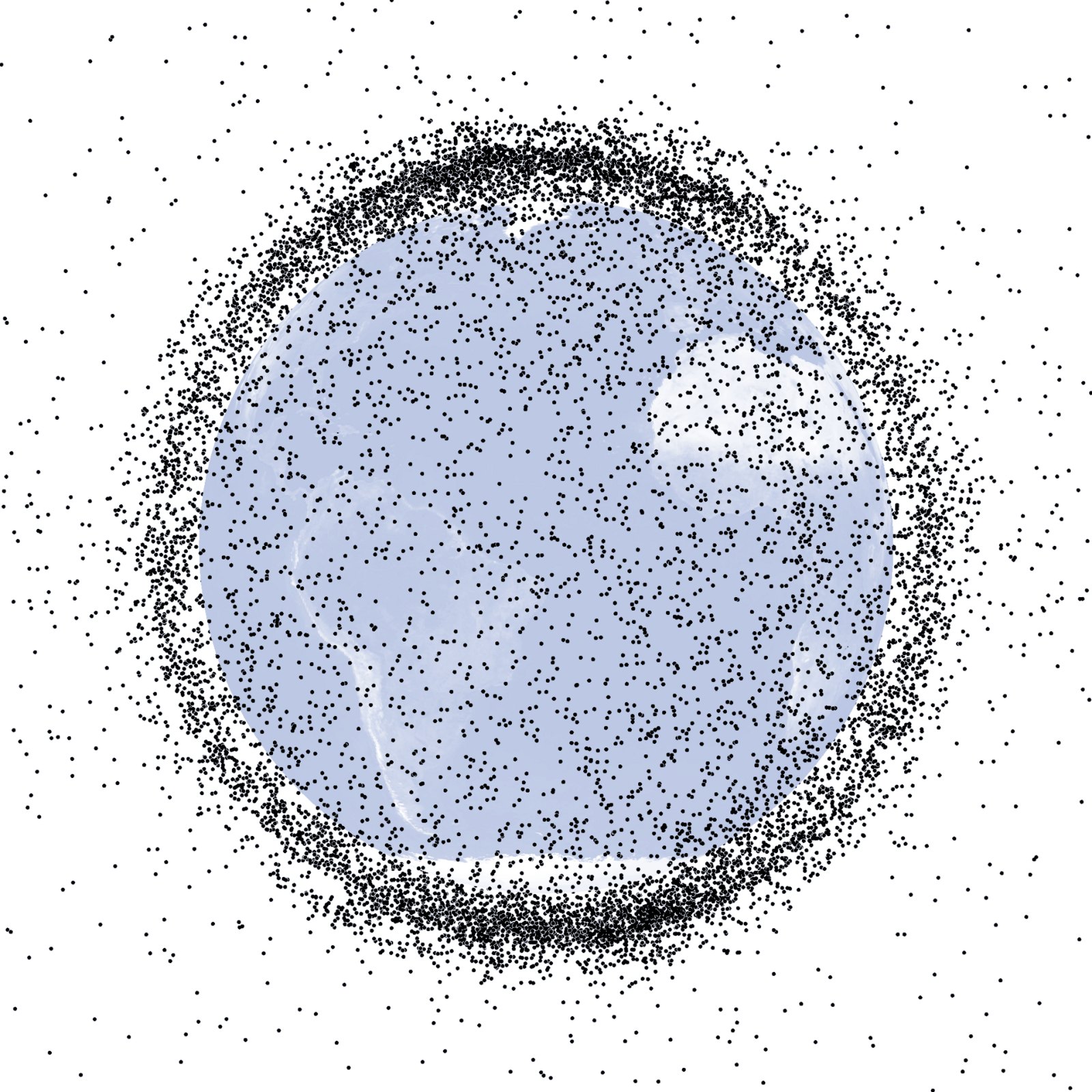
The bands where it bites are known precisely. Between 700 and 800 kilometres there are 2,667 catalogued objects, 2,260 of them debris; between 800 and 900, 2,758 objects of which 2,495 are debris; between 900 and 1,000, another 1,423 debris objects GCAT. This is where the air still has a weak vote — enough, over a strong maximum, to take a few hundred light fragments a year, and not nearly enough to touch anything heavy. Of 3,586 Fengyun-1C fragments ever catalogued, 2,120 are still in orbit at a mean altitude of 832 kilometres, nineteen years after the 2007 test that made them GCAT.
What breaks, in order
The first thing to fail is arithmetic that nobody re-checks. The FCC replaced a guideline permitting post-mission satellites to remain in orbit for as long as 25 years with a requirement to dispose of low-orbit satellites within five years of mission end, adopted on 29 September 2022 FCC. For a satellite that reaches a disposal orbit under its own power, that rule is a propellant budget and the Sun is irrelevant. For the many objects whose compliance case rests on a modelled decay time — a spent stage, a dead satellite left at its operating altitude, a cubesat with a drag device — the five years is a forecast resting on an assumed solar cycle. In this scenario a decade of those forecasts come due and are quietly missed, one object at a time, with no breach anyone is obliged to report.
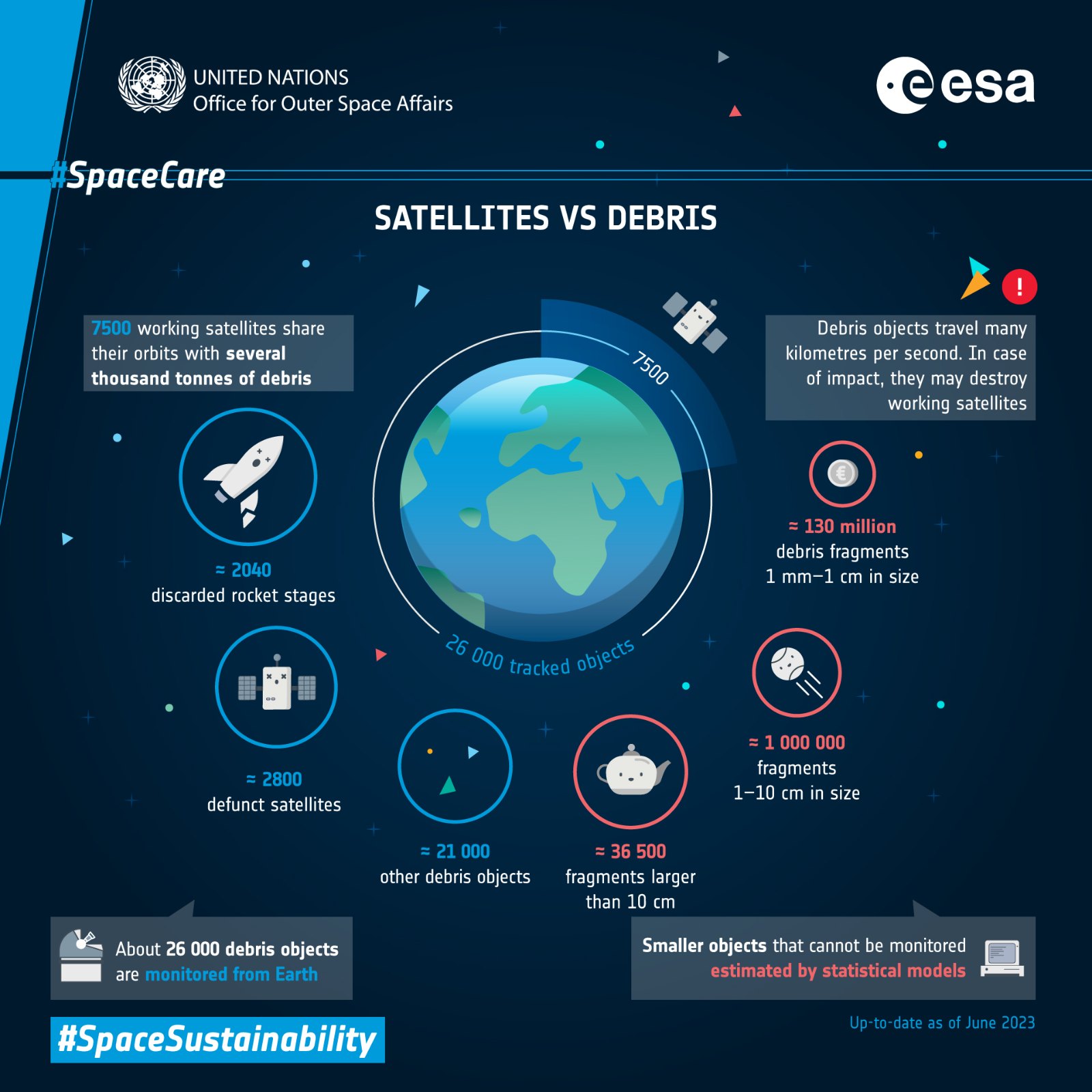
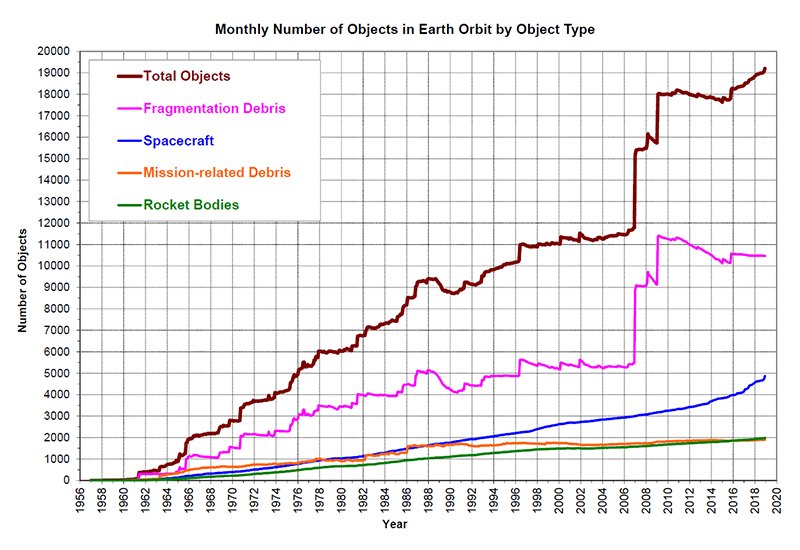
The second thing to fail is the statistic that made everyone comfortable. ESA's 2026 environment report records more than three intact satellites or rocket bodies reentering per day on average during 2025, and attributes the rise partly to better compliance and shorter design lifetimes ESA Space Environment Report 2026. Part of that number is engineering and will hold. Part of it is the Sun, and in this scenario that part goes away over a decade while launch continues at roughly ten new payloads a day. More than 17,400 tonnes of material is in orbit now ESA DISCOS; in this scenario the inflow is unchanged and the one outflow that was never under contract slows by a factor of several.
The third thing to fail is the ability to tell what happened. A falling reentry count looks identical whether the cause is a quieter Sun, a change in operator behaviour, or a catalog that has stopped being republished. Nobody in this scenario is lying. The signal is simply not separated anywhere, so the decade reads as stability right up to the point where a collision supplies a different kind of evidence.
The signals that would distinguish it
If this scenario is running, it is detectable years before any consequence, from data already published daily. Decay counts for the 2009 collision clouds and the Fengyun-1C cloud, plotted against solar flux rather than against the calendar, separate the Sun's contribution from everyone else's. The median realised lifetime of objects whose disposal case was a modelled decay, compared with the modelled figure, turns a forecast into a track record. And the population between 700 and 1,000 kilometres, counted separately from the payload-dominated shells below 600, shows whether the part of orbit that nothing clears is growing.
None of those three measurements requires new hardware, a new sensor or a new treaty. They require someone to publish them on a schedule and to be held to them.
ClearOrbit's view
The uncomfortable thing about this scenario is that it is the default. A weak cycle 26 is not a tail risk; it is one of two roughly equally plausible outcomes, and only one of them has been priced into the disposal rules now on the books. Drag devices have been Flown on small satellites and work where the air is thick enough to grip. Active removal of a large derelict has been Proposed and studied for two decades and performed never.
We think the honest reform is small and specific. Every disposal claim that rests on natural decay should be published with the solar assumption underneath it stated as a number, and re-run against the cycle that actually occurred. That turns a silent failure into a visible one, at no cost, using data that agencies already produce.
ClearOrbit vision: treat the atmosphere as a service with a duty cycle nobody controls, and size the removal programme to the objects it will never reach — the intact derelicts between 700 and 1,000 kilometres, which you can see ranked on our derelict watch and whose arithmetic we set out in the orbital clock and nobody has removed a piece of debris yet. If the Sun is generous next decade, that programme is still the right size. If it is not, it is the only thing standing between a quiet decade and a loud one.
Reader mail
Have a better idea?Spotted something we got wrong?
We publish in public so the numbers can be checked. If a figure looks wrong, a source is missing, or you know something this piece should have said, send it over. One box, no sign-up.
Send an idea or correctionQuick question
If you could fund one thing first to cut collision risk in low Earth orbit, what would it be?
Anonymous. You will see how others answered after you vote.
Sources
- GCAT, J. McDowell
- N. L. Johnson, The Effects of Solar Maximum on the Earth's Satellite Population and Space Situational Awareness (IAC-12.A6.2.9), NASA
- SIDC, Royal Observatory of Belgium: Progress of SC25
- Met Office: 'Declining phase' for the Sun's activity, but what's next?
- FCC, Mitigation of Orbital Debris in the New Space Age (adopted 29 September 2022)
- ESA Space Environment Report 2026
- ESA DISCOS space environment statistics