Daily briefing · · 3 min read
Orbit on 20 September 2026: 34 new objects, and two spent stages left low enough to fall
33,617 objects on orbit, up 33 in a day from three launches. The two rocket stages among the new entries sit below 300 km, which makes them two of only 26 in the whole catalog.
Today's catalog refresh counts 33,617 objects in Earth orbit, thirty-three more than yesterday: 19,571 payloads and 14,046 rocket bodies, fragments and discarded components, with roughly 16,372 payloads flagged as active (GCAT). Thirty-four new catalog numbers were issued in the last twenty-four hours, from exactly three launches. (Conjunction figures did not refresh today and are not used here.)
What changed
The new entries, catalog numbers 100,746 through 100,779, divide cleanly. One is Strix-10, a radar satellite at 517 by 589 km. Four are Hongtu 2-13 through 2-16, flying together near 517 by 532 km in a sun-synchronous orbit. Twenty-seven are Starlink satellites released into a 246 by 263 km insertion orbit, from which they climb under their own power. The last two are the spent hardware of the Strix launch (GCAT).

The 30-day launch tally now reads 307 new objects. Against that, 68 objects re-entered in the last 30 days and four in the last week; the catalog has logged none since 14 September, a reporting gap rather than a quiet week, since decay dates are entered after the fact. Of the 155 that came down over 60 days, 47 percent were Starlink. 228 catalogued objects now have perigees below 250 km (GCAT).
Object of the day: the two stages of Electron flight 96
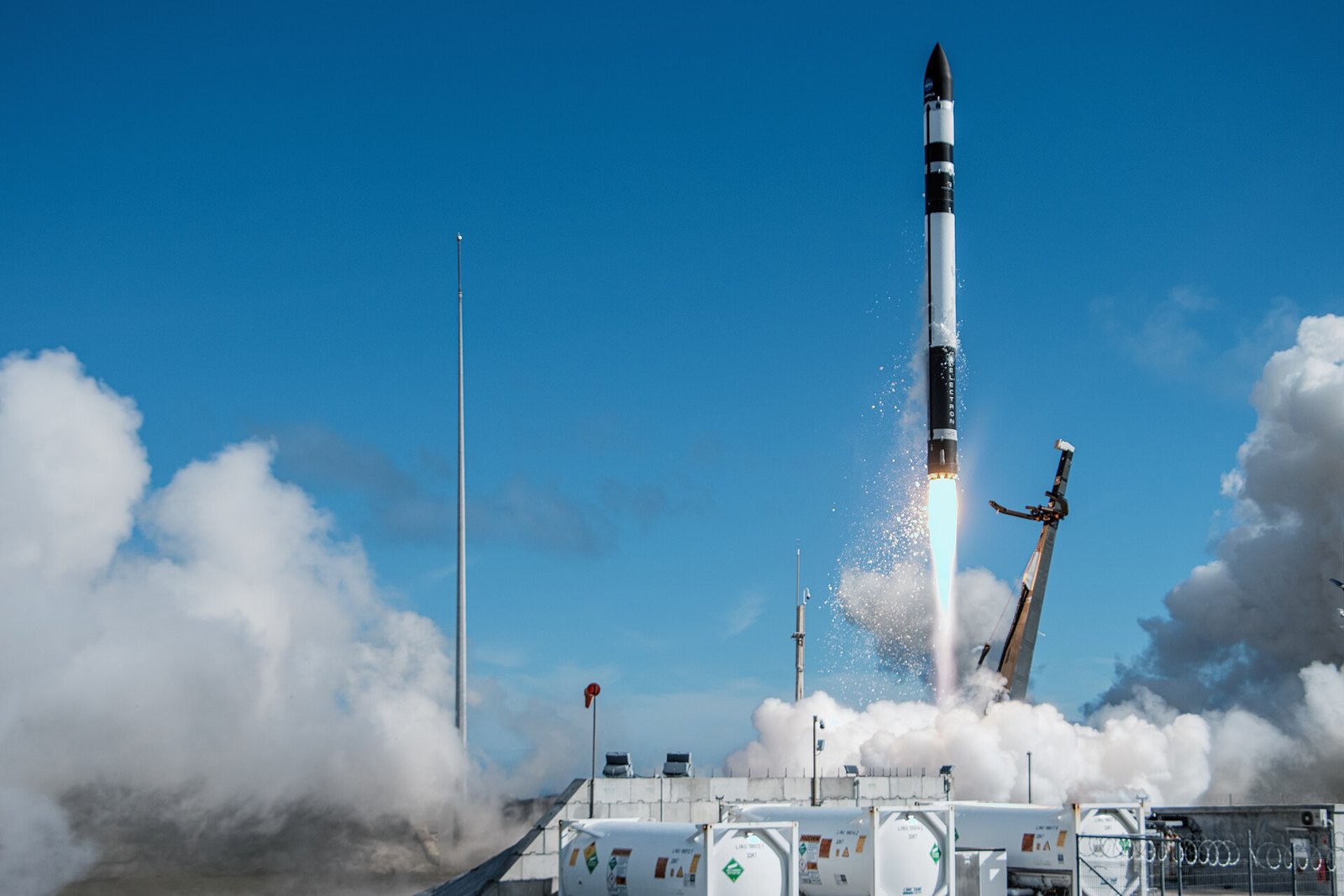
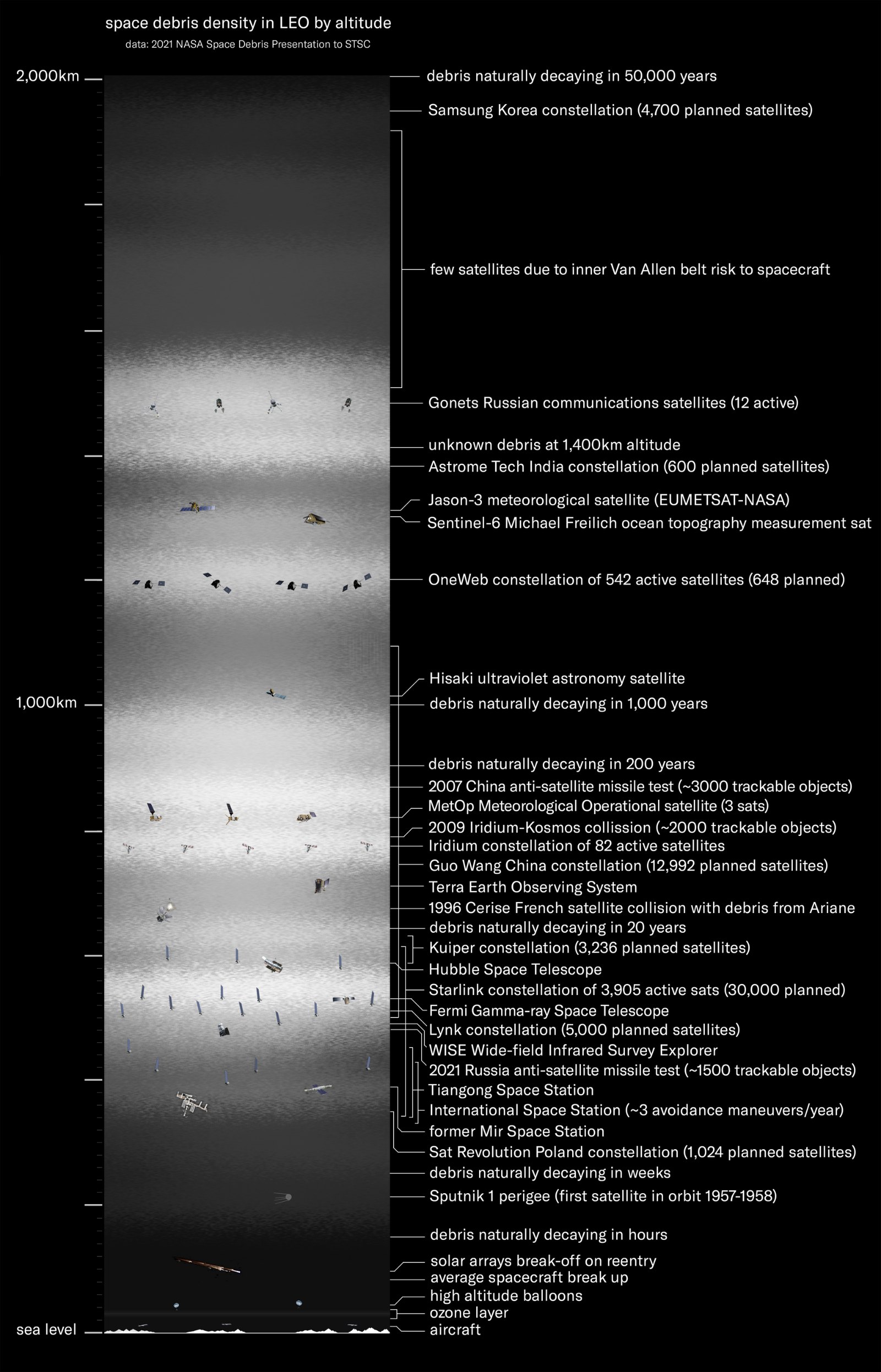
Little in the catalog is as informative as the altitude at which an operator abandons its rocket stage. NORAD 100747, the Electron second stage, is in a 173 by 559 km orbit. NORAD 100748, the kick stage that delivered Strix-10, is at 290 by 577 km (GCAT). Both perigees sit in air thick enough to finish the job unaided: debris left below 600 km normally falls back within several years, and at 173 km the honest unit is weeks (NASA ODPO).
That is rarer than it ought to be. GCAT lists 2,115 rocket bodies in orbit today. Of the 1,019 that stay entirely inside low Earth orbit — apogee below 2,000 km — 712, seven in ten, have a perigee at or above 600 km, where the atmosphere is too thin to help. Only 26 have a perigee below 300 km. Today's two stages are two of those twenty-six. Over the last 365 days, 82 rocket bodies were left in low orbit: sixteen below 300 km, twenty-eight at 600 km or above, where decay times run to centuries and, past 1,000 km, to a thousand years or more (NASA ODPO).
Where the junk is
The 400 to 500 km shell is the most crowded at 10,174 objects, yet only 186 are debris; it is busy and self-cleaning, which is why a 246 km insertion orbit costs the environment almost nothing. The damage sits higher, where 800 to 900 km holds 2,767 objects, 2,488 of them debris or rocket bodies (GCAT). ESA's modelled population adds roughly 68,450 objects larger than 10 cm and 1.5 million between 1 and 10 cm (ESA DISCOS) — untrackable, unavoidable, and nearly all of it shed by hardware parked where it will not come down.
ClearOrbit's view
A launch licence asks where a satellite will operate. It should ask, with the same force, where the upper stage will be left. That answer is not a promise anyone has to be trusted on; it is a number in kilometres, in the public catalog within a day of launch, measured by people who are not the operator. Nobody is scored on it.
We would like perigee at disposal published per launch and per provider, as a plain running tally (ClearOrbit vision). Today's scoreboard reads twenty-six rocket bodies disposed of below 300 km against 712 abandoned above 600 km — a figure no operator gets to choose after the fact.
Those 712 are the other half of the argument. They are not a modelling assumption but catalogued objects with names and numbers, most of them a tonne or more, in shells the orbital clock will not clear within a human lifetime. Each is a removal job someone eventually pays for, at a price that rises every year it is deferred. The cheapest fix remains a few seconds of propellant at the end of a launch, which is the case for designing for disposal. The second cheapest has to go and get them.
Reader mail
Have a better idea?Spotted something we got wrong?
We publish in public so the numbers can be checked. If a figure looks wrong, a source is missing, or you know something this piece should have said, send it over. One box, no sign-up.
Send an idea or correctionQuick question
Who should pay for cleaning up orbit?
Anonymous. You will see how others answered after you vote.