Scenario · · 6 min read
Forty-two kilograms at 14 kilometres per second: a hypothetical breakup at 761 kilometres
A real encounter on 14 October 2026 passes 3.43 kilometres wide. In this scenario it passes thirty metres wide, and a four-tonne stage from 2002 becomes the band's problem for a century.
The encounter that is actually happening
On 14 October 2026 at 23:42 UTC, two objects cross about 761 kilometres above Saudi Arabia. One is Orbcomm FM20, catalogue object 25416, a 42-kilogram Microstar messaging satellite launched on 2 August 1998 and still active, circling at 762 by 765 kilometres and inclined 45 degrees. The other is catalogue object 27601, the second stage of H-2A flight 4, launched on 14 December 2002: 9.2 metres long, 4.0 metres in diameter, four tonnes on the books, inclined 98.35 degrees, drifting between 729 and 828 kilometres for twenty-four years GCAT. Their planes meet at 140.5 degrees, so they close at 14.08 kilometres per second. Public screening puts them 3.43 kilometres apart with a worst-case probability of about 1 in 1.86 million CelesTrak SOCRATES Plus. The 3D view is here.
That is a comfortable miss, and it will almost certainly stay one. Nothing below is a prediction about these two objects. In this scenario we change one number — the miss distance becomes thirty metres instead of 3,430 — and follow what the rest of the arithmetic then requires. The point is not that it is likely. The point is that the catalog contains thousands of encounters with this shape, and the consequences do not depend on which one goes wrong.
Why there is no partial outcome
In this scenario the geometry is unchanged, so the closing speed is still 14.08 kilometres per second. A 42-kilogram object at that speed carries about 4.2 gigajoules of kinetic energy, which is just under a tonne of TNT equivalent. Spread across the four-tonne stage, that is roughly 1,040 joules per gram of target mass.
The threshold that matters is far lower. NASA's debris modelling treats a collision as catastrophic — total fragmentation of the target, not a dent — once impact energy exceeds 40 joules per gram of target mass NASA. This encounter would clear that threshold by a factor of about twenty-six, and that is the generous direction: taking the 42-kilogram satellite as the target instead puts the ratio four orders of magnitude higher still. In this scenario both objects are converted entirely into fragments, and the small one contributes almost nothing to the result. Four tonnes of 2002 rocket stage is what gets distributed.
What the band inherits
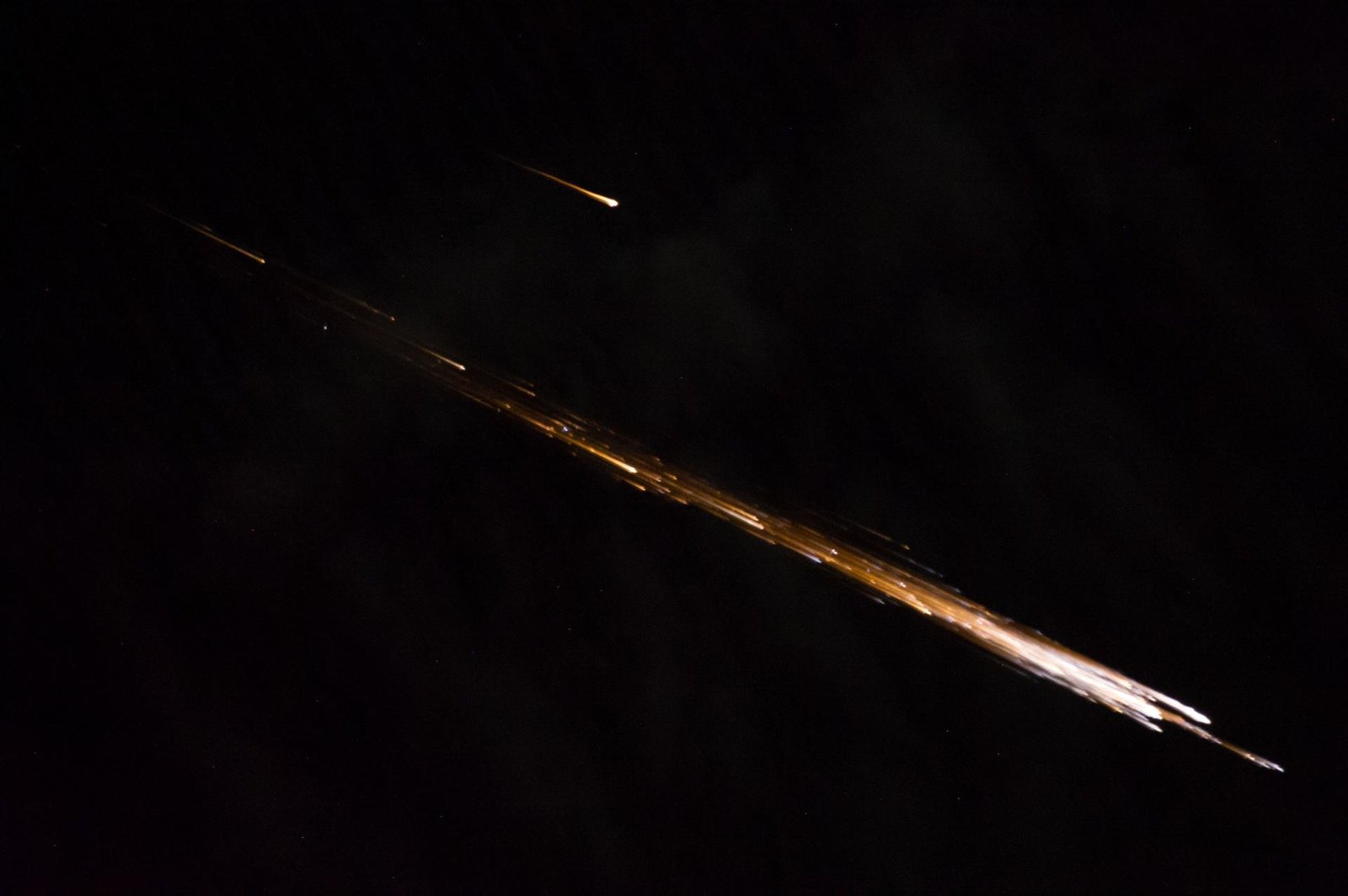
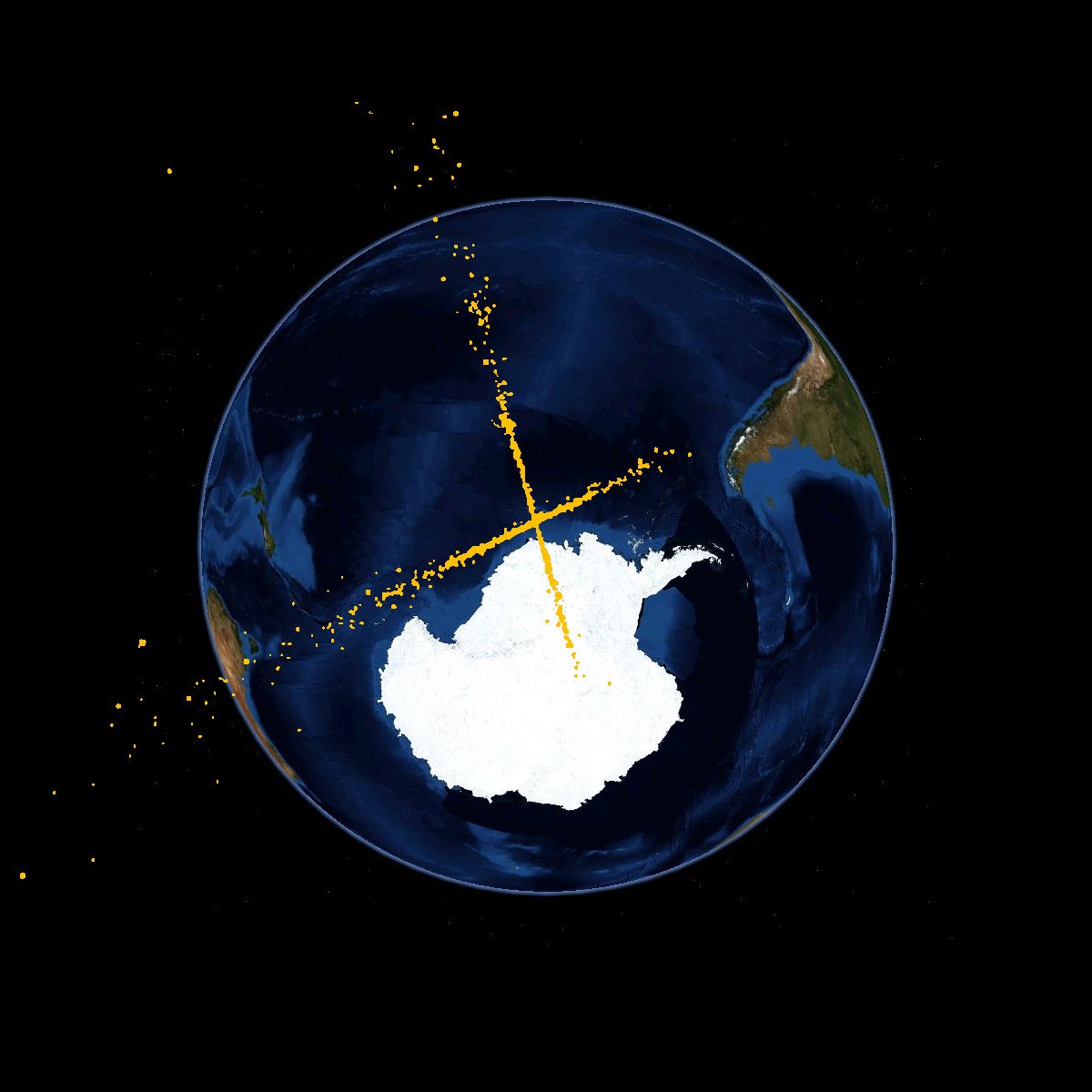
The precedent is 10 February 2009, when Iridium 33, an operational 560-kilogram satellite, met Cosmos 2251, a derelict 900-kilogram satellite, at 790 kilometres. The US Space Surveillance Network tracked more than 1,800 new pieces of debris in the two resulting planes, and NASA wrote at the time that some of it will remain in orbit through the end of the century NASA. Seventeen years on, GCAT still lists 1,726 Cosmos 2251 fragments catalogued in total with 608 of them on orbit, and 685 Iridium 33 fragments with 127 still up GCAT.
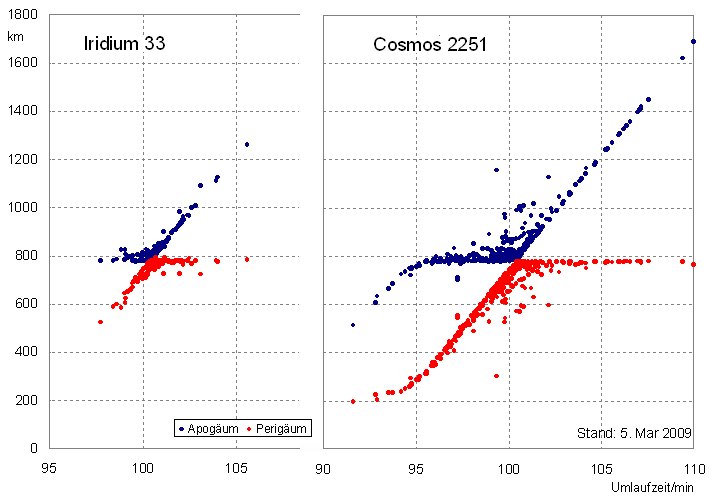
In this scenario the colliding mass is 4,042 kilograms against 2009's 1,460 — nearly three times as much, at a comparable altitude and a comparable closing speed. We will not put a fragment count on that, because the honest answer is that breakup models give distributions rather than numbers and the inputs for this stage are not public. What the comparison does support is the direction: 2009's "more than 1,800" is a floor for an event of this size, not a ceiling, and it is our inference from the mass ratio rather than a modelled result.
The fragments would not stay where the stage was. A catastrophic breakup spreads debris in altitude far more than in inclination, which is why Gabbard diagrams of 2009 fan out so widely: pieces end up with perigees low enough to decay in years and apogees high enough to persist for centuries, all of them still crossing the original plane twice an orbit. Here that plane is sun-synchronous at 98.35 degrees, through the shells that already carry the most tracked debris in low orbit — 2,250 fragments between 700 and 800 kilometres and 2,493 between 800 and 900, against 408 and 262 working payloads respectively GCAT. A second population would also be left in Orbcomm's 45-degree plane, which crosses almost everything.
Below the tracked fragments sits the part nobody screens. ESA's modelling puts about 1.5 million debris objects between 1 and 10 centimetres in orbit now, from more than 660 fragmentation events, with over 17,400 tonnes of material in Earth orbit in total ESA DISCOS. A four-tonne stage breaking up would add to that invisible population in proportion, and none of it would appear in any conjunction screening, including ours.
The part that is already true
Strip out the hypothetical collision and the uncomfortable facts remain. Only one object in this pair can move. Orbcomm FM20 has an operator; the stage has had none since December 2002, and no amount of warning time changes what it will do. The current screening run found 7,834 encounters within one kilometre across the whole catalog, 111 of them within 100 metres, and 21 between two objects that are both debris CelesTrak SOCRATES Plus. In that last category there is nobody to warn.
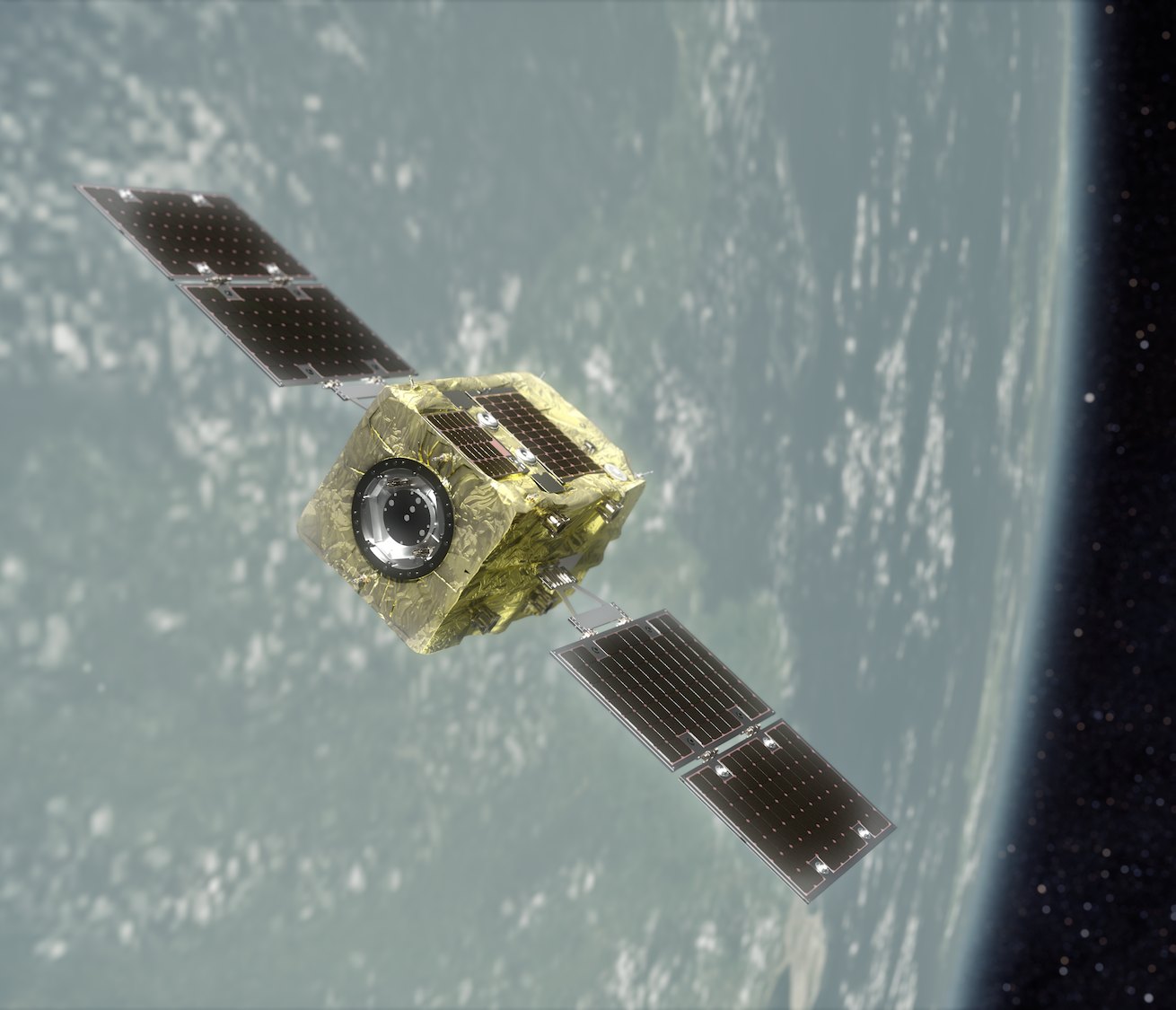
Nudging a derelict out of the way before an encounter is Proposed and has never been done see how just-in-time avoidance would work. Flying close enough to try is Flown, once: JAXA's Commercial Removal of Debris Demonstration sent Astroscale's ADRAS-J to catalogue object 33500, the roughly three-tonne H-2A stage that launched GOSAT in 2009, and it closed to about 15 metres in November 2024 JAXA CRD2. Forty-nine H-2A second stages remain in orbit GCAT. One of them has been visited. The stage in this scenario is one of the forty-eight that have not.
ClearOrbit's view
Scenarios about cascades get the attention, and we have written one about 850 kilometres. This one is deliberately smaller, because the case for removal does not need a chain reaction. A single derelict stage, breaking up once, puts debris into the two most crowded debris shells in low orbit and leaves a fraction of it there for a century. That is the whole argument, and it costs one encounter out of the thousands screened this week.
What that implies is a shift in what gets prioritised. Avoidance is a service for satellites with operators, and it is working: operators move, warnings get acted on, and the system mostly holds as we have described. None of that protects the half of an encounter that cannot move. Every year a four-tonne derelict stays up is another year of drawing from the same deck, and the odds get slightly worse as the shells fill.
Our view is that the first removal targets should be chosen on mass, altitude and plane rather than on novelty, and that the H-2A stages are an unusually clean place to start: one manufacturer, documented dimensions, several sharing sun-synchronous planes, and one already photographed from fifteen metres by a spacecraft that had to solve the approach from scratch. That is a ClearOrbit vision rather than a programme, and it depends on something no demonstration has yet produced — a customer willing to pay for the second, tenth and fortieth removal after the first one has stopped being a first. The physics in this scenario will not change. Which of these encounters we are still unable to do anything about in 2036 is a decision, not a forecast.
Reader mail
Have a better idea?Spotted something we got wrong?
We publish in public so the numbers can be checked. If a figure looks wrong, a source is missing, or you know something this piece should have said, send it over. One box, no sign-up.
Send an idea or correctionQuick question
If you could fund one thing first to cut collision risk in low Earth orbit, what would it be?
Anonymous. You will see how others answered after you vote.