Scenario · · 6 min read
Through every shell at once: a hypothetical breakup in an eccentric orbit
A real 1993 Ariane stage sweeps from 215 to 1,894 kilometres 13 times a day. In this scenario something small hits it, and the fragments inherit an orbit that crosses every crowded shell.
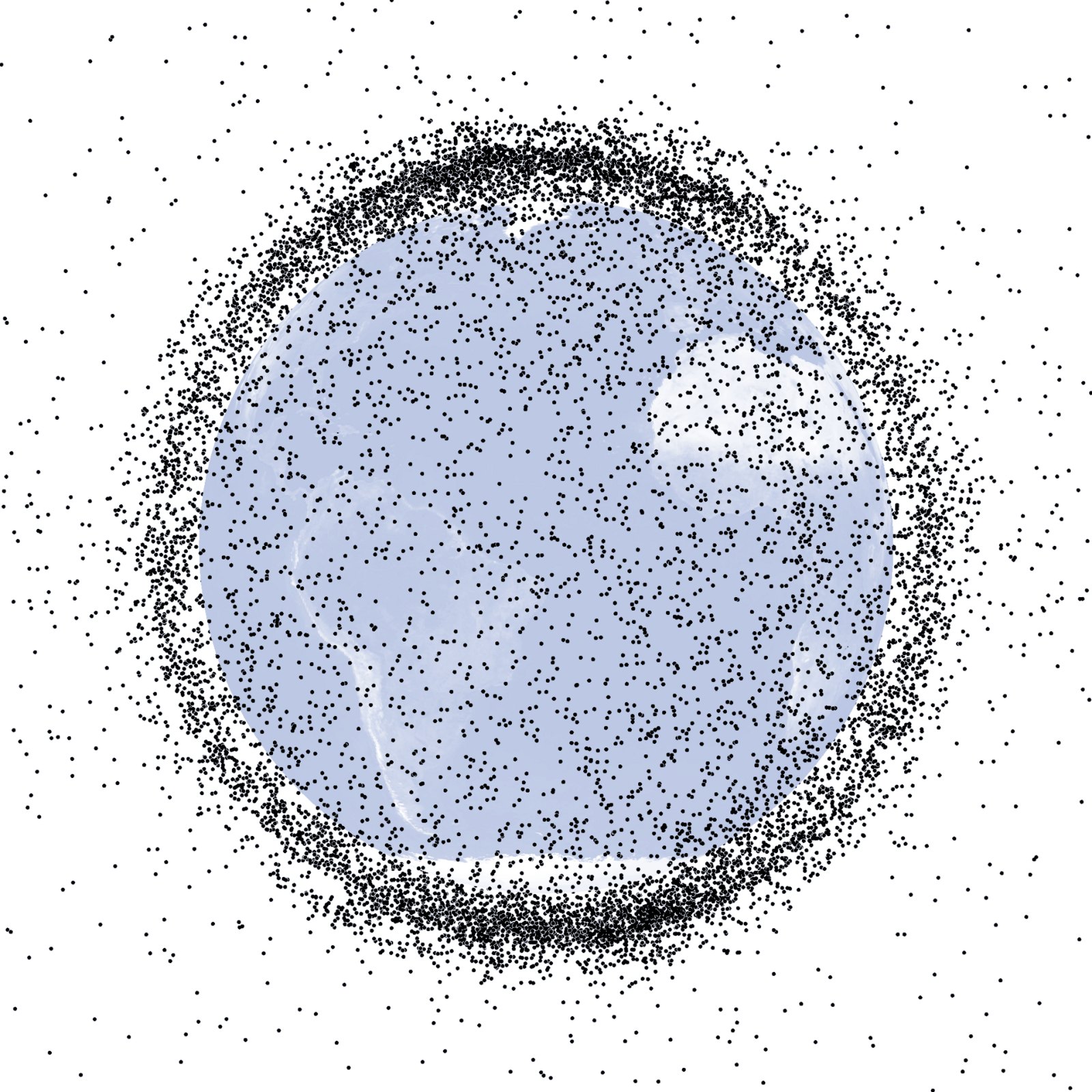
Almost every debris scenario ever written, including two of ours, puts the collision in a circular orbit: two objects in the same shell, meeting at a shallow angle, leaving a ring of fragments that stays roughly where the parents were. That is the right picture for the 850-kilometre cascade and for a breakup at 761 kilometres, because that is where most of the mass sits. It is the wrong picture for a large and under-discussed part of the catalog, and this scenario is about what the other picture looks like.
The object, which is real
Ariane 4 flight V61 lifted off from Kourou at 01:17 UTC on 20 November 1993 and put Solidaridad 1 and Meteosat 6 into a transfer orbit reaching 36,868 kilometres GCAT. Its H10+ third stage was left there: a stepped cylinder 14.1 metres long, 2.6 metres across, 2,080 kilograms empty GCAT. Thirty-three years of drag at perigee have pulled the far side of that orbit down by nearly 35,000 kilometres. On elements of 17 October 2026 the stage measures 215 by 1,894 kilometres at 6.7 degrees of inclination, with a period of 106.3 minutes GCAT. Today's briefing has the rest of its arithmetic: 13.5 orbits a day, each one a climb from 215 kilometres out past 1,894 and back down again.
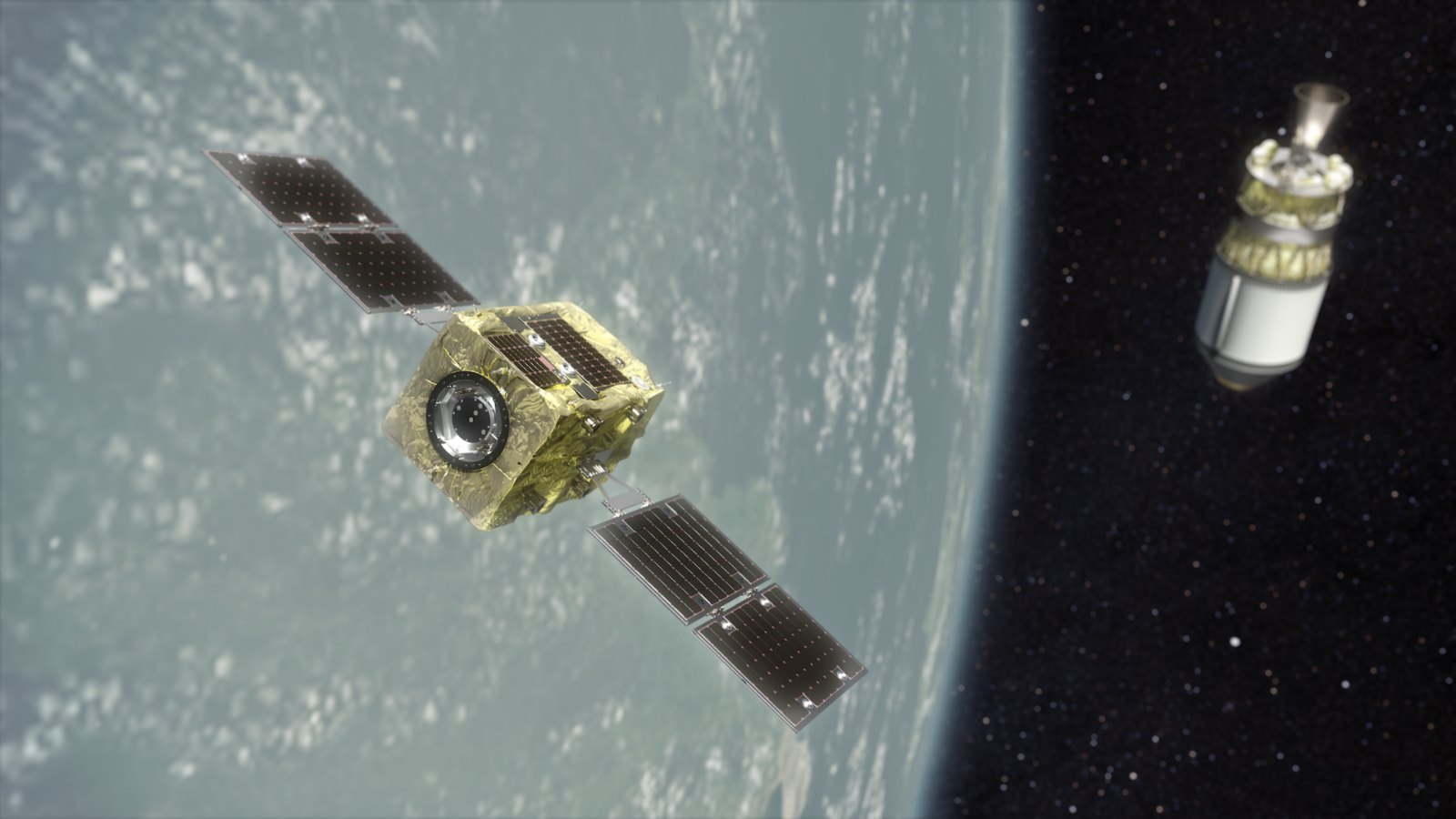
It is not alone. Counting GCAT's current catalogue, 1,463 objects in Earth orbit today have a perigee at or below 600 kilometres and an apogee between 1,500 and 35,000 — orbits that dip into the air at one end and reach above the whole crowded stack at the other. Three hundred of them are rocket bodies and 813 are catalogued debris GCAT. None of them can manoeuvre.
In this scenario
In this scenario it is a Tuesday in March 2028, and nothing has gone wrong yet. The stage is on its outbound leg, passing 1,150 kilometres at about 7.3 kilometres per second, when it is struck by a fragment of a few centimetres that was never in anyone's catalogue. The impactor is small. The stage is empty, so there is no explosion, only a hypervelocity impact that breaks a 2-tonne pressurised cylinder into pieces.
Call it 300 trackable fragments and some thousands below 10 centimetres. The number is not the interesting part. The interesting part is where they go.
Every fragment leaves the impact with the parent's velocity plus a small change of its own — metres to tens of metres per second against the parent's 7,300. In a circular orbit that nudge turns a ring into a slightly fatter ring. Here it does something else. The parent orbit already spans 215 to 1,894 kilometres; a few tens of metres per second applied near the middle of the climb moves perigees down below 200 and apogees up past 2,100, and it tilts the cloud a fraction of a degree either side of 6.7. Within one orbit the fragments are spread along the whole ellipse. Within a week they are spread all the way around it.
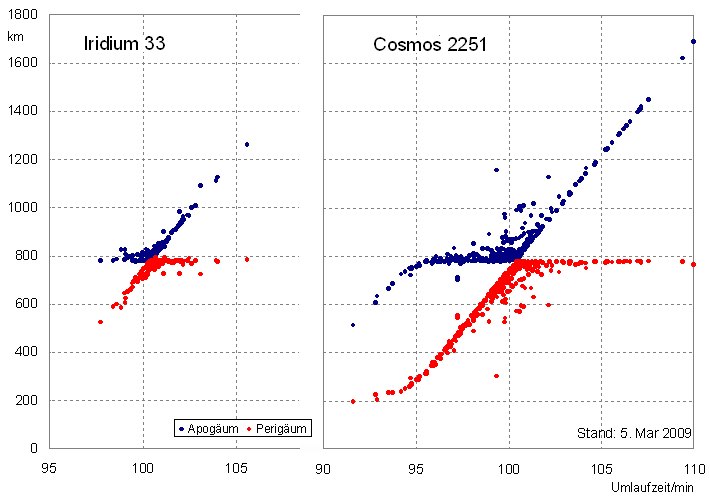
A Gabbard diagram of the result would not look like the one above, which is the Iridium-Cosmos cloud from two near-circular orbits at 790 kilometres: a tight X around a single period. This one would be a long smear, perigees from under 200 to around 400 kilometres, apogees from 1,600 to 2,200, periods from 96 minutes to 112. And because the cloud keeps the parent's shape, every fragment in it passes twice per orbit through the 400-to-500-kilometre shell where 10,193 working satellites fly, and twice through the 800-to-900 band that already holds 2,499 pieces of debris GCAT.
What the operators can and cannot see
Here is the part that makes an eccentric breakup worse than its fragment count suggests. A cloud like this is hard to catalogue.
The precedent is on the record. A Briz-M upper stage, 2006-006B, broke up in February 2007 in an orbit of roughly 500 by 15,000 kilometres. NASA's Orbital Debris Program Office put the event at more than 1,000 pieces; by January 2016, nine years later, 102 had been catalogued and 94 were still on orbit, and the office noted plainly that the highly elliptical orbit had impeded the network's ability to detect, identify and catalogue the debris NASA ODQN. The same issue of that newsletter records two further Briz-M fragmentations, in December 2015 and January 2016, with eight and zero fragments catalogued respectively months afterwards and "hundreds" suspected in each case.
The reasons are geometric. A fragment on this orbit crosses the altitudes where ground radars have their best sensitivity at high angular rate and spends most of its time far above them; an object low and fast for ten minutes in every 106 is a poor radar target and a difficult optical one. Our explainer on how tracking actually works covers the machinery. The gap it leaves is visible in the aggregate: ESA's model puts 68,450 objects larger than 10 centimetres in orbit against roughly 47,140 regularly tracked, and more than 660 fragmentation events in the record ESA DISCOS.
So the operators between 400 and 500 kilometres would spend the following month in an unpleasant position: a known event, a known parent orbit, a cloud crossing their altitude twenty-seven times a day, and a catalogue covering perhaps a third of what is actually up there. Conjunction screening against the catalogued third would run normally and would mean less than usual.
Why this one ends
The scenario has a genuinely reassuring half, and it should be said as clearly as the rest. This cloud comes down.
A survey of two million simulated 200-year transfer-orbit histories found perigee altitude to be the strongest single predictor of whether an object in such an orbit reenters at all. For small, high-area-to-mass fragments with perigee below 1,000 kilometres, the reentry probability approaches one and the mean lifetime is roughly 25 to 30 years; more than 70 per cent of small debris reenters naturally within about 25 to 90 years, depending on inclination. The same work found that orbits which do reenter spend only about a year, cumulatively, inside the protected low-orbit region on the way Skoulidou et al..
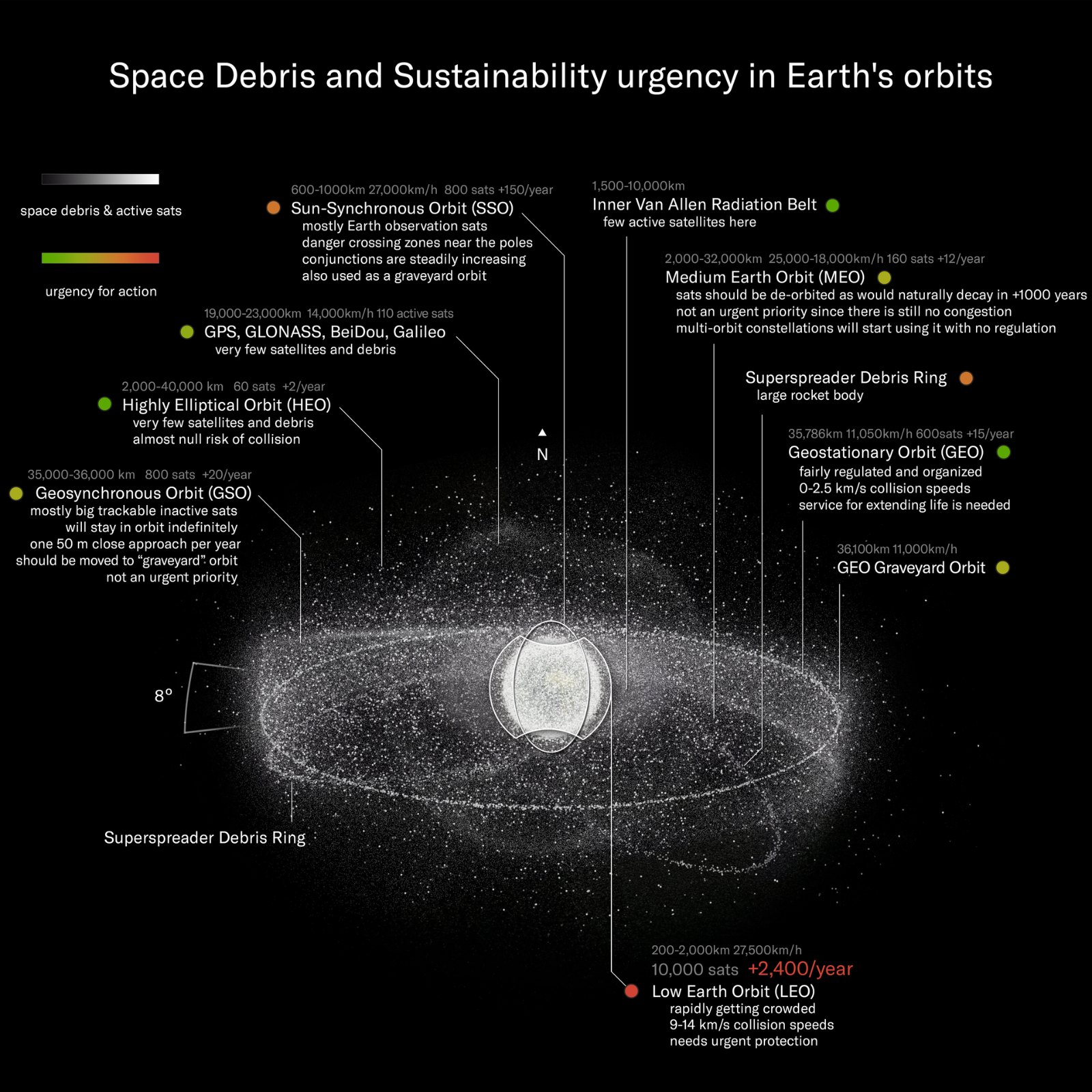
That is the trade an eccentric orbit makes. The cloud touches everything, and it touches everything briefly. Compare it with a breakup in the near-circular band at 800 to 900 kilometres, where drag is not a plan and fragments stay for a century or more: fewer shells affected, vastly more object-years of risk. The eccentric case is a sharp, wide, self-clearing problem. The circular case is a narrow, permanent one. Only one of the two is a candidate for being waited out.
ClearOrbit's view
Nothing in this scenario needs new technology to prevent. It needs a stage not to be left in a transfer orbit with propellant, pressure and thirty years ahead of it, and the practice that achieves that — venting tanks, discharging batteries, relieving pressure before the stage is abandoned — is Flown and has been for years. Our explainer on passivation sets out what it involves. The catalog still shows the cost of skipping it: a Zhuque-2E second stage fragmented on its launch day, 9 June 2026, and seven pieces were catalogued, six of which have since reentered and one of which is still up GCAT.
For the 300 spent stages already on these crossing orbits, passivation is a decision that was taken decades ago and cannot be retaken. Removal of them is Proposed and nobody has flown it. We would argue it is also the wrong priority: these objects are on their way down, and the real queue is the 140 tonnes of spent stages sitting in circular orbits above 700 kilometres, where nothing is on its way anywhere.
What the eccentric population does deserve is to be seen. The ClearOrbit vision we keep arguing for starts with the measurement layer rather than the hardware: a public conjunction picture that covers eccentric orbits as well as it covers circular ones, so that an operator at 480 kilometres learns about a cloud crossing their shell from a screening service rather than from a window strike. The Briz-M record says we are not there. Nine years and 102 of 1,000 is not a catalogue; it is an estimate with a long tail, and the tail is the part that hits things.
Reader mail
Have a better idea?Spotted something we got wrong?
We publish in public so the numbers can be checked. If a figure looks wrong, a source is missing, or you know something this piece should have said, send it over. One box, no sign-up.
Send an idea or correctionQuick question
If you could fund one thing first to cut collision risk in low Earth orbit, what would it be?
Anonymous. You will see how others answered after you vote.