Daily briefing · · 3 min read
Orbit on 23 September 2026: the catalog did not move, and a six-day-old stage is already falling
33,643 objects on orbit, unchanged from yesterday in every category. The motion is in the elements: a Kuaizhou-11 third stage now sits at 133 by 1,823 km.
Today's catalog refresh counts 33,643 objects in Earth orbit: 19,569 payloads and 14,074 rocket bodies, fragments and discarded components (GCAT). Every one of those figures is identical to yesterday's, as is the all-time total of 70,133 catalogued objects. The ledger did not move.
What changed
Nothing, to the object — a fact about bookkeeping rather than about orbit. The 30-day launch window still reads 250 new objects and the highest catalog number issued still stands at 100,789 (GCAT). Things launched and things came down; the catalog simply has not been updated to say so.
The same lag shows in the reentry column. Fifty-eight objects re-entered in the last 30 days and 147 in the last 60, 47 of them Starlink spacecraft (GCAT). Yet the most recent decay date on file is still 14 September, a nine-day gap and one day longer than yesterday's. Decay dates are entered after the fact, and the queue behind them is not short: 197 catalogued objects now have perigees below 250 kilometres, which is to say 197 objects in the last weeks of their orbital lives (GCAT).
Object of the day: a six-day-old stage on a very tall ellipse
Second-lowest in that queue is KZ-11 Y3 Stage 3, catalog number 100743, a Chinese rocket body whose 17 September element set puts it at 133 by 1,823 kilometres (GCAT). Nothing else in the bottom fifteen comes near that apogee; the rest are Starlink spacecraft and old payloads on nearly circular orbits around 150 kilometres.
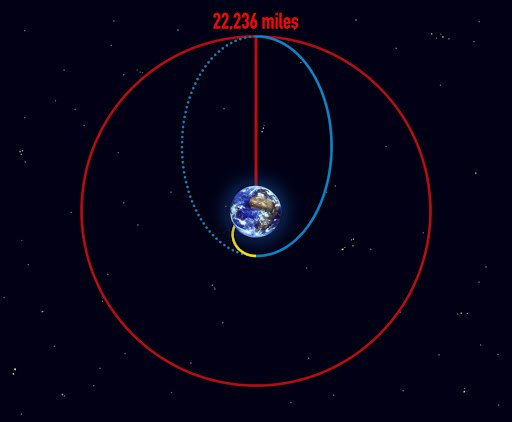
The object is the third and final solid stage of a Kuaizhou-11, a commercial Chinese launcher of three solid stages rated at 1,000 kg to low Earth orbit; the Y3 flight carried Tianyi 51 and Tianyi 52 on 17 September 2026 (Gunter's Space Page). Six days later the stage is on an orbit of roughly 105 minutes that dips to 133 km and climbs past 1,800 km.
That shape is the interesting part. A stage with a 133 km perigee will be gone within weeks, and NASA's rule of thumb returns anything below 600 km within a few years (NASA ODPO). Until it goes, though, it is not a local object. Twice a revolution, some fourteen times a day, it climbs through the 400 to 500 km shell and its 10,175 catalogued objects, on through the 800 to 900 km shell, where 2,487 of the 2,765 residents are debris or spent hardware, and out the far side before falling back (GCAT). A derelict on a circular orbit shares one neighbourhood. A derelict on an ellipse visits everybody's, and crosses their orbital planes at a steep angle while it does.
Below the catalog
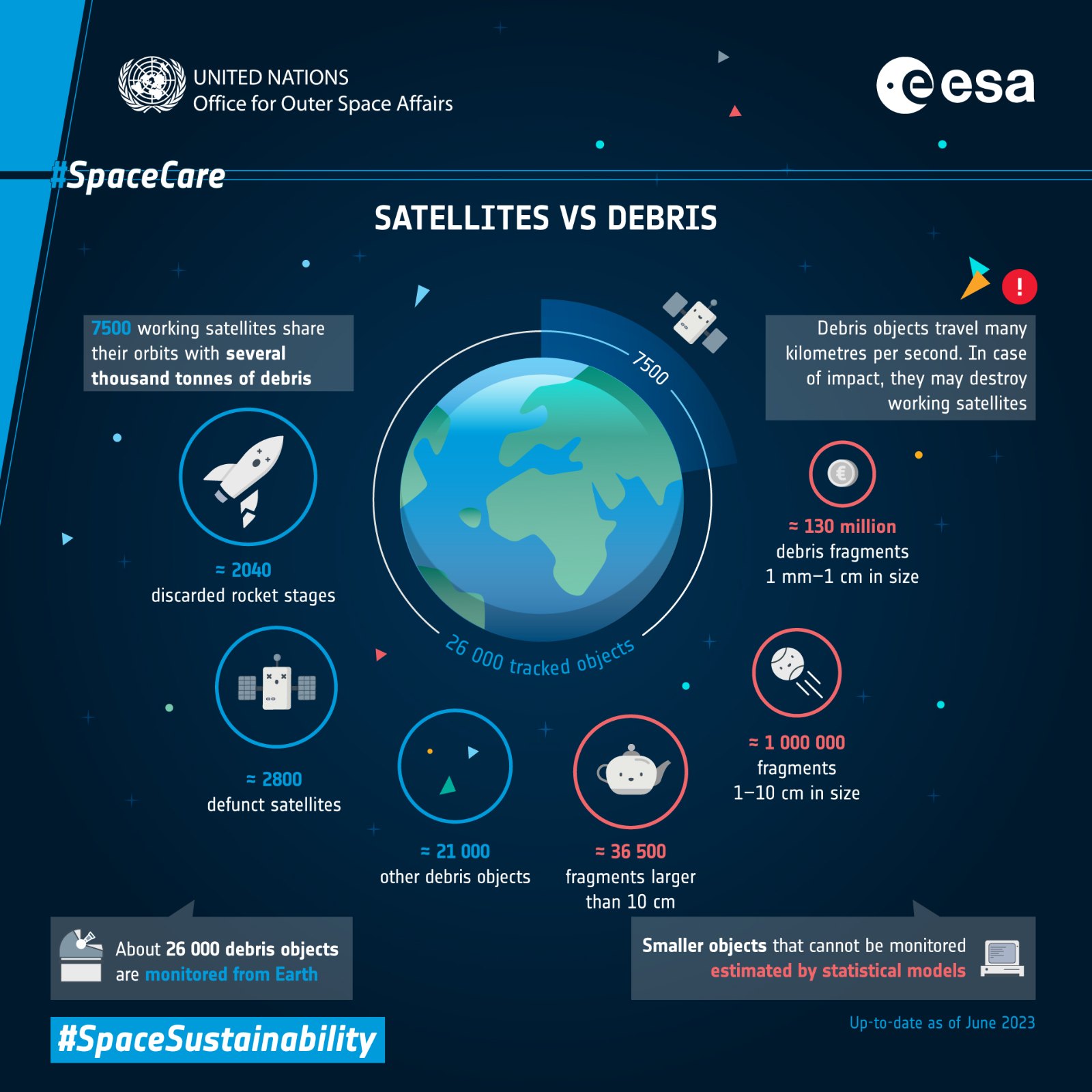
ESA's MASTER-8 model, reference population February 2026, estimates 68,450 objects larger than 10 cm and about 1.5 million between 1 and 10 cm, against more than 17,000 tonnes of material in orbit (ESA DISCOS).
ClearOrbit's view
A day with no catalog change is a reminder that the public record of orbit is kept by people, on a schedule, with a lag. The physics ran at full speed; the ledger did not.
That gap is harmless at 133 kilometres, where the atmosphere will settle the question of KZ-11 Y3 Stage 3 before anyone has to decide anything. It is not harmless at 800, where the same lag applies to objects that will still be there next century. We would like the tracked catalog and the modelled population published on the same clock, with their uncertainties attached (ClearOrbit vision): a removal programme chooses its targets from a list, and a list that is quietly nine days stale is a poor basis for choosing.
Today's stage got lucky in its altitude, not in its design. The objects that need removing are the ones the orbital clock will never reach, and the cheapest fix remains designing hardware to come down on its own. For derelicts already parked up there, the hard part is not grabbing them — it is getting into their orbital plane in the first place.
Reader mail
Have a better idea?Spotted something we got wrong?
We publish in public so the numbers can be checked. If a figure looks wrong, a source is missing, or you know something this piece should have said, send it over. One box, no sign-up.
Send an idea or correctionQuick question
Who should pay for cleaning up orbit?
Anonymous. You will see how others answered after you vote.